Ask an AI tool what your brand does, and you might not recognize the answer not because it’s hallucinating, but because it’s remembering an old version of you.
This happens through co-citation: the brands, categories, and concepts that repeatedly show up alongside yours across the web.
Consider TaskFlow a to-do list app that spent 18 months rebuilding into a full project management platform, yet is still filed as a to-do app in half its directory listings and old listicles.
Co-citation is the mechanism behind that mismatch. AI doesn’t learn who you are from your homepage alone; it pieces you together from every listicle, directory, guest post, and comparison page that’s ever mentioned your name, then uses that pattern to decide what category you belong to, who your real competitors are, and when you’re worth recommending. When those associations are current and accurate, AI positions you correctly and sends you the right traffic.
If AI has ever described your brand in a way that made you wince, this is usually why. This piece covers what co-citation is, how it shapes your AI positioning, how to audit your current associations, and exactly how to fix the ones dragging you down.
What Is Co-Citation?
In traditional SEO, co-citation refers to two sites being mentioned together, often without even linking to each other in a way that signals a relationship between them. Search engines used this as a weaker cousin of backlinks: not a vote of authority, but a sign of association.
AI extends that idea much further. It’s no longer just “these two sites got mentioned in the same article.” AI models build semantic relationships between brands, products, categories, and use cases based on every place your name appears alongside others’ comparison pages, listicles, directories, guest posts, and review sites. Each mention is a small data point. Enough of them, repeated consistently, and AI treats the pattern as fact.
Take TaskFlow. It appears in dozens of “best to-do list apps” roundups published back when that’s exactly what it was. The product has since changed completely, but those old mentions haven’t gone anywhere, and AI is still reading them. Every time TaskFlow shows up next to Todoist and Wunderlist under a “to-do list” heading, that association gets reinforced. The web is effectively still teaching AI who TaskFlow used to be.
Co-Citation vs. Backlinks vs. Entity Recognition
Co-citation is often confused with two related signals, but each one teaches AI something different:
| Signal | Helps AI Understand |
|---|---|
| Backlinks | Authority |
| Entity Recognition | Who you are |
| Co-Citation | What you’re associated with |
Backlinks tell AI your site is trustworthy enough to link to. Entity recognition tells AI you exist as a distinct, identifiable brand. Co-citation tells AI something neither of the others can: what category you belong to, who your real competitors are, and when you deserve to be recommended.
How Does Co-Citation Shape Your AI Positioning?
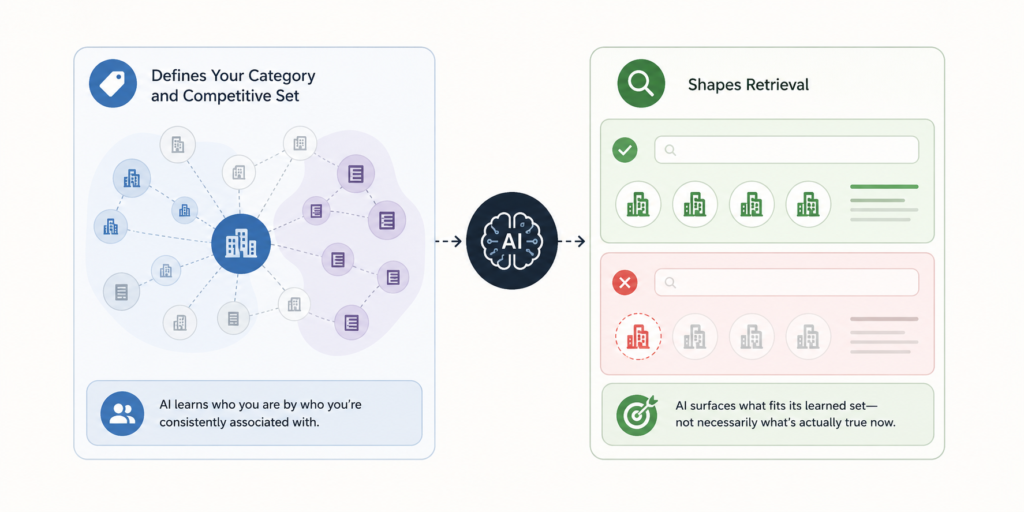 It Defines Your Category and Competitive Set
- AI doesn’t assign you a category from a single source of truth; it infers one from patterns across the web
- Every mention alongside another brand acts as a small vote for what kind of company you are and who you belong next to
- Enough consistent votes, and AI treats the category as settled regardless of what’s actually true today
- Example: TaskFlow is still co-cited with Todoist and Wunderlist far more often than with Asana and Monday.com, so AI continues to group it with lightweight to-do apps rather than full project management platforms
- The product itself has changed, but the web’s association pattern hasn’t caught up, so neither has AI’s understanding of where TaskFlow belongs
It Shapes Retrieval
- Category and competitive set aren’t just labels; they determine whether AI surfaces you at all
- When someone asks for comparisons, alternatives, or “best tools” recommendations, AI pulls from the competitive set it has already learned, not from your product’s current capabilities
- Example: a user asking an AI tool for “Asana alternatives” is unlikely to see TaskFlow surfaced, even though it’s now a legitimate, direct competitor
- As far as the AI’s association data is concerned, TaskFlow isn’t part of that conversation; it’s still filed under to-do list tools, a category nobody is comparing Asana against
- This isn’t a flaw in the AI’s reasoning; it’s an accurate reflection of outdated inputs
Key takeaway: this is co-citation’s real leverage point; it’s not just describing your brand, it’s deciding which queries you’re even eligible to win.
When Does Co-Citation Work Against You?
AI can learn an outdated or inaccurate association just as easily as an accurate one — it doesn’t know the difference between a mention that’s current and one that’s three years stale. It just sees the pattern and treats it as fact.
What Causes Bad Brand Associations?
- Stale listicles: “best of” roundups that haven’t been updated since your last pivot. TaskFlow is still sitting in a dozen “best to-do apps” roundups from before its relaunch.
- Legacy directories: category listings that predate a rebrand. TaskFlow is still filed under “Productivity > To-Do Lists” on two major directories, months after repositioning as a project management platform.
- Product pivots and outdated guest posts: content published under an old version of your product that the web, and by extension AI, hasn’t caught up to.
How Do You Know If Your Brand Is Misclassified?
- AI describes your product incorrectly. Ask an AI tool “what is TaskFlow,” and there’s a real chance it still answers “a simple to-do list app” years after that stopped being true.
- You’re absent from comparison queries where you belong. If AI won’t surface you for “Asana alternatives” even though you compete directly, misclassification is usually why.
If either of these sounds familiar, you’re looking at the exact symptoms covered in “AI got you wrong”; this is where they come from.
How to Audit Your Brand’s Co-Citation Landscape
Before you can fix your co-citation problem, you need to see it clearly. This three-step audit gives you a full picture of what AI currently associates you with and where the gaps are.
Step 1: Ask AI How It Understands Your Brand
Start with the source itself. Ask an AI tool directly what your brand does, who your competitors are, and what category you belong to, then document exactly what it says.
Running this for TaskFlow surfaces Todoist and Wunderlist as its named “competitors” and “to-do list app” as its category. That’s the baseline: it confirms the outdated association before any external research even begins.
Step 2: Review External Mentions, in Priority Order
Once you know what AI currently believes, work backward to find out where that belief is coming from. Check these sources in order:
- Stale listicles: search your brand “best” OR “top” and sort results by date. This search for TaskFlow turns up 14 listicles, 9 of them published before the pivot, a clear source of the outdated association.
- Legacy directories: G2, Capterra, Crunchbase, and any industry-specific directories. Check the category tags, not just whether you’re listed.
- Review sites and comparison pages: where you’re positioned relative to competitors.
- Older guest posts and press: content describing an earlier version of your product.
Step 3: Map It
Turn what you find into a single table, so every association is accounted for and prioritized:
| Website | Type | Associated Brands | Category Listed | Correct? | Priority | Action |
|---|---|---|---|---|---|---|
| “10 Best To-Do Apps 2023” | Listicle | Todoist, Wunderlist | To-Do List | No | High | Email editor for an update. |
As you fill it in, sort each row into one of four buckets:
- Strong: accurate and helpful; leave it alone
- Weak: accurate but low-impact; low priority
- Incorrect: actively wrong; fix first, especially stale listicles and legacy directories
- Missing: an opportunity you haven’t captured yet
By the end of this step, you’ll have a prioritized list of exactly what to fix, which is where the next section picks up.
How to Improve Your Co-Citation Signals
Once you’ve mapped where things stand, the work splits into three parts: fix what’s wrong, earn what’s missing, and keep everything consistent going forward.
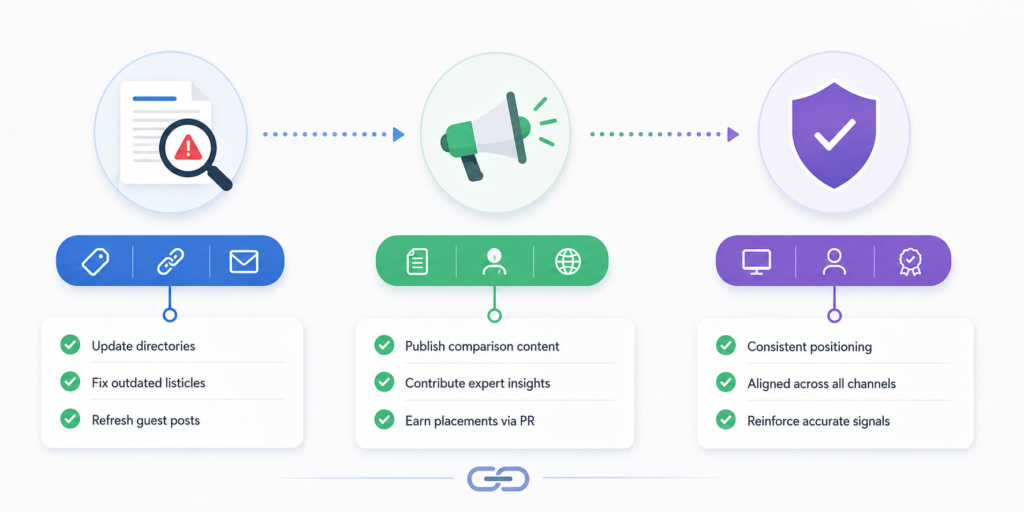 Correct Existing Mentions
- Directories: Claim or log into your listing and update it directly; category, description, and competitor comparisons all matter. TaskFlow, for example, updates its Capterra category from “To-Do List Software” to “Project Management Software,” bringing the listing in line with what the product actually does now.
- Stale listicles: Don’t use a generic contact form; email the author or editor directly. Keep it short: name the outdated claim, give the correction, and add one line on why it matters now. A working template: “We’re listed as a to-do app, but we relaunched as a full project management platform in a month or year.” Short enough to act in a single read.
- Guest posts: Where you have author access or an existing relationship with the site, request an editorial update rather than a full rewrite. Editors move faster on fixing a factual error than on approving a repositioning request.
- Prioritize traffic, not ease. A high-traffic outdated listicle is worth fixing before five low-traffic directory tweaks, even if the directory updates are quicker to make.
Earn Better Associations
Fixing old mentions only gets you back to neutral. To actively shift your co-citation profile, you need new, accurate associations entering the web. Publish comparison content that positions you correctly by name, pitch expert quotes and insights to industry roundups rather than waiting to be included, and use digital PR to get placed beside the brands you actually want to be grouped with. TaskFlow does this by publishing a “TaskFlow vs. Asana vs. Monday.com” comparison page content that exists specifically to teach AI (and readers) the competitive set it belongs in now.
Stay Consistent
None of this works if your own messaging is inconsistent. Your website, author bios, directory listings, PR pitches, and editorial mentions all need to describe your brand the same way. Every inconsistency is a small signal working against the corrections you’re actively making.
FAQ
What is co-citation in the context of AI search?
Co-citation is the pattern of brands, categories, and concepts that repeatedly appear alongside yours across the web, which AI uses to determine what category you belong to and when to recommend you.
How is co-citation different from backlinks?
Backlinks signal authority, and entity recognition signals who you are, while co-citation specifically signals what you’re associated with the company you’re grouped with, not just your credibility or identity.
