A B2B SaaS AEO agency helps a company improve how it is understood and represented across AI-powered search and answer experiences. Its role is to connect the company’s expertise, products, and market position with the information AI systems use when generating answers.
For B2B SaaS, this goes beyond increasing visibility. The work supports commercial discovery by helping the company appear in relevant conversations where potential customers are learning about a category, exploring solutions, or evaluating vendors.
How an AEO Agency Works With a B2B SaaS Company
An AEO agency turns this strategy into practical improvements across the company’s digital presence.
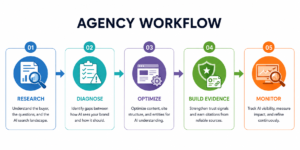
It identifies important gaps, improves the information buyers need, strengthens supporting sources, and ensures the company’s key information is clear and consistent.
The work can involve buyer-query research, content improvements, product and use-case information, competitor gap analysis, citation opportunities, external evidence, and ongoing visibility tracking. Together, these activities help build a stronger presence around the questions that matter to the business.
How a B2B SaaS AEO Agency Finds AI Visibility Opportunities
A B2B SaaS AEO agency begins with the questions buyers ask and then looks at where competitors already appear. This reveals gaps across the buyer journey, from early problem research to vendor selection.
Buyer Questions
Start with the problems, use cases, and requirements buyers are actively researching. These questions reveal opportunities to provide useful information before a buyer reaches a shortlist.
Category Queries
Category queries show how buyers define and explore software solutions. They also create opportunities for a SaaS brand to become associated with the category it serves.
Comparison Queries
When buyers compare products, they want clear differences between their options. AEO should make the company’s strengths, limitations, use cases, and product differences easy to understand.
Alternative Queries
Alternative searches usually signal that a buyer already knows an existing solution and is considering other options. This makes them valuable opportunities for SaaS brands competing against established products.
Recommendation Queries
These are often closer to commercial intent, with searches shaped by factors such as budget, company size, integrations, or specific requirements.
Competitor Visibility Gaps
Look at where competing SaaS brands appear while your company remains absent. The key is to understand which queries, sources, and supporting information contribute to their visibility.
What Does an AEO Agency Optimize for AI Search?
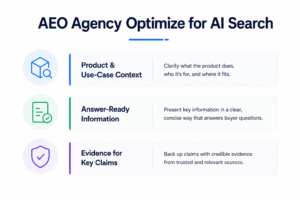
An AEO agency focuses on the information AI systems need to understand a SaaS company accurately. For B2B SaaS, that mainly means making the product, its use cases, and important claims easier to interpret and verify.
Product and Use-Case Context
Product and use-case information should clearly explain what the software does, who it is for, and where it fits. This gives AI systems enough context to connect the product with relevant buyer questions.
Answer-Ready Information
Important information should be easy to find and understand without requiring interpretation from long or unclear explanations. Definitions, features, use cases, and key product details should be presented in a way that can directly address common buyer questions.
Evidence for Key Claims
Claims about product capabilities, results, expertise, or market position should have relevant evidence behind them. This could come from original research, customer evidence, expert input, documentation, or other credible sources.
How an AEO Agency Builds Citation Opportunities
An AEO agency builds citation opportunities by identifying the sources that influence conversations around a SaaS category and strengthening the company’s presence across those sources.
This starts with the company’s own website. First-party content should clearly explain what the product does, who it serves, where it fits, and why it is different. External sources then provide additional context and independent evidence.
Relevant opportunities can include:
- First-party sources: Product pages, research, documentation, case studies, and original data.
- Third-party sources: Industry publications, specialist websites, and relevant editorial coverage.
- Reviews: Customer and software-review platforms where buyers research products.
- Comparisons: Independent comparison and software-selection resources.
- Expert content: Contributions, interviews, commentary, and subject-matter expertise.
- Original research: Proprietary data, benchmarks, surveys, and studies that other sources can reference.
How an AEO Agency Analyzes Competitor AI Visibility
Competitor analysis identifies where other SaaS companies appear in AI answers and what drives that visibility.
An agency compares relevant prompts to determine:
- Where competitors appear and your brand does not.
- Which questions trigger their visibility, especially commercial and comparison queries.
- Which sources are cited, including their own sites and third-party publications.
- What supports their presence, such as product details, comparisons, reviews, research, or expert content.
How Does an AEO Agency Measure Results?
An AEO agency measures results by tracking AI visibility, citations, brand mentions, share of voice, AI-driven traffic, and business outcomes such as leads and pipeline influence.
AI Visibility
AI visibility measures how consistently a SaaS company appears in relevant AI-generated answers, recommendations, comparisons, and category searches across platforms such as ChatGPT, Google AI Overviews, Perplexity, and Gemini. It indicates whether the brand is being discovered and represented during key stages of the buyer journey.
- Mentions: How often the company is referenced in relevant AI answers.
- Citations: How often its website or content is used as a supporting source.
- Query coverage: How many relevant buyer queries include the company.
- Competitor presence: How the company’s visibility compares with competing brands.
Business Impact
Business impact shows whether improved AI visibility is translating into qualified traffic, leads, conversions, opportunities, and pipeline, connecting AEO performance to measurable acquisition outcomes.
- AI-driven referrals: Traffic coming from AI search and answer platforms.
- Conversions: Leads or other desired actions generated from AI-referred visitors.
- Qualified opportunities: Sales opportunities influenced by AI-driven discovery.
- Pipeline: Revenue pipeline associated with AI-assisted acquisition.
The goal is to connect visibility changes with commercial outcomes, rather than treating mentions alone as success.
What Should You Expect From a B2B SaaS AEO Agency?
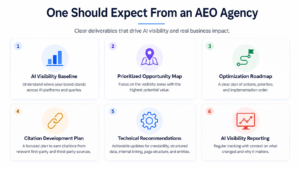
A good AEO engagement should give you more than a list of recommendations. It should establish where the brand stands, identify the most useful opportunities, define what needs to change, and show how visibility develops over time.
AI Visibility Baseline
The agency should establish how often and where the company currently appears across relevant AI platforms and buyer queries. This provides a starting point for measuring progress.
Prioritized Opportunity Map
Rather than treating every visibility gap equally, the agency should identify the areas with the greatest potential value. These may include important buyer queries, categories, competitors, or sources where the brand is currently underrepresented.
Optimization Roadmap
The roadmap turns those findings into specific actions. It should show what needs to be addressed first, what can follow, and how the work fits into the company’s broader AEO strategy.
Citation Development Plan
The agency should identify the external and first-party sources that could strengthen the brand’s presence. The plan should prioritize relevant opportunities rather than simply aiming to increase the number of citations.
Technical Recommendations
Technical recommendations address issues that may affect how easily AI systems can access and interpret information. Depending on the website, this can include crawlability, structured data, internal linking, page structure, and entity clarity.
AI Visibility Reporting
Reporting should track changes in mentions, citations, query coverage, and competitive visibility over time. More importantly, it should explain what changed, why it changed, and whether those changes are contributing to meaningful business outcomes.
What an AEO Agency Can and Cannot Control
An AEO agency can strengthen the information, content, sources, and visibility opportunities that support a SaaS brand. However, it cannot control how AI systems interpret information, generate answers, or recommend a company.
What an AEO Agency Can Control
- Company information: Improve the clarity and consistency of product, company, and use-case information.
- Content: Address relevant buyer questions and information gaps.
- Supporting sources: Strengthen the external evidence and references surrounding the brand.
- Visibility opportunities: Identify relevant queries and areas where the company can improve its presence.
What an AEO Agency Cannot Control
- AI-generated answers: AI systems decide how information is interpreted and presented.
- Brand recommendations: No agency can guarantee that an AI system will recommend a specific company.
- Query outcomes: Results can vary based on the query, context, sources, and AI system.
- Commercial results: Greater visibility does not automatically lead to conversions or pipeline.
AEO improves the conditions for relevant visibility, but the final outcome depends on the AI system, available information, query context, and broader market factors.
How RankingBite Approaches B2B SaaS AI Visibility
RankingBite approaches B2B SaaS AI visibility through five connected layers that shape how a company becomes discoverable, understandable, and credible across AI search.
These layers define what the company represents, how it is described, where its information appears, what factual signals exist about it, and how consistent and trustworthy those signals are across the ecosystem.
Together, they create a structured approach for building AI visibility from defining the brand to strengthening the information AI systems can find, interpret, and trust.
Frequently Asked Questions
-
How is AEO different from traditional content marketing?
Traditional content marketing focuses on attracting and engaging audiences through owned channels. AEO focuses on how information is interpreted and surfaced across AI-driven search systems.
-
Does AEO require changes to an existing SaaS website?
Not always. Required changes depend on current structure, content quality, technical setup, and identified visibility gaps.
-
Can product documentation contribute to AI visibility?
Yes. Documentation can improve visibility by clearly explaining features, integrations, use cases, and implementation details used in AI-generated answers.
-
Does AEO apply to SaaS companies with niche products?
Yes. Niche SaaS products often benefit due to clearer audience intent and more focused query targeting opportunities.
-
Can AEO support a SaaS company’s category creation strategy?
Yes. Consistent terminology and clear positioning help shape how AI systems and users understand a new or emerging category.
-
Does an AEO strategy need subject-matter experts?
Not always, but experts improve accuracy and depth, especially for complex B2B SaaS topics.

kashish
Passionate about SEO, AI search, and content marketing, sharing practical insights on search trends, AI visibility, and digital growth.