

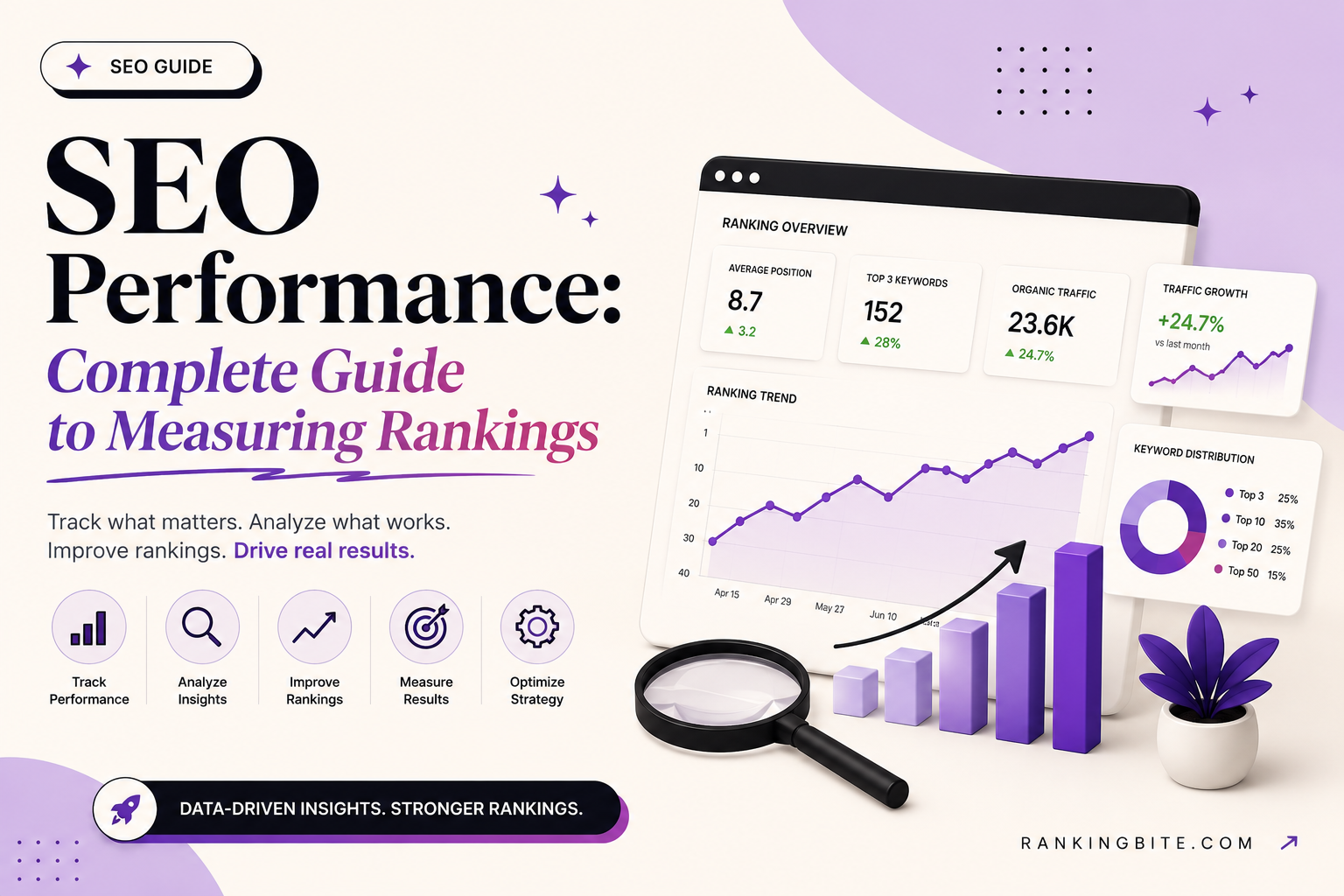
SEO performance is the measurable ability of a website to rank in search results, attract organic traffic, and convert visitors through search engines. Organic search remains the largest single channel for most companies. BrightEdge’s 2019 research found it drives 53% of all trackable website traffic, ahead of paid search, social, and display combined (source: BrightEdge). A site that ranks well doesn’t just attract more visitors; it attracts visitors who were already searching for exactly what it offers, which converts differently than an ad that interrupts someone.
This guide covers what SEO performance is, why it matters, which metrics to track, how to measure them, and the tools that make tracking practical.
What is SEO performance?
SEO performance measures how well a website’s optimization efforts are working, based on metrics such as organic traffic, keyword rankings, click-through rates, and conversions.
It differs from SEO success in scope: SEO success is a business outcome (more revenue, more leads), whereas SEO performance is the data-driven process that enables that outcome.
Why SEO Performance Matters
SEO drives business directly in five key areas. The higher a page ranks for relevant queries, the more organic traffic it receives, reducing the reliance on paid advertising. Research from BrightEdge finds that organic search accounts for 53% of all website traffic.
The more pages in the top spots, the better the search visibility. The brand is recognizable before the user even clicks. Organic visitors are actively looking for what a business has to offer and are more likely to convert, which helps to grow qualified lead generation.
According to HubSpot data, SEO leads close at a 14.6% rate, compared to 1.7% for outbound leads. Unlike paid ads, optimized content ranks for months or years with no additional spend, meaning SEO ROI compounds over time. It supports long-term business growth because consistent SEO performance builds topical authority that creates a durable competitive moat that paid channels can’t replicate.
Key SEO Performance Metrics You Should Track
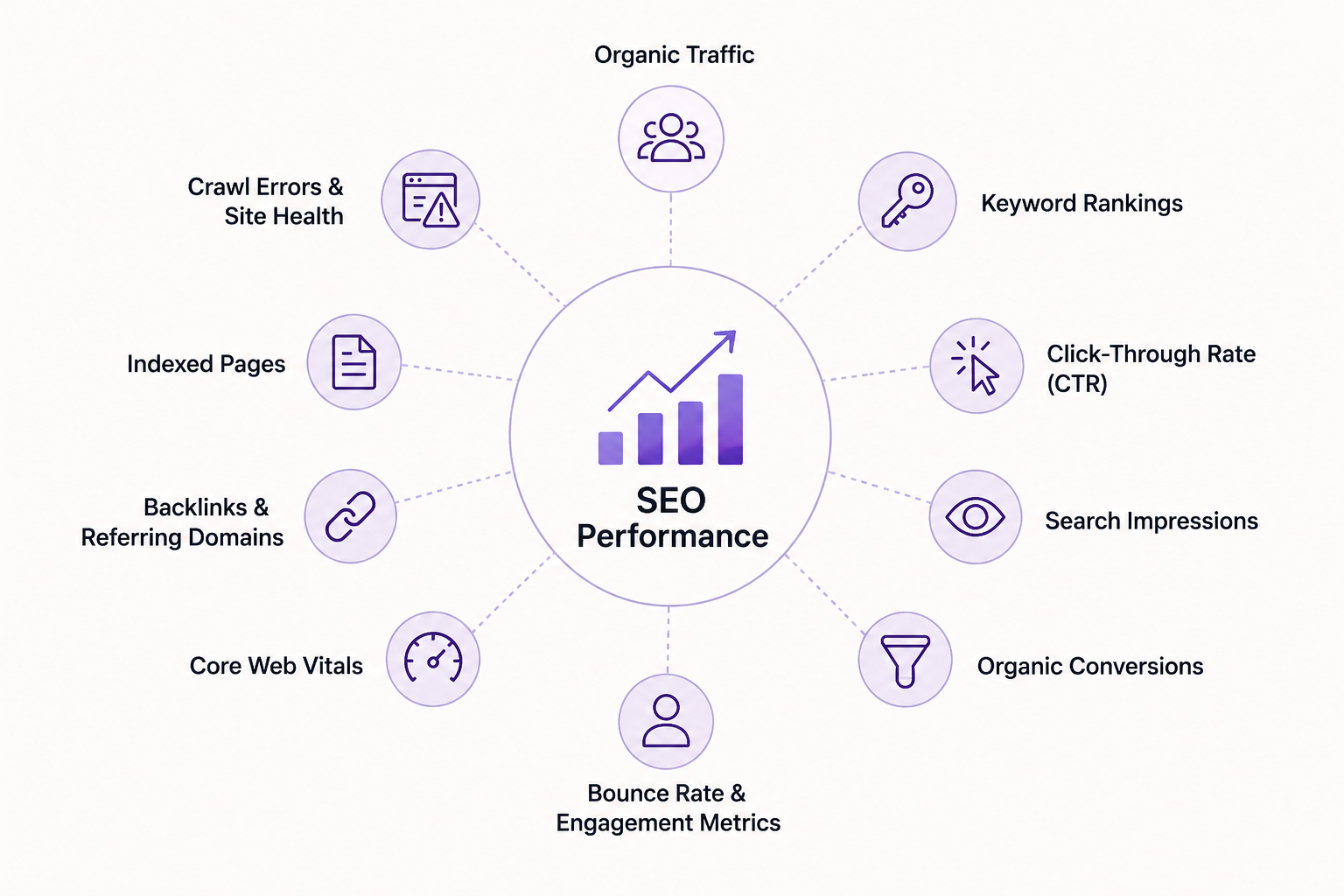
Measuring the right metrics is the basis for any successful SEO strategy. Below are 10 metrics that cover every aspect of a website’s performance in search—from visibility to technical health.
Organic Traffic
Organic traffic is the number of visitors who come from free search results and is tracked in GA4 under the “Organic Search” channel. You’ll want to check this number weekly, not monthly, because a slip that goes unnoticed over four weeks is much harder to fix than one you catch within days. A robots.txt file quietly blocking a set of product pages is a common and easy-to-miss culprit.
Keyword Rankings
Keyword rankings show where a page is in search results for a specific query, tracked by tools such as Ahrefs or SEMrush. According to Backlinko’s 2024 CTR study, pages in positions 1–3 get more than 54% of all clicks. One page position shift from position 9 to position 2 can take forty monthly clicks to several hundred without changing any of the words in the content itself.
CTR (click-through rate)
Click-through rate (CTR) is the percentage of users who click on a result after seeing it (i.e., clicks divided by impressions in Google Search Console). High impressions, low CTR, is rarely a ranking problem; it’s a title tag problem. In most cases you can boost CTR within days by simply rewriting a flat, generic title to have a specific number or outcome.
Search Impressions
“Search impressions” is a Google Search Console metric that tells you how many times a page has appeared in search results, whether or not someone clicked on the page. The best starting list for title rewrites is pages that get a lot of impressions but few clicks. A page that gets thousands of impressions but almost no clicks is wasting traffic away for the cost of a five-minute edit.
Organic Conversions
Organic conversions are completed ones like form fills, purchases, and signups that GA4 attributes to the Organic Search channel. This is the metric that connects SEO directly to dollars. A stakeholder that sees the exact rupee value of organic traffic generated in a month is much more likely to continue funding SEO beyond the first quarter than one that only sees a traffic graph.
Engagement Metrics & Bounce Rate
The bounce rate is the percentage of visitors that arrive at a page and leave without doing anything else. Google Analytics 4, which uses sessions over 10 seconds, scrolls, or conversions, prefers the engagement rate (or its inverse). A high bounce rate can often be a sign of content-to-intent mismatch or a slow page load speed.
Core Web Vitals
Core Web Vitals are Google’s page-experience metrics, and Google made them an official ranking factor in 2021:
- Largest Contentful Paint (LCP): under 2.5 seconds
- Interaction to Next Paint (INP): under 200 milliseconds
- Cumulative Layout Shift (CLS): under 0.1
Backlinks & Referring Domains
Backlinks are links that point to a page from other sites, and referring domains count the unique sites that link to it. With outreach tools like Snov.io, you get to see exactly what pitches land. A few backlinks from really relevant sites will get a stuck page off page three faster than another round of on-page tweaks ever could.
Indexed Pages
Indexed pages are the pages that Google has crawled and added to its index. You can check this in the Pages report in Google Search Console. This is where you normally find duplicate content. Hundreds of nearly identical filter URLs indexed on an e-commerce site quietly consume crawl budget that should be going to the product pages that actually matter.
Crawl Errors & Site Health
Crawl errors occur when search engine bots cannot access a page due to broken links, blocked resources, or server errors. A site health score measured by tools like Screaming Frog SEO Spider and Ahrefs Site Audit quantifies the overall technical condition of a website. Unresolved crawl errors prevent pages from ranking regardless of content quality.
What About AI Overviews and Zero-Click Search?
AI Overviews are reshaping what “ranking well” even means. When an AI Overview appears for a query, the #1 organic result’s CTR drops by roughly 58%, according to Ahrefs (source: Ahrefs, via Sixth City Marketing), meaning a page can hold its position and still lose most of its clicks.
Track this by segmenting Search Console data for queries where AI Overviews appear, watching for rising impressions paired with falling CTR on your best-ranking pages, and counting brand mentions inside AI Overviews as a visibility win even without a click. Zero-click traffic isn’t necessarily wasted traffic if the brand still gets seen, but it does mean CTR and clicks alone no longer tell the full story.
How to Measure SEO Performance
In order to measure SEO performance, you need to connect multiple data sources since each tool captures a different layer of the picture.
Using Google Search Console
Google Search Console gives you impressions, clicks, CTR, and average position straight from Google’s index, and it’s well worth being the first thing you open every Monday. Its performance report tends to bring up queries on a page that already ranks for something nobody actually went after. Often the fastest way to win in rankings is to create a dedicated page around one of those hidden winners.
Use of Google Analytics 4
GA4 tracks what happens after the click: sessions, engagement rate, organic conversions, and revenue. Connecting GSC and GA4 makes gaps obvious: a keyword sending five hundred clicks a month with a twelve percent engagement rate is a clear sign the page doesn’t actually match what searchers wanted when they clicked
Tracking Keyword Rankings
We track keyword rankings with dedicated rank tracking tools like Ahrefs or SEMrush or the average position metric from Google Search Console. If you’re tracking on a week-to-week basis, you can see the trends in rankings, whether target pages are climbing, remaining stable, or declining, and it can help to prioritize which pages need a content refresh or help with link building.
Monitoring Conversions
Set up GA4 events to measure conversions for important actions like form submissions, purchases, phone calls, or content downloads. Once conversion events are live, the Organic Search channel segment shows precisely how much revenue or lead volume SEO is driving the metric that gets stakeholders to spend money on SEO.
Conducting Regular SEO Audits
An SEO audit is an in-depth review of a website’s technical health, on-page optimization, content quality, and backlink profile. Use tools like Screaming Frog SEO Spider, Ahrefs Site Audit, or SEMrush’s Site Audit feature to conduct audits on a quarterly basis. They identify broken internal links, duplicate content, missing meta tags, slow-loading pages, and thin content. If not fixed, all these issues will suppress rankings.
Best Tools for Tracking SEO Performance.
The tools below cover traditional search performance. To see how often your brand appears inside ChatGPT, Perplexity, and Google AI Overviews, compare dedicated AI visibility tracking tools.
| Tool | Primary Function | Best For | Pricing |
|---|---|---|---|
| Google Search Console | Impressions, CTR, rankings, crawl errors | All websites — foundational SEO data | Free |
| Google Analytics 4 | Traffic behavior, conversions, engagement | Connecting SEO to business outcomes | Free |
| Ahrefs | Keyword tracking, backlink analysis, site audit | Competitive research & link building | From $129/month |
| SEMrush | Keyword research, rank tracking, content audit | All-in-one SEO campaign management | From $139.95/month |
| Screaming Frog SEO Spider | Technical site crawl, crawl error detection | Deep technical SEO audits | Free up to 500 URLs; £259/year for full |
| Google PageSpeed Insights | Core Web Vitals, page speed scoring | Page experience optimization | Free |
What SEO Performance Mistakes Should Be Avoided?
The most damaging SEO performance mistakes share a common pattern: measuring the wrong things or acting without data. Vanity metrics like total page views mislead teams when not filtered for organic traffic. Ignoring Core Web Vitals causes ranking drops even when content quality is strong. Without GA4 conversion tracking, SEO’s business impact becomes impossible to prove.
Publishing content without keyword intent alignment attracts the wrong visitors who bounce quickly. Keyword cannibalization, where multiple pages compete for the same query, splits ranking authority and reduces overall visibility. Letting technical audits slide allows crawl errors and broken links to quietly erode rankings over months.
Finally, making SEO changes without documentation makes it impossible to identify what caused a rankings improvement or drop. Every one of these mistakes is preventable through consistent tracking, structured audits, and a clear measurement framework aligned to business goals.
Frequently Asked Questions (FAQs)
How long does it take to see SEO performance improvements?
SEO improvements typically become measurable within 3 to 6 months, though competitive keywords can take 6 to 12 months.
What is a good organic CTR in search results?
Position 1 averages 27.6% CTR, position 2 averages 15.8%, and position 3 averages 11%, according to Backlinko’s 2024 CTR study.
How often should SEO performance be reviewed?
Weekly for rankings, monthly for conversions, and quarterly for full technical audits.
Does page speed directly affect SEO performance?
Yes. Page speed affects rankings through Core Web Vitals; a page with LCP above 4 seconds faces direct ranking disadvantages.
What is the difference between organic impressions and organic traffic?
Impressions count how many times a page appeared in search results. Organic traffic counts how many users actually clicked through.
Conclusion
SEO performance is the foundation of sustainable organic growth. According to StanfordWeb Credibility Research, 75% of users judge a website’s credibility based on its overall design and search visibility, making organic rankings a direct trust signal for most businesses. Pages that rank higher convert better, load faster, and attract more qualified leads.