Ask ChatGPT “what are some of the best WordPress SEO plugins?” and it names Yoast SEO sometimes directly, sometimes in passing. This isn’t hypothetical; it’s a documented pattern. And whether that answer links back to yoast.com barely matters.
For two decades, links were the currency of digital authority. Google’s ranking model treated every backlink as a vote of trust, and SEO revolved around earning those votes.
AI search works differently. Language models don’t follow a link graph the way crawlers do. They read text, recognize patterns, and build associations. Instead of asking, “Who links to this brand?” they ask, “Who talks about this brand, and how?”
That’s why unlinked brand mentions matter. When your brand is repeatedly mentioned in relevant, independent sources, even without a hyperlink, AI models learn to associate it with a topic. BrightEdge found that ChatGPT mentions brands 3.2 times more often than it formally cites them, making unlinked brand mentions a much stronger driver of AI visibility than most traditional SEO strategies account for.
Mentions vs. Citations: the Distinction That Matters
Two Different Signals
A mention is your brand named in text, linked or not. It’s how a model learns about you: the raw material it absorbs while reading the web, whether during training or while pulling in live results to answer a question.
A citation is the model explicitly attributing or linking to you as a source for its answer. It’s how a model credits you in the visible, attributed moment where your name shows up as the origin of what it just said.
| Aspects | Mention | Citation |
| What it is | Brand named in the answer or source text | Model links or attributes a specific source |
| Where it happens | Inside the AI’s response and across the open web | In a source list or footnote-style attribution |
| Who controls it | Third parties mostly out of your hands | The model, based on which pages it draws from |
| Real pattern | ChatGPT names Yoast SEO in about 20% of relevant answers | ChatGPT cites sources in most answers, but a cited source isn’t always named |
Why the Gap Matters
These two signals move independently, and the gap between them is wider than most people assume. A brand can be cited and linked as a source at the bottom of an answer without ever being named in the text a reader actually sees. It can also be named constantly, shaping how a model talks about a category, with zero formal citations to show for it.
That independence matters strategically. Optimizing for one doesn’t guarantee the other. A brand chasing citations alone might rack up source links while remaining invisible in the actual conversation. A brand chasing mentions alone might become the name people recognize without ever being credited as the authority behind it. The two need different tactics, and treating them as one signal means missing half the picture.
Why AI Reads Mentions Differently Than Search Engines Read Links
 Links vs. Meaning
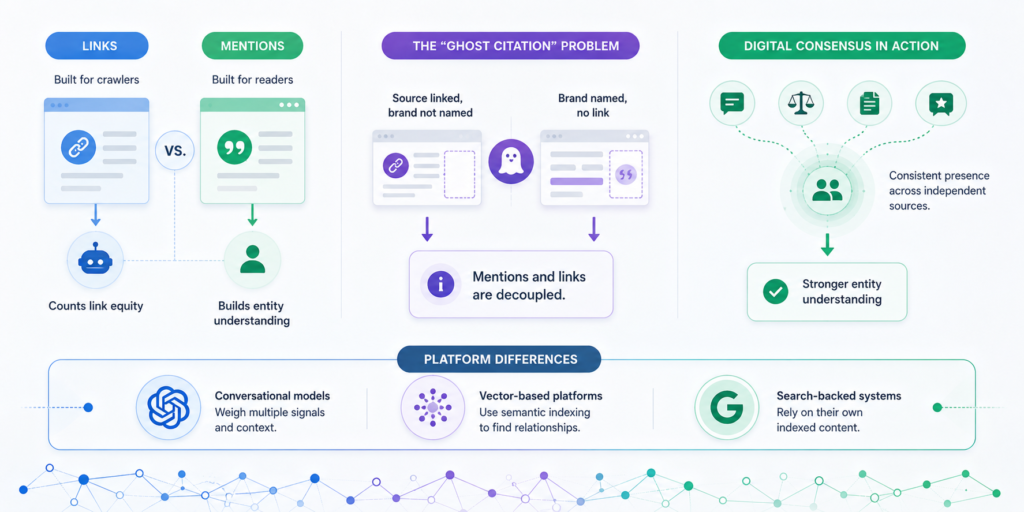
Links were built for crawlers. Mentions are built for readers, and language models are readers. Instead of counting link equity, models build entity-based understanding: they associate a brand with a topic through repeated co-occurrence across independent sources.
The “Ghost Citation” Problem
Research by Kevin Indig found that in over half of cases, a model cites a source linked to it without ever naming the brand in the visible answer. He calls this a “ghost citation.” The reverse happens just as often: brands get named with no link at all. Mentions and links are increasingly decoupled from each other.
Digital Consensus in Action
Yoast SEO’s visibility isn’t the result of one placement. It comes from consistent, repeated presence across WordPress forums, plugin comparisons, and SEO blogs, most of it never linking back. This plays out differently across platforms: ChatGPT, Perplexity, and Google AI Overviews each weigh it differently, since Perplexity uses vector indexing while AI Overviews draws from Google’s own index.
Owned vs. Earned: Where Unlinked Mentions Actually Come From
Not all mentions carry equal weight with AI models; where a mention comes from shapes how much it counts. Here’s the difference between owned and earned, and why one matters more.
Owned Media
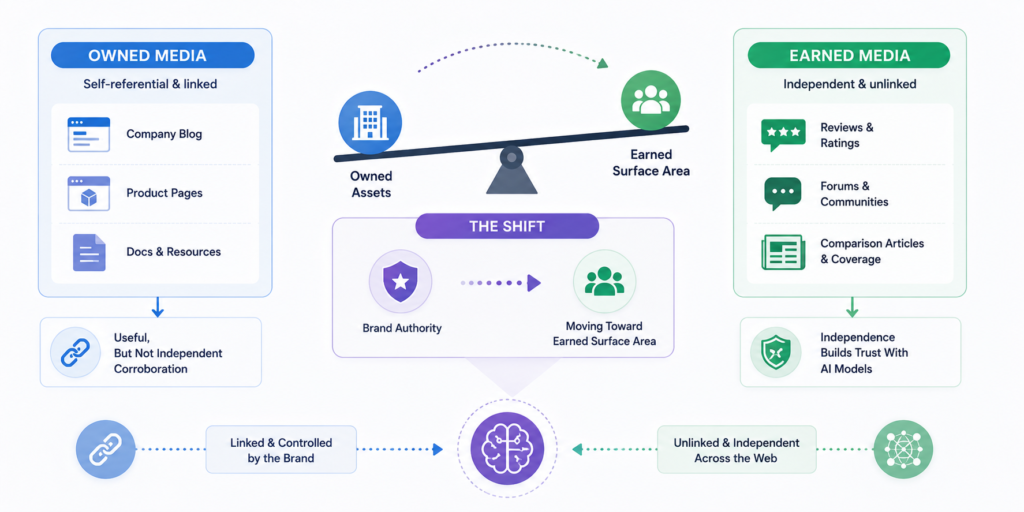
Company blog, product pages, docs mostly self-referential and linked. Useful, but not independent corroboration.
Earned Media
Third-party reviews, forums, comparison articles, trade coverage; this is where unlinked mentions accumulate, and independence is what earns model trust. Yoast SEO’s presence in independent WordPress plugin roundups and forum threads is earned, not owned, and it’s this layer the models draw on most.
The Shift in Center of Gravity
Brand authority is moving from owned assets toward earned surface area a brand doesn’t control.
 How to Find Unlinked Brand Mentions
Finding unlinked mentions means looking beyond your backlink profile; tracking baseline visibility, checking AI answers, and working backward from the sources AI already trusts. Here’s how to build that picture, plus emerging surfaces to watch.
Baseline Monitoring
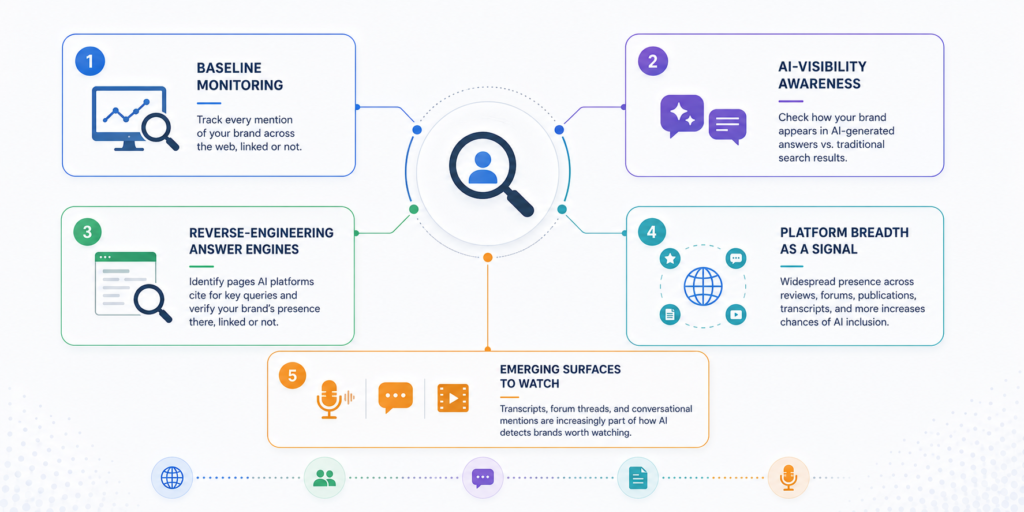
Start by tracking unlinked brand mentions across the web to understand your current visibility. Monitor every place your brand name appears, whether it’s linked or not, to establish a baseline of your AI and search presence.
Check AI Visibility
Don’t rely only on traditional search results. Regularly ask ChatGPT, Perplexity, and Google AI Overviews relevant questions in your niche to see whether your brand appears in AI-generated answers and how those unlinked brand mentions are presented.
Reverse-Engineer AI Sources
Identify the pages AI platforms already use to answer your target queries. Then check whether your brand is mentioned on those sources, even without a backlink. Increasing unlinked brand mentions on pages that AI frequently references can improve your chances of being recognized in future responses.
Platform Breadth as a Signal
Presence across many independent platform types reviews, forums, publications, transcripts correlates with higher odds of inclusion in AI answers than depth on any single one.
Emerging Surfaces to Watch
Podcast and video transcription, forum threads, and voice or conversational mentions are all becoming part of how models detect a brand worth watching, even though they sit outside a traditional monitoring setup.
How to Earn More Mentions
Earning more mentions isn’t about creating more content; it’s about getting picked up in the right places, in formats models can parse, repeated by independent sources. Here’s how to make that an ongoing practice.
Go Where the Sources Already Are
Target the sources AI already cites for relevant queries rather than building authority from zero. A comment, quote, or inclusion in an already-cited page carries more weight than a brand-new asset built from scratch.
Make Content Extractable
Tables, comparisons, and spec sheets get parsed more reliably by models than prose.
Prioritize Repetition and Independence
Brand mentions correlate roughly three times more strongly with AI visibility than backlinks, according to industry analysis. Repeated, independent mentions outweigh a single strong placement.
Treat PR as Infrastructure
Earned coverage, forum participation, expert quotes, and podcast appearances work best as ongoing practice, not a one-off campaign.
What This Means Going Forward
A New KPI
Reframe the metric that matters: from link count to mention frequency times source credibility times topical relevance.
The Platform-Specific Reality
ChatGPT cites sources in the large majority of its answers but only names the brand in about a fifth of them. Gemini behaves closer to the opposite, naming brands more often than it formally cites them. Strategy has to account for these differences platform by platform, not treat “AI search” as one system.
A Caution
Mentions aren’t automatically positive. Sentiment matters, and specific tactics here will age faster than the underlying principle.
The Close
Yoast SEO didn’t earn its AI visibility from a single backlink campaign. It came from years of being named, consistently and independently, across a category it never fully controlled.
As discovery moves into AI answer engines, “being talked about” becomes the new being linked to.
