

B2B SEO is the process of optimizing a company’s online presence to rank higher in search results and acquire other businesses as customers. B2B SEO targets decision-makers, procurement teams, and executives who research a purchase well before they speak to a salesperson. This is quite different from B2C SEO, which is about serving individual consumers making personal, often impulsive, buying decisions.
Search is now one of the main ways that business buyers find information before they contact a vendor. In this guide, we will explain what B2B SEO is, a practical 7-step strategy, the tools worth using, and the major differences between B2B and B2C SEO.
What is B2B SEO?
B2B SEO is the process of optimizing a business’s visibility on search engine results pages to attract, engage, and convert other businesses into customers. It blends technical optimization, content strategy, and link building, all shaped around the longer, research-driven buying cycles typical of B2B markets.
The goal is ranking for the keywords B2B buyers actually search during research and decision-making from awareness-stage queries like “What is marketing automation?” to bottom-funnel queries like “Best CRM software for enterprises.”
How B2B SEO Works
B2B SEO works by targeting the specific queries business buyers use at every stage of the funnel, built on four core components:
- Keyword Research: identifying high-intent, industry-specific search terms used by decision-makers
- On-Page Optimization: structuring content with proper headings, meta tags, schema markup, and internal links
- Content Marketing: publishing authoritative guides, case studies, and comparison pages that answer buyer questions
- Link Building: earning backlinks from authoritative industry publications to build domain authority
The 7-step strategy below turns these four components into a sequence you can actually execute: personas and funnel mapping feed content marketing and on-page work, while keyword research and link building run throughout.
Why Businesses Invest in B2B SEO
Businesses invest in B2B SEO because buyers do most of their research digitally before a sales conversation ever starts. Gartner research found B2B buyers spend only 17% of their total purchasing time actually meeting with potential suppliers . A site that doesn’t show up during that independent research phase is invisible for most of the decision-making process.
The average B2B buying group involves 6.8 stakeholders, each doing independent research before the group compares notes, a figure that’s been widely cited since roughly 2017, so treat it as a directional benchmark rather than a current count. That independence is growing: in a March 2026 Gartner survey, 67% of B2B buyers said they’d prefer a sales-rep-free buying experience. That means a website’s content is increasingly doing the job a rep used to do face-to-face.
Gartner’s 2020 research also projected that 80% of B2B sales interactions would shift to digital channels by 2025 that target year has already passed, and the shift it predicted is now largely the reality vendors are operating in.
A 7-Step B2B SEO Strategy
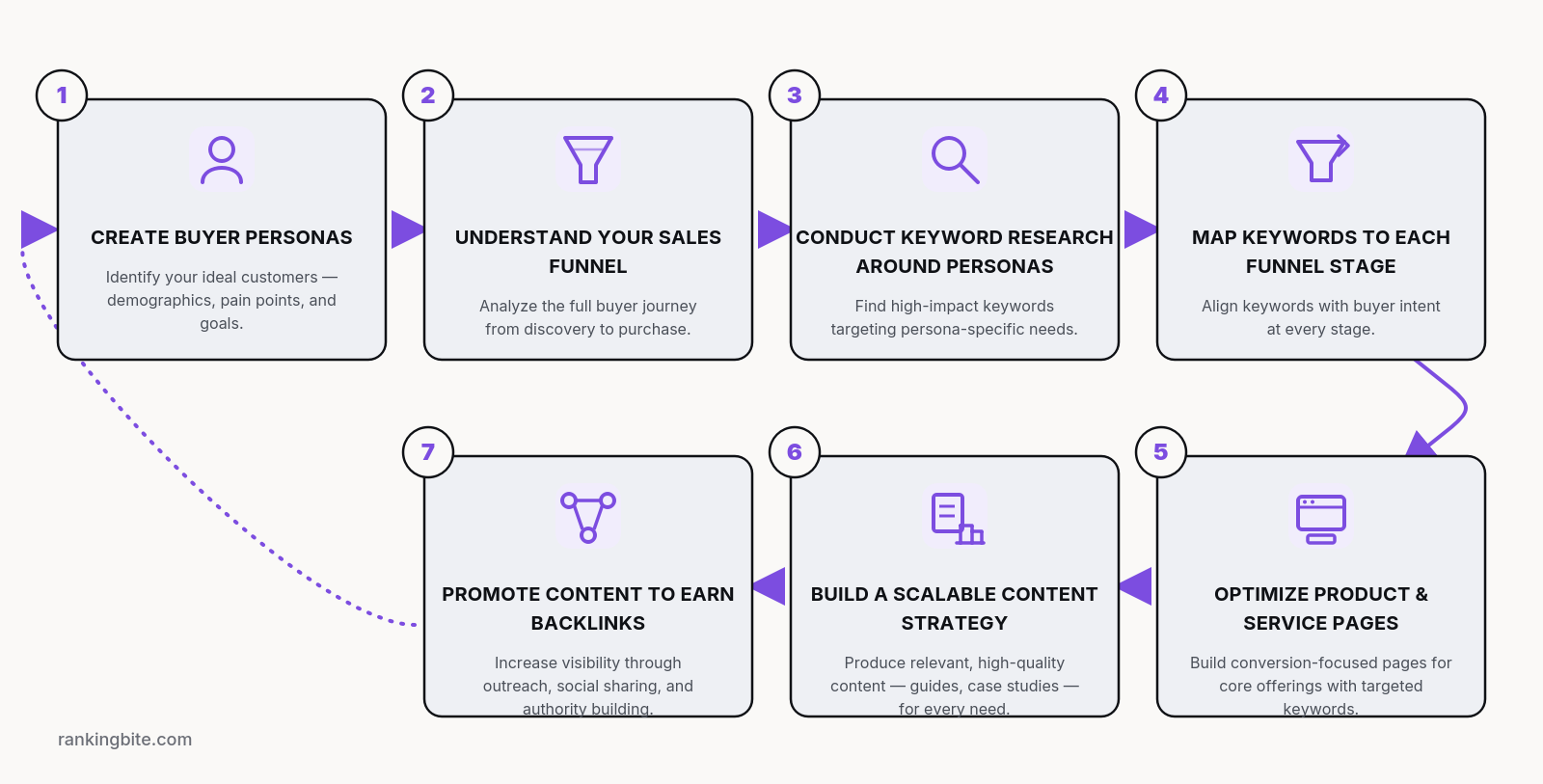
Keyword density alone doesn’t win at B2B SEO. It comes down to knowing your buyer, mapping their journey, and serving the right content at each funnel stage. Here are the 7 steps that build a strategy generating consistent organic leads.
1. Create Buyer Personas
A buyer persona is a semi-fictional representation of your ideal customer, built from real data and market research. In most B2B deals, three persona types show up: the end user who wants a solution, the manager who evaluates options, and the executive who approves the budget.
Each persona searches differently; a marketing manager looks for “marketing automation tools for mid-sized companies,” while a CFO looks for “marketing software ROI case studies.” “Build out personas with job titles, pain points, goals, preferred content formats, and what each one searches for at every buying stage.
2. Understand Your Sales Funnel
The B2B sales funnel has three stages: Top of Funnel (TOFU), Middle of Funnel (MOFU), and Bottom of Funnel (BOFU). Your SEO content needs to cover all three. TOFU serves awareness-stage buyers who don’t yet fully recognize their problem. MOFU serves buyers actively evaluating solutions, not just passively considering them. BOFU serves buyers ready to purchase or book a demo.
One of the most common B2B SEO mistakes is writing only TOFU blog content and skipping MOFU comparison pages and BOFU landing pages entirely. A full-funnel site with content at every stage converts far more of its traffic than one stacked with awareness posts alone.
3. Conduct Keyword Research Around Your Personas
B2B keyword research starts with your buyer personas, not a keyword tool. List the specific questions and language each persona uses at each funnel stage, then validate and expand that list with tools like Ahrefs, Semrush, and Google Search Console.
Prioritize low-volume, high-intent keywords over high-volume, generic terms. A keyword like “enterprise HR software for healthcare” might only get 200 searches a month, but those 200 searchers are highly qualified decision-makers. Map keywords by buyer awareness level:
- Problem-aware: “how to reduce employee churn”
- Solution-aware: “best HR software features”
- Product-aware: “[Your Brand] vs Workday”
4. Map Keywords to Buyers at Each Funnel Stage
Keyword mapping connects each keyword to a specific page type based on funnel stage. TOFU keywords map to educational blog posts and guides. MOFU keywords map to comparison pages, template downloads, and webinar landing pages. BOFU keywords map to product pages, pricing pages, case studies, and demo request pages.
| Persona | Funnel Stage | Example Query | Target Page Type |
|---|---|---|---|
| End-user | TOFU | “What is marketing automation?” | Educational blog post |
| Manager | MOFU | “best HR software features” | Comparison / template page |
| Executive | BOFU | “[Your Brand] vs Workday” | Pricing or demo page |
This mapping keeps every page on the site tied to a purpose in the buyer journey. Skip it, and multiple pages start competing for the same keyword keyword cannibalization which dilutes search authority and drags down rankings for every competing page.
5. Create and Optimize Product or Service Landing Pages
Product and service landing pages are the B2B SEO assets that drive conversions directly. Each one needs to be clear about what the product does, who it’s for, the measurable business outcome it delivers, and why it beats the alternatives.
Focus each landing page on one primary BOFU keyword, give it a clear CTA (demo, trial, or contact), and include social proof—client logos, G2 ratings, and ROI-driven case studies. Optimize with proper H1/H2 tags, schema markup, an LCP under 2.5 seconds, and internal links to relevant blog content to pass SEO authority.
6. Build a Scalable Content Strategy
Topic clusters are the backbone of a scalable B2B content strategy: one pillar page covering a broad topic, linked to 6–10 cluster articles covering related subtopics, each linking back to the pillar. This structure signals topical authority through semantic SEO to Google and lifts rankings across the whole cluster
A pillar page on “B2B Lead Generation,” for example, would link to clusters on cold email outreach, LinkedIn lead generation, B2B SEO strategy, and account-based marketing. HubSpot has found that implementing topic clusters grew their own domain authority and drove over 500% more clicks to target keywords, with more internal linking correlating with stronger SERP placement.
7. Promote Your Content to Earn Backlinks
Links from other sites remain one of the core signals search engines use to judge a page’s relevance and quality. PageRank has been one of Google’s core ranking systems since launch, and it’s still part of how content gets evaluated today, according to Google’s own ranking systems documentation.
In practice, that means guest posting on real, relevant industry sites, publishing original research other writers will naturally cite, and building free tools like ROI calculators that earn links on their own merit. Descriptive, specific anchor text “read our B2B SEO strategy guide” instead of “click here” helps both readers and search engines understand what a linked page is about.
How Do You Get Cited in AI Search Results?
AI search is now part of the B2B research stage, not a separate channel from it. If 67% of buyers want a rep-free experience and most of the buying process happens before a sales call, a growing share of that independent research is happening inside ChatGPT, Perplexity, and Google AI Overviews, not just on the search results page.
Getting cited there depends less on keyword targeting and more on the same fundamentals that build topical authority: comprehensive topic-cluster coverage; clearly structured data (schema markup, FAQ blocks, and comparison tables); original research and proprietary data AI tools can quote and attribute; and content written in direct, extractable answer form rather than buried in narrative.
A comparison page with a clean table of “[Your Brand] vs Workday” features is far more likely to get pulled into an AI answer than a paragraph making the same comparison in prose. Track this by watching brand mentions and citations in AI-generated answers alongside traditional rankings. A page can be cited by an AI tool and drive zero clicks, and that’s still a visibility win worth measuring.
B2B SEO vs. B2C SEO: What’s the Difference?
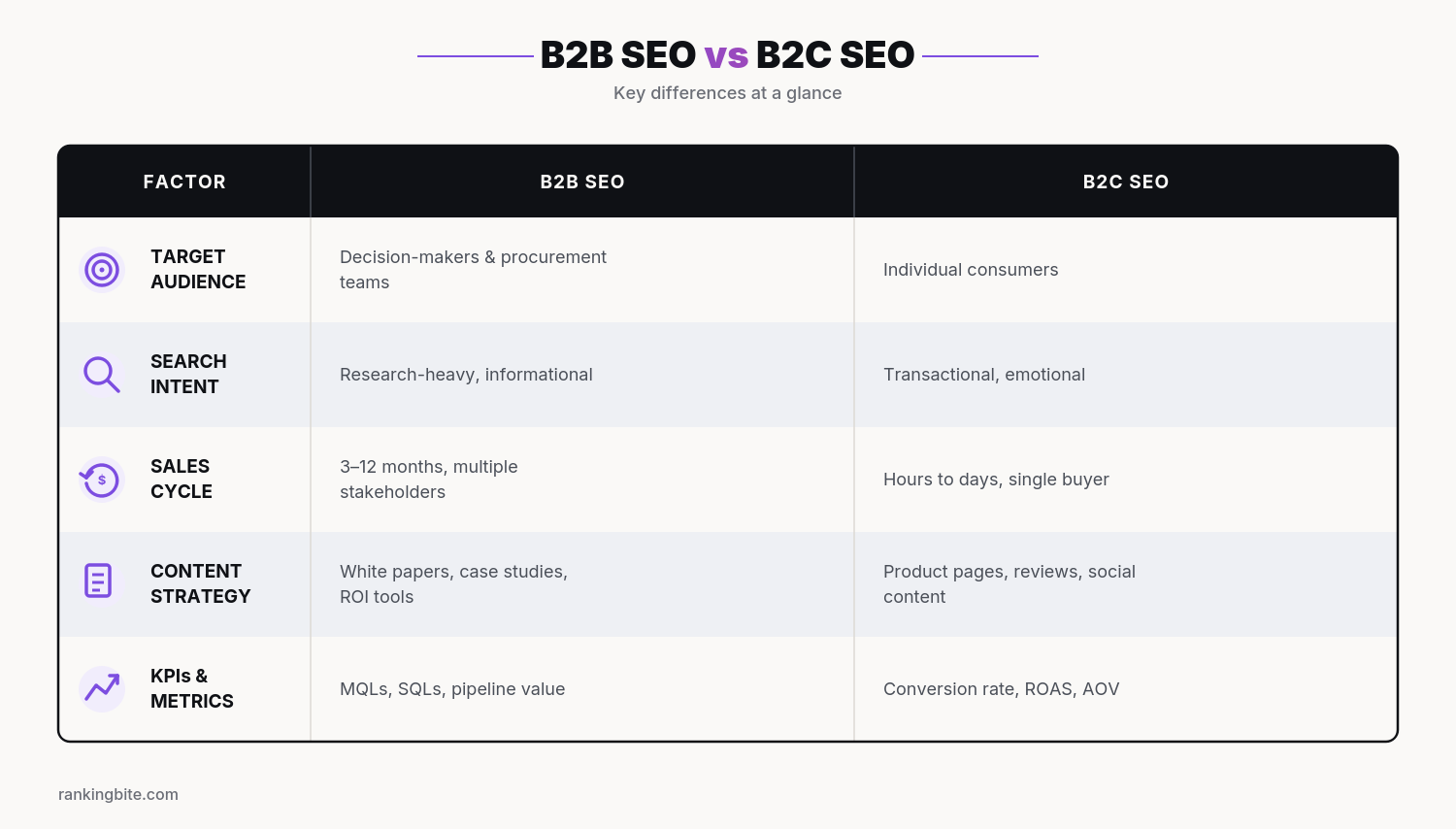
B2B and B2C SEO share the same technical foundation but differ in audience, intent, content format, and success metrics.
Target Audience: B2B SEO targets decision-makers, procurement managers, and C-suite executives buying for an entire organization. B2C SEO targets individual consumers making personal decisions based on price, emotion, and convenience.
Search Intent: B2B search intent is research-heavy and spans weeks or months — a buyer moves from informational queries (“what is account-based marketing?”) to commercial queries (“best ABM platforms”) to transactional queries (“HubSpot ABM pricing”). B2C buyers often move from awareness to purchase in a single session.
Sales Cycle: The average B2B sales cycle runs 3–12 months with multiple stakeholders per deal. B2C sales cycles involve one buyer and close in hours or days. B2B content has to nurture buyers across a long period and multiple touchpoints; B2C content can focus on driving an immediate conversion.
Content Strategy:
| B2B Content | B2C Content |
|---|---|
| Long-form guides | Product pages |
| Original research reports | Top 10 listicles |
| Software comparison pages | User reviews |
| ROI calculators | Short how-to blogs |
| In-depth case studies | Quick-decision content |
KPIs and Success Metrics: B2B SEO success is measured through Marketing Qualified Leads (MQLs), Sales Qualified Leads (SQLs), demo requests, pipeline value, and cost per organic lead. B2C SEO success is measured through e-commerce conversion rate, revenue per session, return on ad spend (ROAS), and cart abandonment rate.
To actually attribute pipeline to organic search, connect your CRM to GA4 and tag every campaign and content asset with UTMs. Without that link, MQLs and SQLs sit in one system, and organic traffic sits in another, and nobody can prove which content produced which deal.
Best Tools for B2B SEO
The right tools separate a B2B SEO strategy that guesses from one that grows. These six cover every core function, from technical auditing to content optimization to performance tracking.
- Google Search Console: free; impressions, clicks, CTR, indexing status, crawl errors, sitemap submission
- Google Analytics 4: organic traffic by landing page, conversion tracking (demos/forms), engagement metrics
- Ahrefs: backlink analysis, keyword research, content gap analysis, technical site audits
- Semrush-Keyword Magic Tool for topic clusters, position tracking, content optimization, ad intelligence
- Screaming Frog: desktop crawler; broken links, duplicate meta tags, redirect chains, page depth analysis
- Surfer SEO: NLP-based content scoring, ideal word count/headings, Google Docs & WordPress integration
Frequently Asked Questions?
How long does B2B SEO take to show results?
4-6 months for measurable results, 9–12 months for consistent lead flow. Low-competition niches with existing domain authority can rank in 60–90 days.
What is topical authority in B2B SEO?
It’s how comprehensively a site covers a subject through topic clusters. Deep coverage of one topic beats shallow coverage of many.
Is paid search (PPC) better than B2B SEO?
No, PPC is faster but stops producing the moment spend stops. SEO compounds over time and outperforms PPC long-term, which is why most brands run both.
What type of content performs best in B2B SEO?
Long-form guides, original research, comparison pages, ROI calculators, and case studies. These formats earn backlinks and signal E-E-A-T.
How do you measure B2B SEO ROI?
Through traffic growth, rankings, organic leads, cost per lead, and pipeline value connect your CRM and GA4 with UTM tagging for full revenue attribution.
Conclusion
B2B SEO isn’t optional anymore; it’s the most reliable, scalable system for generating high-intent leads at a sustainable cost. The Demand Gen Report (2024) found that 62% of B2B buyers consult 3–7 pieces of content before engaging with a vendor.
Start with your buyer personas. Plot their search journey. Create content that answers questions at every funnel stage, including where AI tools are now doing part of that research for them. Build authoritative backlinks. Don’t just track traffic; track pipeline impact. Done right, B2B SEO doesn’t just bring traffic; it brings qualified buyers straight to your sales team.