Agency vs Tool vs In-House AI Visibility: Which Model Actually Wins in 2026?
If you’re trying to get cited in ChatGPT, Google AI Overviews, AI Mode, Perplexity, and Gemini, you actually have three levers, not two:…
If you’re trying to get cited in ChatGPT, Google AI Overviews, AI Mode, Perplexity, and Gemini, you actually have three levers, not two:
- A tool that tracks whether and where you’re mentioned or cited.
- An agency that brings AI-search expertise and executes the fixes.
- An in-house team that owns the function long-term.
Skipping the tool and jumping straight to “in-house vs. agency” is how companies end up paying for strategy work with no baseline to measure it against. For most companies, the strongest setup isn’t one of these: it’s tool + internal ownership + agency support where needed.
The right model depends less on which option sounds best and more on what your team can realistically execute today.
At a Glance
| Factor | Agency | Tool In-House | Fully In-House Team |
|---|---|---|---|
| Expertise | High | Requires internal expertise | Must be built internally |
| AI Overview / citation optimization experience | Usually strong (cross-client learning) | Measurement only | Depends entirely on hiring |
| Strategy & execution | Agency-led | Internal team | Internal team |
| Setup speed | Fast (days–weeks) | Fast (hours–days) | Slowest (months) |
| Control | Medium | High | Highest |
| Internal knowledge retained | Lower unless contractually required | High | Highest |
| Hiring required | Usually no | Existing team needed | Yes |
| Typical monthly cost (US mid-market) | $2,500–$15,000+ retainer | $200–$2,000 software | $8,000–$25,000+ in loaded salary |
| Best for | Teams needing expertise + execution fast | Experienced SEO/content teams | Companies making AI visibility a core, permanent channel |
| Main weakness | Ongoing external dependency | Data without execution | Cost, hiring risk, and ramp-up time |
The core distinction the “in-house vs. agency” framing misses: a tool tells you whether you have a problem. An agency or internal team decides what to do about it. Comparing only the second question while ignoring the first is why so many companies buy expensive strategy work with no way to prove it moved the needle.
What Is AI Visibility (and How Is It Different from “AI SEO”)?
AI visibility is your brand’s ability to appear, get mentioned, or get cited when someone asks an AI system a question related to your product, category, or competitors. “AI SEO” and “GEO” (generative engine optimization) are the practice of improving that visibility but visibility is the outcome you’re actually being judged on.
Traditional SEO asks: “Where does my website rank?”
AI visibility asks a broader question: “When a prospect asks an AI system for an answer, does my brand show up and is my content the one being cited?”
A brand can rank #1 in traditional search and still be invisible inside an AI Overview, because generative engines frequently pull from third-party reviews, forums, and industry publications instead of the brand’s own site. That’s why AI-search optimization work centers on prompt coverage, citation frequency, brand mentions, source authority, and entity clarity not keyword rankings alone.
Why This Decision Matters More Now
AI visibility has become an operational discipline, not something to check quarterly. That creates three distinct jobs, and conflating them is the single biggest reason companies pick the wrong model:
- Measure – are we being cited, and for which prompts?
- Understand – why are we losing visibility to specific competitors or sources?
- Improve – what needs to change in our content, entity signals, or authority to fix it?
A visibility tool can fully own job #1. It can partially inform job #2. It cannot do job #3 On its own no software fixes your content or builds your authority for you. That’s the gap agencies and in-house teams exist to close, and it’s why “which model wins” really means “which model closes the job you’re missing,” not which one wins in the abstract.
Option 1: An AI Visibility Tool
A tool is a measurement and intelligence layer tracking brand mentions, citations, competitor share of voice, prompt-level visibility, sentiment, and which domains AI systems actually cite.
A tool is the right starting point when:
- You already have SEO/content expertise and just lack visibility into the AI-search layer specifically.
- You want a baseline before committing a budget to an agency or a hire you can’t prove ROI on work you never measured against.
- You want continuous monitoring folded into an existing workflow rather than a periodic outside report.
The mistake: treating the dashboard as the strategy. A tool can tell you your brand is cited in 18% of tracked answers. It won’t tell you which content to fix first, whether you need third-party authority, or how to close the gap. Without a person interpreting it, a visibility tool becomes a number nobody acts on.
If you’re evaluating tools, RadarKit is worth a look. Instead of pulling data from API responses, it runs real browser-based prompts against ChatGPT, Gemini, Perplexity, Copilot, and Google AI Overviews/AI Mode so what you see is closer to what an actual user sees, including citations, cited URLs, and competitor share of voice, with tracking across 50+ locations.
It also connects to GA4, which addresses the most common tool complaint above: you can see whether a visibility change actually moved traffic, not just whether a score went up. Plans start at roughly $29/month, which makes it a low-risk way to get a real baseline before deciding whether you need an agency or a hire at all.
Option 2: An AI SEO / AI Visibility Agency
An agency is an external team responsible for some or all of the strategy and execution: audits, prompt research, citation analysis, entity and content optimization, digital PR, and ongoing testing.
An agency makes sense when:
- You lack specialized AI-search expertise. Traditional SEO skills don’t automatically transfer to entity optimization or citation engineering; this is a genuinely newer discipline with different mechanics.
- You need execution, not just a diagnosis. A tool can flag that competitors are being cited instead of you. An agency does the work of figuring out why and fixing it.
- You need speed. An established agency already has frameworks, testing processes, and cross-client pattern recognition building that internally from scratch takes months.
- The function doesn’t yet justify a full internal team, but is too important to ignore.
Downsides to weigh:
- Less direct control. External teams need access to your site, analytics, and brand guidelines, and the more you outsource, the more dependent the program becomes on that one relationship.
- Knowledge often stays external unless the contract explicitly requires documentation and transfer.
- Quality varies enormously. This is a young, unregulated discipline. Don’t hire based on buzzwords like “GEO,” “AEO,” or “AI SEO” in a sales page. Ask exactly what they measure, what they change, and how they prove it worked.
If you’re shortlisting agencies, RankingBite is a reasonable one to include. It’s positioned specifically around Generative Engine Optimization (GEO) getting cited by ChatGPT and other AI platforms alongside programmatic SEO for scaling content and white-hat link building for authority. That combination matters because citation work rarely succeeds in isolation: an AI system is more likely to cite a page that also has the technical foundation and third-party authority behind it, which is the traditional-SEO backbone the red flags below are checking for.
Option 3: A Fully In-House Team
This means building the capability permanently: SEO specialists, content strategists, technical SEO, digital PR, and subject-matter experts, supported by visibility software.
Full in-house makes sense when:
- AI search is becoming a primary acquisition channel for the business, not a side experiment.
- You have budget and time to both interpret data and execute recommendations without external dependency.
- Your product or domain knowledge is specialized enough that outside teams take too long to ramp up.
- You want lasting organizational knowledge rather than a channel someone else understands better than you do.
Hidden costs beyond salary: recruitment, benefits, training, software, management time, ramp-up, and turnover risk. Comparing one employee’s salary to an agency retainer is a misleading calculation; the real comparison is total capability cost vs. total external cost, not headline price.
Roles You Actually Need to Staff This Internally
| Role | What They Own |
|---|---|
| AI visibility / AI SEO strategist | Prompt research, competitive citation analysis, roadmap |
| Content strategist / writer | Rewriting and structuring content for extractability |
| Technical SEO | Structured data, schema, crawlability, site architecture |
| Digital PR / authority lead | Third-party citations, mentions on high-authority sources |
| Data analyst | Tracking citation rate, share of voice, and business impact over time |
Few companies staff all five as dedicated headcount, most combine roles or lean on a tool + a lean team, which is functionally the hybrid model below.
The Hybrid Model (Usually the Strongest Starting Point)
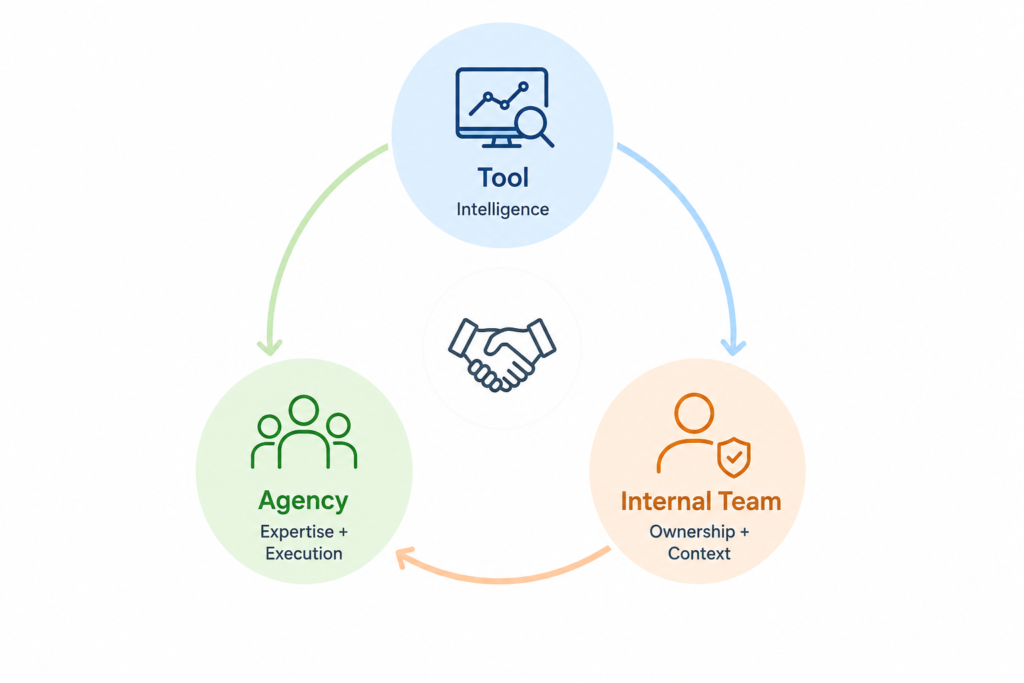
For most companies, the most practical setup splits responsibility three ways instead of picking one:
- Tool → intelligence. Prompt tracking, citation tracking, competitor monitoring, trend analysis.
- Agency → expertise + execution. Strategy, content and technical optimization, authority building, testing.
- Internal team → ownership + context. Brand knowledge, product positioning, approvals, business priorities.
This is stronger than a pure agency model because you retain a measurable baseline and institutional knowledge. It’s stronger than pure in-house because you’re not trying to build a brand-new discipline from zero. And it’s stronger than a pure tool because someone is actually acting on what it shows.
In practice, this often looks like a tool such as RadarKit running the daily measurement layer while an agency such as RankingBite handles strategy and execution against what it finds with your internal team owning approvals and brand context in between. Neither piece works as well without the other: the tool without execution is just a dashboard, and execution without the tool is a strategy with no baseline to prove it worked.
Decision Matrix
| If Your Situation Looks Like This… | Best Starting Point |
|---|---|
| You have no AI visibility expertise at all | Agency |
| You have an experienced SEO/content team | Tool + in-house |
| You need results but lack execution capacity | Agency |
| You need maximum internal control | In-house |
| You just want to monitor visibility yourself | Tool |
| You need strategy and implementation fast | Agency |
| AI visibility is a long-term, core growth channel | In-house |
| You need both expertise and internal control | Hybrid |
| You’re still validating whether AI search matters for you | Tool or short-term audit |
| You manage multiple brands and need scalable execution | Agency or hybrid |
What Results Actually Look Like: A 30/60/90-Day View
Timelines are the piece most comparisons skip entirely and they differ meaningfully by model.
| Milestone | Tool Alone | Agency | In-House |
|---|---|---|---|
| Day 0–30 | Full baseline visibility data | Audit + prioritized roadmap | Hiring/onboarding, tool selection |
| Day 30–60 | Data accumulating, no action without a person | First content/technical changes live | First changes shipped if team is already staffed |
| Day 60–90 | Same gaps repeat with no execution | Early citation movement measurable on some prompts | Early movement possible only if hiring finished on time |
| 90+ days | Still just a dashboard unless paired with execution | Clearer trend in citation rate and share of voice | Comparable to agency pace once fully staffed and ramped |
AI citation changes are not instantaneous in any model search and AI systems need time to re-crawl, re-index, and re-evaluate authority signals. Anyone promising AI Overview placement inside 30 days is overselling regardless of which model they represent.
What Each Option Really Costs
Don’t compare a software subscription price to an agency retainer directly — compare total realistic cost:
- Agency: Retainer + internal management time + any execution you still have to do in-house.
- Tool: Software + internal expertise + internal execution time + management.
- Full in-house: Salaries + benefits + software + recruitment + training + management.
The better question isn’t “which is cheapest?” it’s “which option gives us the required capability at the lowest realistic total cost?”
Control: The Tradeoff
- Full in-house – highest control, highest internal responsibility.
- Tool + in-house – high control; you own strategy and implementation.
- Hybrid – high control with external expertise where you need it.
- Agency-led -lower operational control, but far less internal burden.
More control generally means more internal responsibility. There’s no model that gives you both maximum control and minimum effort.
Which Fits Your Company Size?
Small teams: Start with a tool + your existing SEO/content team if they already have the bandwidth and skill to act on the data. If not, an agency is usually more practical than trying to build a brand-new function from nothing.
Enterprise companies: Often have a stronger case for hybrid or in-house since they may already have content, SEO, PR, and analytics teams in place. But multiple sites, markets, and business units add complexity; many enterprises land on internal team + platform + specialist agency support rather than any single pure model.
7 Questions to Ask Before You Choose
- Who owns AI visibility internally right now? If the answer is “nobody,” a tool alone won’t fix that ownership is a people problem, not a software one.
- Who interprets the data once it exists?
- Who implements the recommendations? This is usually the biggest real difference between a tool and an agency.
- Do we already have the required expertise, or do we need to acquire it?
- How quickly do we genuinely need to move?
- Is this a monitoring task or a growth function for us?
- What happens if the tool shows a problem tomorrow? If your honest answer is “our team will analyze, prioritize, and fix it,” you’re ready for a tool-led model. If it’s “we don’t have anyone who can do that,” you need external expertise first.
What to Measure, Regardless of Model
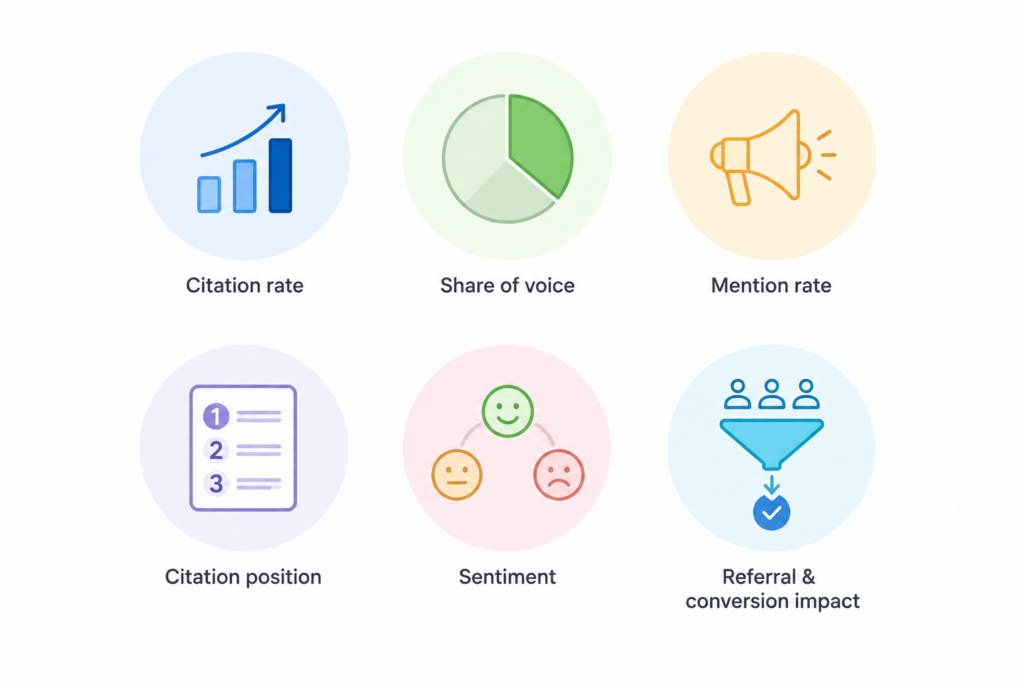
Don’t judge success by the number of prompts tracked. Track outcomes:
- Citation rate – how often your brand or content is cited across tracked prompts.
- Share of voice – your slice of the AI-answer landscape versus named competitors.
- Mention rate – how often your brand appears in AI-generated answers, cited or not.
- Citation position – where you land within the answer or source set.
- Sentiment – whether AI descriptions of your brand skew positive, neutral, or negative.
- Referral and conversion impact – whether AI visibility is translating into traffic, leads, or pipeline, where measurable.
Evaluate these together. A rising mention rate with flat citation rate, for example, usually points to a specific fixable gap, not a reason to switch your entire operating model.
The Bottom Line
- If you only need data, start with a tool.
- If you need expertise + execution, consider an agency.
- If you need long-term ownership, build internally.
- If you need all three which is most companies the strongest model is tool + internal team + specialized agency support.
The real question isn’t “agency or in-house?” that framing skips the step that makes either one worth paying for. It’s “do we need data, expertise, execution, or all three?” In 2026, AI visibility is less about picking a side in that debate and more about building a repeatable system for measuring, understanding, and improving how your brand appears in AI-generated answers.
FAQ
Is an AI visibility tool better than hiring an agency?
Not necessarily, and it’s not really a fair comparison: a tool provides measurement, an agency provides strategy and execution. Most companies need both: the tool to know if something’s wrong, the agency (or an internal team) to fix it.
Is it cheaper to use a tool instead of an agency?
The software itself usually costs less, but that’s not the full cost. You still need people with the time and expertise to act on what it shows you, or the data just sits there.
Should a small business hire an AI SEO agency?
Only if it lacks the internal time or expertise to act on visibility data. Otherwise, a tool paired with the existing team is usually more cost-effective at that stage.
Can I use a tool and an agency together?
Yes this is the hybrid model, and it’s increasingly the default recommendation: the tool measures continuously, the agency (or internal team) executes against what it finds.
How long does it take to see results from AI SEO / GEO work?
Expect early movement in citation rate and share of voice around the 60–90 day mark in most cases, not immediately AI systems need time to re-crawl and re-evaluate authority signals regardless of which model you choose.
Should AI visibility sit with SEO or marketing?
There’s no universal answer, but it needs a clear, named owner rather than sitting unclaimed between departments. That ownership gap is the most common reason visibility work stalls.
How do I know I’ve outgrown a DIY tool?
Common signals: data is piling up with no time to act on it, the same visibility gaps keep recurring, you lack specialized expertise, or you need a broader strategy spanning content, technical SEO, and third-party authority.
What should I ask an agency before hiring them?
What platforms they track, how they define a citation versus a mention, how they analyze competitors, what they actually change on your site, who executes the work, and how they connect AI visibility improvements to business outcomes, not just “visibility score.”
