Choose an AI visibility tool if you already have the expertise and resources to act on the data. Choose an agency if you need specialized expertise and execution. And if you need both measurement and implementation, a hybrid model can make more sense than choosing only one.
AI Visibility Agency vs Tool: Quick Comparison
| Factor | AI Visibility Agency | AI Visibility Tool |
|---|---|---|
| Primary purpose | Strategy + execution | Monitoring + intelligence |
| AI visibility tracking | Yes | Yes |
| Competitor monitoring | Yes | Yes |
| Citation tracking | Yes | Yes |
| Prompt research | Agency-led | Yes, depending on tool |
| Strategy | Agency-led | Internal |
| Content optimization | Agency-led | Recommendations vary |
| Technical implementation | Often included | Usually internal |
| Digital PR / authority building | May be included | Usually not |
| Expertise required internally | Lower | Higher |
| Implementation responsibility | Agency | Internal team |
| Control | Medium | High |
| Setup | Faster | Usually faster |
| Typical monthly cost | $2,000–$15,000+ retainer | $29–$500 for dedicated platforms; often $0 extra if bundled into an SEO suite you already own |
| Scalability | High | Depends on team |
| Best for | Companies needing expertise + execution | Teams with existing SEO/content expertise |
| Biggest limitation | Agency dependency, and reporting is often built on third-party tools the agency doesn’t own | Data without execution |
The distinction is important: a tool can tell you what is happening; an agency can help determine what to do about it.
What Is an AI Visibility Agency?
An AI visibility agency is a specialist service provider that helps brands improve their presence in AI-generated search results and answers.
The work can include:
- AI visibility audits
- Prompt research
- Competitor analysis
- Citation analysis
- Brand mention tracking
- Content optimization
- Entity optimization
- Technical SEO
- Digital PR
- Authority building
- Content strategy
- AI-search monitoring
- Reporting
- Ongoing experimentation
The exact service mix varies by agency.
The key difference from software is that an agency provides people, expertise, strategy, and execution.
Instead of giving your team a dashboard and asking them to interpret the results, the agency can potentially take responsibility for the process from identifying visibility gaps through implementing improvements.
One thing worth checking early: whether the agency measures its own results, or reports using a third-party tool it doesn’t own. Most agencies fall into the second category they assemble reporting from platforms they license rather than build. That’s not disqualifying, but it means the party grading its own work isn’t always using a neutral ruler. Ask which it is before you sign.
What Is an AI Visibility Tool?
An AI visibility tool is software that monitors how your brand appears across AI-powered search and answer platforms.
Depending on the platform, it can track:
- Brand mentions
- AI citations
- Citation sources
- Competitor mentions
- Share of voice
- Sentiment
- Prompt visibility
- AI platforms
- Visibility trends
- Cited domains
- Content opportunities
The market is increasingly divided between tools that focus mainly on monitoring and platforms that also provide optimization or action-oriented recommendations.
This distinction should be one of the first things you evaluate before buying a tool.
A platform that tells you “your brand appeared in 20% of answers” is fundamentally different from one that also helps your team understand why you are missing from the other 80%.
Before shopping for a new tool, check what you already own. If your team pays for Ahrefs, Semrush, or HubSpot, look at their current feature set first Ahrefs’ Brand Radar and Semrush’s AI Visibility Toolkit both now track AI-platform mentions and citations to some degree, and HubSpot includes lightweight AI-search tracking in its marketing hub. Coverage is usually narrower than a dedicated platform, fewer engines, shallower prompt volume, less citation detail but it’s a free or near-free way to get a first read before adding a new line item.
Once you’ve outgrown a bolt-on, the dedicated market roughly splits into three tiers:
| Tier | Typical range | What it’s for | Watch-out |
|---|---|---|---|
| Lightweight trackers | Under $100/mo | Small teams testing the category, a handful of prompts/engines | Limited strategic guidance, fewer platforms covered |
| Mid-market platforms | ~$100–$500/mo | Marketing teams wanting daily tracking, competitor benchmarking, citation detail | Still requires an operator to act on findings |
| Enterprise platforms | Custom pricing | Large brands with internal execution teams already running | Instruments an existing content engine rather than creating one |
Agency vs Tool: The Biggest Difference
The easiest way to understand the difference is to look at the AI visibility workflow.
Step 1: Measure
Where does my brand appear?
A tool is particularly useful here.
Step 2: Diagnose
Why is my competitor appearing instead of me?
This requires data interpretation and expertise.
Step 3: Strategize
What should we change?
This requires strategic judgment.
Step 4: Execute
Who is going to make those changes?
This requires people and resources.
Step 5: Measure again
Did visibility improve?
A tool becomes useful again.
So the complete workflow is:
Measure → Diagnose → Strategize → Execute → Measure
A tool can be excellent at the measurement layer.
An agency can potentially cover most or all of the workflow.
It helps to think about why Step 1 and Steps 2–4 are genuinely different kinds of work, not just different vendors. Getting cited by an AI system is really a four-stage path: your content has to be discovered (crawlable, indexed), extracted cleanly enough to summarize, backed by enough trust signals (third-party corroboration, entity clarity) to be treated as credible, and then actually selected over competing sources.
A tool sits at the end of that path and reports the outcome cited or not, how often. It doesn’t make your content more extractable or your brand more trusted; that work happens upstream, in Steps 2–4, which is exactly the work a tool doesn’t do and an agency (or an internal team) does. This is the most common reason a company buys a tool, watches the number sit flat for three months, and concludes “AI visibility doesn’t work for us” when what actually happened is they measured a problem without assigning anyone to fix it.
AI Visibility Agency vs Tool: Feature Comparison
| Capability | Agency | Tool |
|---|---|---|
| Track AI mentions | ✓ | ✓ |
| Track citations | ✓ | ✓ |
| Monitor competitors | ✓ | ✓ |
| Track prompts | ✓ | ✓ |
| Measure share of voice | ✓ | ✓ |
| Analyze citation sources | ✓ | ✓ |
| Interpret results | ✓ | Depends |
| Build strategy | ✓ | Limited |
| Content recommendations | Depends | Depends |
| Content implementation | ✓ | Usually no |
| Technical implementation | Depends | Usually no |
| Digital PR | Depends | No |
| Ongoing optimization | ✓ | Depends |
| Custom consulting | ✓ | No |
| Connects visibility to revenue/traffic (e.g. GA4) | Depends | Depends — a real differentiator between tools, not a given |
| Internal ownership | Lower | Higher |
The word “depends” is important.
Not every agency provides the same services, and not every tool provides the same capabilities. Current 2026 tool comparisons show significant differences in platform coverage, reporting, optimization functionality, and agency workflows.
When Should You Choose an AI Visibility Tool?
An AI visibility tool is generally the better starting point when your company already has an experienced SEO, content, marketing, or growth team.
You Already Have the Expertise
If your team understands:
- SEO
- Content strategy
- Search intent
- Technical SEO
- Digital PR
- Competitor analysis
- Analytics
you may not need an external agency to interpret every visibility report.
The tool can become your AI search intelligence layer.
You Want Direct Control
With a tool-led model, your team owns:
- Data
- Strategy
- Content
- Implementation
- Reporting
- Experimentation
That can be valuable if AI visibility is closely connected to your brand and product strategy.
You Need Continuous Monitoring
Instead of waiting for a monthly agency report, your team can monitor visibility continuously.
For example:
Track prompts → identify gaps → update content → monitor citations → compare competitors → repeat.
This makes AI visibility part of the ongoing marketing workflow.
You Have the Resources to Execute
This is the most important condition.
If your tool identifies a major citation gap tomorrow, do you have someone who can fix it?
If yes, a tool can be extremely useful.
If not, the tool may simply show you problems that remain unsolved.
RadarKit as an AI Visibility Tool Option
For companies that want to manage AI visibility in-house, RadarKit can be positioned as the measurement and intelligence layer.
It is particularly relevant to a tool-led workflow where a team wants to monitor AI visibility, analyze citations and competitors, and use those insights to guide its own optimization work.
Rather than pulling data from API responses, RadarKit runs real browser-based prompts against ChatGPT, Gemini, Perplexity, Copilot, and Google AI Overviews/AI Mode, so what you see is closer to what an actual user sees including citations, cited URLs, and competitor share of voice, with tracking across 50+ locations. It also connects to GA4, which directly addresses the “data without execution” limitation flagged throughout this article: you can see whether a visibility change actually moved traffic, not just whether a score moved. Entry pricing sits around $29/month, in line with the lightweight-tracker tier above.
The important point is that RadarKit doesn’t need to replace your SEO or content team.
Instead, it can give that team the visibility data required to make better decisions.
That makes a tool such as RadarKit particularly relevant for:
- In-house SEO teams
- Content teams
- B2B SaaS marketing teams
- Growth teams
- Brands already running SEO programs
- Companies that want to monitor competitors
The underlying principle is simple:
Use the tool to understand what AI search is saying about your brand, then use your existing team to act on those findings.
When Should You Hire an AI Visibility Agency?
An agency becomes more attractive when the problem isn’t a lack of data.
It’s a lack of expertise, strategy, or execution capacity.
You Don’t Have Specialized AI-Search Expertise
Your SEO team may be strong but still lack experience with:
- AI citation behavior
- Prompt-level visibility
- Generative search
- Entity optimization
- AI-answer source analysis
- AI-specific competitive research
An agency can provide specialized knowledge without requiring you to build the capability from scratch.
You Have the Data but Don’t Know What to Do With It
This is one of the clearest signs that a tool alone isn’t enough.
Imagine your dashboard shows:
Competitor A: 42% citation rate
Your brand: 14% citation rate
The number tells you there is a problem.
It doesn’t necessarily tell you:
- Why Competitor A is winning
- Which sources influence the answers
- Which content gaps matter
- Which pages should be improved
- Whether your entity signals are weak
- Whether you need third-party authority
- What should be prioritized first
That’s where expertise becomes valuable.
Your Team Doesn’t Have Enough Time
Even when a team understands AI visibility, it may not have enough time to execute the work.
A tool doesn’t write your content strategy, coordinate subject-matter experts, optimize dozens of pages, conduct digital PR, or manage implementation.
An agency can take some or all of that workload off the internal team.
You Need to Move Quickly
Building a new internal AI visibility function requires:
- Hiring
- Training
- Tool selection
- Process development
- Reporting
- Testing
- Management
An established agency may already have these systems in place.
RankingBite as an AI Visibility Agency Option
For companies that need specialist support rather than simply another dashboard, RankingBite is an agency option to consider.
RankingBite focuses on AI search visibility and helps brands work toward being understood, mentioned, and cited across AI platforms, combining Generative Engine Optimization (GEO) with programmatic SEO for scaling content and white-hat link building for authority. That combination matters because citation work rarely succeeds in isolation. An AI system is more likely to cite a page that also has the technical foundation and third-party authority behind it, which maps directly to the discovery/extraction/trust chain described earlier in this article.
That makes it relevant for companies that need support beyond monitoring and want specialist help with AI-search strategy, content, and optimization.
The distinction between the two models can therefore be summarized as:
RadarKit → visibility measurement and intelligence
RankingBite → specialist strategy and execution
For companies that don’t have the internal capacity to turn visibility data into an optimization program, the agency model can provide a more complete solution.
As with RadarKit, RankingBite is one option among several worth shortlisting evaluate it, and any agency, against the criteria in the sections below rather than the name alone.
Agency vs Tool:
Cost Comparison
Cost is one of the first questions companies ask.
But comparing an agency retainer with a software subscription isn’t an apples-to-apples comparison.
Tool Cost
The direct cost is usually:
Software subscription + internal team cost
But you also need to consider:
- Training
- Analysis
- Content implementation
- Technical work
- Management time
- Reporting
Agency Cost
The direct cost is usually:
Agency fee + internal management
But some execution that would otherwise require internal resources may be included.
Cost by company stage
| Company stage | Tool-only | Tool + lean internal effort | Agency retainer | Full in-house (for reference) |
|---|---|---|---|---|
| Small business / startup | $29–$100/mo | +5–10 hrs/week of existing staff time | $2,000–$4,000/mo | Rarely justified yet |
| Mid-market | $100–$500/mo | +0.5 FTE | $4,000–$10,000/mo | $8,000–$15,000/mo loaded (1 role) |
| Enterprise | $500–$2,000+/mo, custom tiers | +1+ FTE coordinating | $10,000–$25,000+/mo, multi-market | $25,000+/mo loaded (full team) |
“`
The real calculation
Use:
Total cost = Software + People + Management + Execution + Opportunity Cost
A $100/month tool isn’t necessarily cheaper if your team spends 30 hours every month trying to interpret and implement the data.
Likewise, an expensive agency isn’t necessarily better if your existing team already has the expertise and only needs measurement.
Which Is Faster?
It depends on what you mean by “faster.”
A tool can usually be set up quickly.
But:
Fast setup ≠ fast results.
A tool can begin collecting data quickly, but your team still needs to interpret and act on that information.
An agency may take longer to onboard but can potentially move faster on strategy and implementation because the expertise already exists.
Think about four separate timelines:
- Time to measurement
- Time to diagnosis
- Time to implementation
- Time to measurable improvement
A tool can win the first.
An agency may have an advantage in the second and third.
Roughly, expect early citation movement to become measurable around the 60–90 day mark regardless of model AI systems need time to re-crawl and reassess authority signals, so a tool showing instant change, or an agency promising it, should be treated with some skepticism.
Which Gives You More Control?
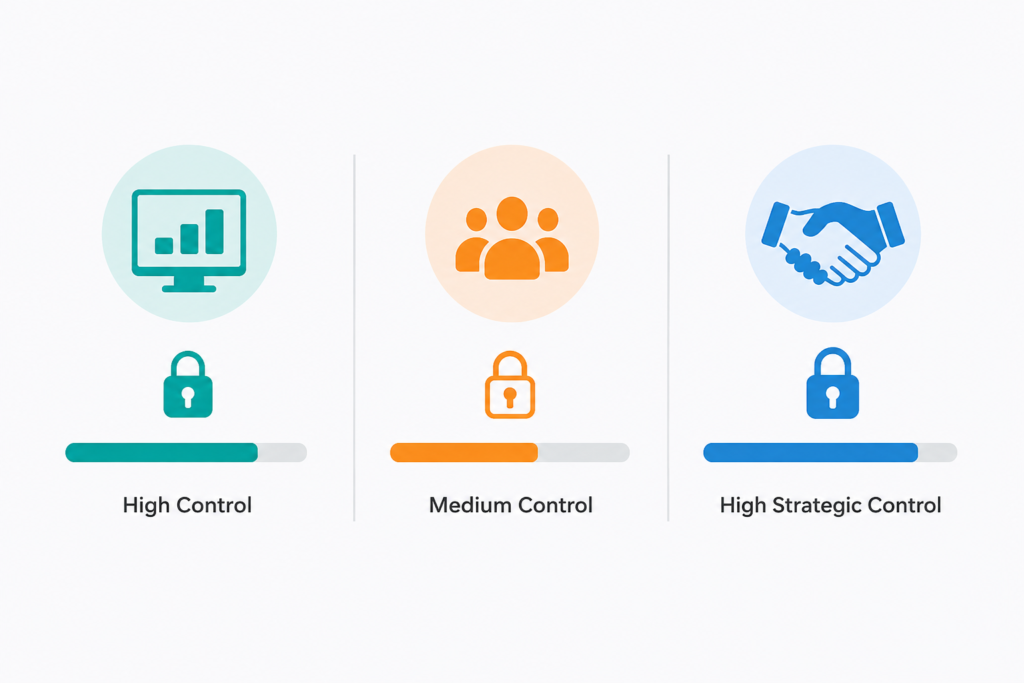
Tool
High control
Your team owns the data, strategy, and implementation.
Agency
Medium control
You retain strategic oversight but outsource some responsibility.
Tool + Agency
High strategic control with external execution
This hybrid approach can give you access to specialized expertise without giving up complete ownership.
The tradeoff is straightforward:
More control usually means more internal responsibility.
Agency vs Tool for Different Types of Businesses
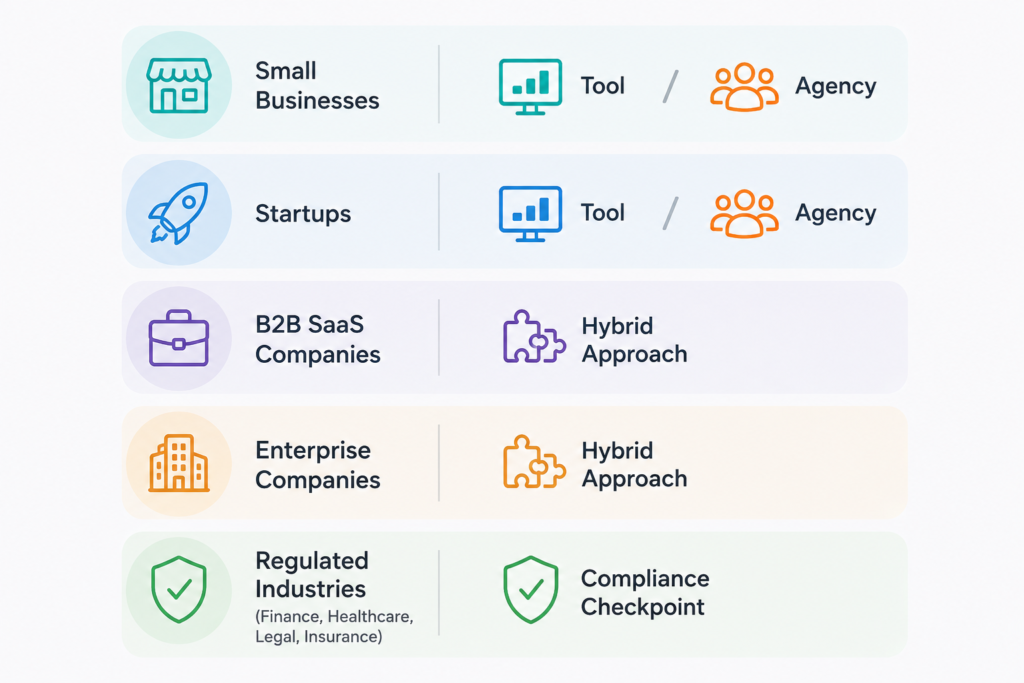
Small Businesses
A tool may make sense if an existing marketing person can manage it check what’s already bundled into an SEO suite you pay for before buying something new.
If there is no AI-search expertise, an agency may be more practical.
Startups
Startups often need to balance speed and budget.
A tool can provide an affordable way to establish a baseline, while an agency can be useful when AI search is a critical acquisition channel.
B2B SaaS Companies
B2B SaaS companies often benefit from a hybrid approach because AI visibility can span:
- Product comparisons
- Category searches
- Problem-based queries
- “Best software” searches
- Competitor comparisons
- Educational queries
The larger the content and competitive landscape, the more valuable specialized analysis can become.
Enterprise Companies
Enterprise brands often have the internal resources to operate a tool but may still use specialist agencies for strategy, experimentation, or execution.
A hybrid model can therefore be particularly effective.
Regulated Industries (Finance, Healthcare, Legal, Insurance)
Worth calling out on its own: the tool-vs-agency decision here has an added constraint. Whichever model you choose, compliance review needs to sit explicitly inside the workflow a tool that flags a content opportunity or an agency that drafts a page isn’t the same as content that’s cleared to publish. Build that checkpoint in rather than assuming it happens by default.
Agency vs Tool vs Hybrid: Which Model Should You Choose?
| Situation | Recommended Model |
|---|---|
| You only need visibility monitoring | Tool |
| You have an experienced SEO team | Tool + In-House |
| You have data but lack expertise | Agency |
| You have expertise but no execution capacity | Agency or Hybrid |
| You want maximum internal control | Tool + In-House |
| AI visibility is a strategic growth channel | Hybrid or In-House |
| You need fast specialized support | Agency |
| You manage many products/markets | Hybrid |
| You are testing AI visibility for the first time | Tool |
| You operate in a regulated industry | Agency or Hybrid, with compliance review built in |
| You want measurement + strategy + execution | Hybrid |
Frequently Asked Questions
Is an AI visibility tool better than an agency?
Not necessarily. They solve different parts of the problem. A tool primarily provides monitoring and intelligence, while an agency can provide strategy, expertise, and execution.
Can an AI visibility tool replace an agency?
For some experienced teams, yes. If your company already has the expertise and resources to analyze and act on AI visibility data, a tool may be enough. If you don’t have those resources, the tool cannot replace the human expertise required for implementation.
Is an AI visibility agency worth the cost?
It can be if your company lacks the expertise or capacity to execute AI-search optimization internally. The right comparison is not agency cost versus software cost; it’s the total cost of achieving the required capability.
Can I use an AI visibility tool and agency together?
Yes. A hybrid model can use the tool for continuous measurement and the agency for strategy and execution.
What does an AI visibility tool track?
Depending on the platform, it can track brand mentions, citations, competitors, prompts, share of voice, sentiment, cited sources, and visibility across multiple AI platforms.
Do I need a dedicated AI visibility tool, or does my existing SEO suite already cover this?
Check first. Ahrefs, Semrush, and HubSpot have all added AI-search tracking features to their existing platforms. Coverage is usually narrower than a dedicated tool, but it’s a free way to get an initial read before buying something new.
How long does AI visibility optimization take?
There is no fixed timeline. Measurement can begin quickly, but meaningful improvements depend on the changes made, the competitiveness of the market, content quality, authority, and how quickly AI systems reassess the information. Most programs start showing measurable movement around 60–90 days in.
What is the biggest advantage of an AI visibility agency?
The main advantage is access to specialized expertise and execution without having to build the entire capability internally.
What is the biggest advantage of an AI visibility tool?
The main advantage is continuous visibility into what AI platforms are saying about your brand and competitors, allowing an internal team to monitor changes and make data-driven decisions.
Does operating in a regulated industry change this decision?
Yes, in one specific way: content can’t publish the moment a gap is flagged — it needs compliance review first. Whichever model you choose, make sure that review step is explicitly built into the workflow rather than assumed.
Should I start with an agency or tool?
If you already have an experienced SEO/content team, start by evaluating a tool. If you don’t have the expertise or capacity to act on the data, an agency is likely the better starting point. If you need both, consider a hybrid approach.
