How to Create Content LLMs Cite as Source in 2026
To structure content for citation, make each important passage directly relevant, specific, self-contained, clearly identified, and supported by attributable evidence. Organize the page with…
To structure content for citation, make each important passage directly relevant, specific, self-contained, clearly identified, and supported by attributable evidence. Organize the page with descriptive headings, answer-first sections, and clearly separated ideas so an LLM can identify and use the relevant information without reconstructing its meaning from surrounding text.
Ranking in search results or being indexed does not automatically make content a source for LLM-generated answers. LLMs need to retrieve information that directly matches a query, understand what the passage means, and connect the information to a clear source.
This makes content citation-ready: information that can be retrieved, understood, and accurately attributed when an LLM generates an answer.
How LLMs Select Content for Citations
Before understanding what makes content citation-worthy, it helps to understand how information moves from a user’s query to a cited source. LLMs generally need to identify relevant information first, then determine which retrieved content can support the answer being generated.

LLMs Retrieve Relevant Information
LLM-based search systems begin by interpreting the user’s query and retrieving information that appears relevant to the question or task.
Query interpretation and retrieval
The system interprets the meaning and intent of a query rather than relying only on exact keyword matches. It then retrieves potentially useful content from available sources.
Matching queries with relevant passages
Retrieved content is assessed at the information or passage level. A section that directly addresses the question can be more useful than a page that broadly discusses the same topic but requires additional interpretation to find the answer.
Retrieved Content Becomes a Citation
Retrieval alone does not mean that a source will appear in the final response. The retrieved information must also provide usable support for the answer the LLM is generating.
From retrieved passage to generated answer
The LLM uses relevant retrieved information to formulate its response. Passages that clearly contain information needed to answer the query provide a more direct basis for generation.
Why some retrieved sources are actually cited
A source may be retrieved without being cited. Citation depends on whether the retrieved content provides useful, sufficiently clear support for a particular statement in the generated answer and can be attributed to a recognizable source.
Ranking Does Not Guarantee Citation
Search visibility and LLM citation are related but distinct. A page can rank well for a query while the LLM uses a different source because that source contains a passage that more directly supports the answer.
Search visibility vs. LLM retrieval
Traditional search ranking determines where a page appears in search results. LLM retrieval focuses on finding information that can contribute to an answer.
Page-level ranking vs. passage-level usefulness
Search engines commonly evaluate and rank pages for queries, while LLM retrieval can depend on the usefulness of specific passages. A highly visible page may therefore contain less citation-ready information than a less prominent page with a clearer, more relevant passage.
How to Structure Content for LLM Extraction
Once a passage contains relevant and self-contained information, the surrounding page structure determines how easily that information can be identified and extracted. A clear hierarchy helps separate questions, answers, supporting details, and distinct ideas into usable content blocks.
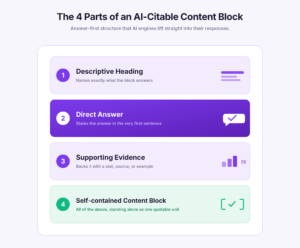
Turn Questions Into Descriptive Headings
Use headings that clearly describe the question or topic addressed in the section. A descriptive heading gives both readers and retrieval systems a clear indication of what the following content covers.
Put the Answer Before the Explanation
State the direct answer at the beginning of the section, then provide the explanation or supporting detail. This keeps the primary information easy to identify without requiring the reader or LLM to reconstruct it from a longer discussion.
Follow a Question → Answer → Evidence Flow
Organize sections around a simple progression: identify the question, provide the answer, and then explain or support it. This creates a predictable relationship between the information being requested and the material that follows.
Separate Distinct Ideas Into Individual Blocks
Keep different claims, concepts, or questions in separate paragraphs or sections. Avoid placing several unrelated ideas into one passage, as this can make it harder to determine which information belongs to which topic.
Use Lists and Tables for Structured Information
Use lists for clearly defined items, steps, or characteristics and tables when multiple entities or attributes need direct comparison. Structured formats can make relationships between pieces of information easier to identify and extract.
Focus: The architecture of the page and its content blocks how information is organized for extraction, rather than whether the information is relevant or properly sourced.
Clear Attribution for LLM-Citable Content
Clear attribution helps LLMs identify a claim’s source and context. Link important claims to specific, identifiable sources so their origin is easy to verify.
Place Sources Close to the Claims They Support
Put the relevant source near the statistic, finding, or factual statement it supports. This creates a clear connection between the claim and its origin instead of making the source difficult to associate with a specific passage.
Give Statistics Their Date and Context
A number without a timeframe or population can easily become misleading. Include the publication date, measurement period, sample, market, or other relevant context when it affects how the statistic should be interpreted.
Distinguish Original Findings From Reported Information
Make it clear whether your organization produced the data or whether the information comes from another source. This distinction helps establish what the page is directly reporting versus what it has independently observed or researched.
Identify the Source Behind Specific Claims
Name the organization, study, report, dataset, or other identifiable source behind significant claims. Generic references such as “research shows” provide less useful attribution than a clearly identified source.
Focus: Making the origin and context of information explicit within the content. This section is about attribution, not evaluating how strong the underlying evidence is.
How to Build Strong Evidence for LLM Citations
Attribution tells an LLM where a claim came from; evidence determines what supports that claim. Important information should therefore be backed by sources or research that can substantiate the specific statement being made.
Prioritize Primary and First-Party Sources
Use original research, official datasets, company documentation, regulatory records, research papers, or other sources closest to the underlying information when available. These sources can provide direct evidence rather than another party’s interpretation.
Add Original Data and Research
When possible, contribute proprietary data, experiments, surveys, case findings, or analysis. Original evidence gives a page information that is directly tied to the publisher rather than simply repeating information already available elsewhere.
Support Important Claims With Evidence
The more consequential or specific a claim is, the more important it is to provide evidence that directly supports it. Avoid using a source merely because it discusses the same general topic.
Corroborate High-Impact Claims
For claims where accuracy has significant implications, compare relevant independent sources or evidence. Corroboration can help distinguish a well-supported conclusion from an isolated or potentially incomplete finding.
Focus: The strength and directness of evidence supporting claims, rather than where citations are placed or how sources are identified.
Content Structures That Weaken Citation Potential
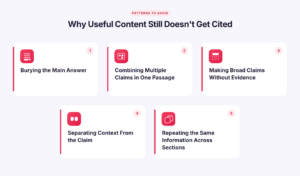
Useful information can still be difficult for an LLM to extract when its structure obscures the main point or mixes information that belongs to different contexts. The following patterns make individual claims harder to identify, interpret, or connect with their supporting context.
Burying the Main Answer
When the direct answer appears only after several paragraphs of background, the relevant information becomes harder to identify quickly. Lead with the main point and use the surrounding content to explain it.
Combining Multiple Claims in One Passage
A single passage containing several unrelated claims can make it unclear which statement is being supported or retrieved. Keep closely related information together while separating distinct claims.
Making Broad Claims Without Evidence
General statements provide little usable information when they lack specific facts, examples, data, or supporting sources. Claims should contain enough substance to establish what is actually being stated.
Separating Context From the Claim
A claim can lose meaning when the information needed to interpret it appears far away or in another section. Keep essential context close enough that the statement remains understandable on its own.
Repeating the Same Information Across Sections
Repeated explanations can blur the distinction between sections and create multiple versions of the same claim. Each section should contribute a distinct piece of information rather than restating an earlier point.
Focus: Structural patterns that make otherwise useful information harder to extract or interpret. It does not introduce new citation or evidence strategies.
RankingBite for LLM Citation Readiness
RankingBite analyzes how your content appears across AI search systems to identify where key information is missing, unclear, or difficult to attribute. It can also uncover citation gaps and show where competitors or third-party sources are being referenced instead.
These insights can be translated into clearer content structures, including answer-first sections, descriptive headings, self-contained passages, and evidence-supported claims. This makes important information easier for AI systems to retrieve and understand.
Ongoing monitoring helps track changes in AI visibility and identify content that is being surfaced, cited, or overlooked. The goal is to make valuable information easier for AI systems to retrieve, understand, and cite when relevant.
How to Audit Content for LLM Citability
An audit should test whether the finished page presents information clearly enough to be retrieved, understood, and attributed. Review the actual sections and passages rather than adding new optimization techniques during the audit.
Check Query-to-Section Alignment
Review whether each important section addresses a defined question or topic and whether its content stays relevant to that subject.
Check Passage Completeness
Read important passages independently. Confirm that they contain enough information to understand the main point.
Frequently Asked Questions
Does content length affect LLM citations?
Not directly. A longer article is not automatically more citable if its key information is unclear or difficult to extract.
Do LLMs prefer newer content?
Freshness matters more for topics that change frequently, such as statistics, products, and regulations. For stable topics, relevance and accuracy remain important.
Should every section be optimized for LLM citations?
No. Prioritize sections that answer relevant questions or contain information your audience is likely to seek.
Can LLMs cite original analysis?
Yes. Original analysis can be cited when it provides useful information and is clearly presented as analysis rather than established fact.
Does updating an article improve citation potential?
It can, when the update adds current information, corrects outdated claims, or improves accuracy. Simply changing the publication date is not enough.

kashish
Passionate about SEO, AI search, and content marketing, sharing practical insights on search trends, AI visibility, and digital growth.