Healthcare companies are using AEO to make medical content easier for AI systems to extract as direct answers and GEO to improve their chances of being mentioned and cited in AI-generated responses. Together, AEO and GEO extend traditional healthcare SEO beyond Google rankings to platforms such as ChatGPT, Perplexity, Gemini, and Google AI Overviews.
For nearly two decades, healthcare marketing has revolved around ranking on Google getting a hospital’s condition page, a specialist’s bio, or a pharma brand’s disease-awareness content into the top results for relevant searches. That model is changing as patients increasingly ask AI tools direct questions about symptoms, treatments, medications, and healthcare providers, sometimes getting the information they need without clicking through to a website.
This shift is pushing healthcare organizations to build capabilities across three layers: SEO for search visibility, AEO for answer visibility, and GEO for AI visibility and citations. AEO and GEO do not replace SEO; they build on the technical foundation, authoritative content, and trust signals that healthcare websites already need.
Why Healthcare Is a Special Case
Several forces converge to make this shift more consequential for healthcare than for almost any other industry.
Scale of the shift. Data from Conductor’s 2026 healthcare benchmarks shows that 48.7% of healthcare-related page-one Google queries now trigger an AI Overview meaning nearly half of all healthcare searches are already being intercepted by an AI-generated summary before a user sees a single ranked link.
Collapsing organic traffic. In pharma specifically, traditional search volume is estimated to have fallen by around 25% by 2026, with organic click-through traffic dropping even faster, since AI Overviews and chat interfaces increasingly answer the question in place rather than sending the user onward.
Longer, more natural queries. AI search queries run to an average of roughly 23 words, compared to about 4 words for a typical Google search. Patients aren’t typing “diabetes symptoms” they’re asking something like “what are the early warning signs of type 2 diabetes and when should I actually see a doctor.” That’s a fundamentally different content target than most SEO-era pages were written for.
Heightened scrutiny (YMYL). Health content falls under Google’s “Your Money or Your Life” classification, meaning both traditional search algorithms and generative AI systems apply extra scrutiny before trusting a source enough to rank or cite it. A wellness blog with thin content simply doesn’t clear that bar, no matter how well its schema is implemented.
Put together, these forces mean healthcare organizations that ignore AI search risk becoming invisible at exactly the moment patients are searching for care.
AEO, GEO, and SEO: How the Three Fit Together
The terminology gets used loosely, but the three disciplines answer three different questions:
| Discipline | Question it answers | What “winning” looks like |
|---|---|---|
| SEO | Does this page rank? | Appearing in the top organic results |
| AEO | Does this content become the answer? | Being pulled into a featured snippet, voice answer, or AI Overview extract |
| GEO | Does the AI trust and cite this brand? | Being named or linked as a source inside a ChatGPT, Perplexity, or Gemini response |
They’re sequential in a loose sense a page usually still needs to be well-optimized and reasonably authoritative (SEO) before it has a shot at being extracted as a direct answer (AEO), and a brand generally needs to demonstrate consistent authority across many pages and external sources (GEO) before an AI model will cite it by name rather than just paraphrase generic information. Agencies increasingly pitch all three as one integrated program rather than separate line items.
The Core Tactics Healthcare Organizations Are Using
1. Medical schema and structured data
This is the most widely adopted, most technical lever. Organizations are implementing schema types like MedicalWebPage, MedicalCondition, Physician, and Hospital/MedicalClinic to give AI systems machine-readable signals about specialties, symptoms, treatments, and credentials.
Two properties matter disproportionately: lastReviewed and reviewedBy. Together they signal that a piece of content underwent real clinical editorial review directly reinforcing the E-E-A-T (Experience, Expertise, Authoritativeness, Trustworthiness) signals that both Google’s algorithm and generative AI systems weigh heavily for medical content.
There’s an implementation trap worth flagging explicitly: most AI crawlers don’t execute JavaScript at runtime. Schema injected client-side through a tag manager is often invisible to the systems deciding what to cite; it needs to live in the raw server-rendered HTML. Teams that assume their existing tag-manager schema “counts” for AI visibility are often wrong.
And schema is additive, not sufficient on its own. A page with immaculate Physician schema wrapped around dense, unbroken clinical prose will still lose out to a competitor with lighter schema but content that’s actually structured for extraction short, self-contained, definition-first sections.
2. Rewriting content around real patient questions
Rather than optimizing for keywords, healthcare content teams are rewriting condition and treatment pages around the literal phrasing patients use when they prompt an AI “how do I know if my child’s fever needs an ER visit,” not “pediatric fever symptoms.” This sometimes gets called prompt optimization: anticipating the exact question format an AI user would type and answering it so directly and completely that the model has little reason to look elsewhere.
3. Building entity authority across the wider web
GEO rewards consistency and repetition across sources, not just quality on one page. A hospital system’s own website matters, but so does whether its physicians, specialties, and locations are described consistently across directories, insurer listings, review platforms, and medical association pages. Linking Physician, MedicalCondition, and MedicalBusiness schema together builds a web of entity relationships that lets an AI model confidently connect a specific doctor to a specific condition to a specific location which is exactly the kind of confident, specific answer generative search is designed to produce.
4. Site-level AI discovery files
A newer and still-emerging tactic is publishing site-wide signals aimed specifically at AI crawlers and agents files like llms.txt and llms-full.txt, plus emerging Model Context Protocol integrations. These operate above individual page schema, functioning as a discovery layer that helps an AI system understand and trust an entire domain rather than evaluating pages one at a time.
5. Pharma’s unbranded workaround
Pharmaceutical marketing operates under the tightest constraints of any healthcare vertical. FDA promotional review, medical-legal-regulatory (MLR) sign-off, and YMYL trust thresholds combine into what’s sometimes called a three-layer compliance gauntlet, one that makes direct promotional GEO optimization for a branded drug genuinely risky.
The practical workaround is investing in unbranded disease-awareness content instead of well-built educational material about a condition that doesn’t promote a specific product but establishes deep topical authority. A branded medication can still surface in an AI-generated answer, but typically as a downstream effect of that authority rather than the direct target of the optimization effort.
6. Monitoring AI visibility on an ongoing basis
Because the same query can return different citations from the same AI tool on different days, manual spot-checking gives an incomplete picture. Healthcare marketing teams are increasingly standing up dedicated monitoring either building simple tracking spreadsheets of recurring test queries, or adopting purpose-built GEO analytics platforms that track brand mentions and citations across ChatGPT, Perplexity, Gemini, Claude, and Copilot at once.
The metrics that matter go well beyond “were we mentioned or not”:
- Citation rate -the share of tracked queries where the brand is cited at all
- Citation position – being the first source named carries more weight than being buried fifth
- Citation sentiment – an unqualified recommendation reads very differently to a patient than a hedged mention
- AI-referred traffic – sessions arriving from AI tools with browsing capability, and how those visitors convert relative to traditional search traffic
For a regulated industry, this monitoring does double duty: it’s a marketing performance dashboard, but it also functions as an early-warning system, letting a compliance team catch an AI misrepresenting a condition or a product before the error compounds.
Content Formats That Perform Better in AI Answers
Not every format extracts equally well. Across implementations, a few patterns show up repeatedly as more citation-friendly:
- Definition-first openers – a direct two-to-three sentence answer before any further elaboration, so the model doesn’t have to infer the core answer from surrounding context
- Comparison tables – drug-vs-drug or treatment-vs-treatment tables are easy for AI systems to lift cleanly
- Symptom and condition checklists – short, bulleted, self-contained lists rather than narrative paragraphs
- Original data – a brand’s own study results or patient-survey statistics tend to get cited more often than a restated version of someone else’s already-published number
- Clinician Q&A transcripts – content phrased in the natural question-and-answer format patients actually use when prompting an AI
Platform Differences Worth Knowing
Optimizing for one AI platform doesn’t guarantee visibility on the others, since each seems to weight signals somewhat differently:
| Platform | Tends to favor |
|---|---|
| Google AI Overviews | Pages that already rank well organically and carry rich schema |
| ChatGPT | Strong entity clarity and sites structured for easy browsing/citation |
| Perplexity | Recency and clearly sourced, original claims |
| Claude / Gemini | Long-form content that’s cleanly structured over thin, sparse pages |
A common mistake is treating “AI Overviews visibility” as a proxy for AI visibility; generally teams that only check Google’s AI Overviews often have no idea how (or whether) they’re showing up in ChatGPT or Perplexity answers.
Sector-by-Sector Breakdown
Healthcare organizations face different AI search challenges depending on their role in the ecosystem. Their GEO strategies therefore vary across hospitals, practices, pharma companies, and digital health brands.
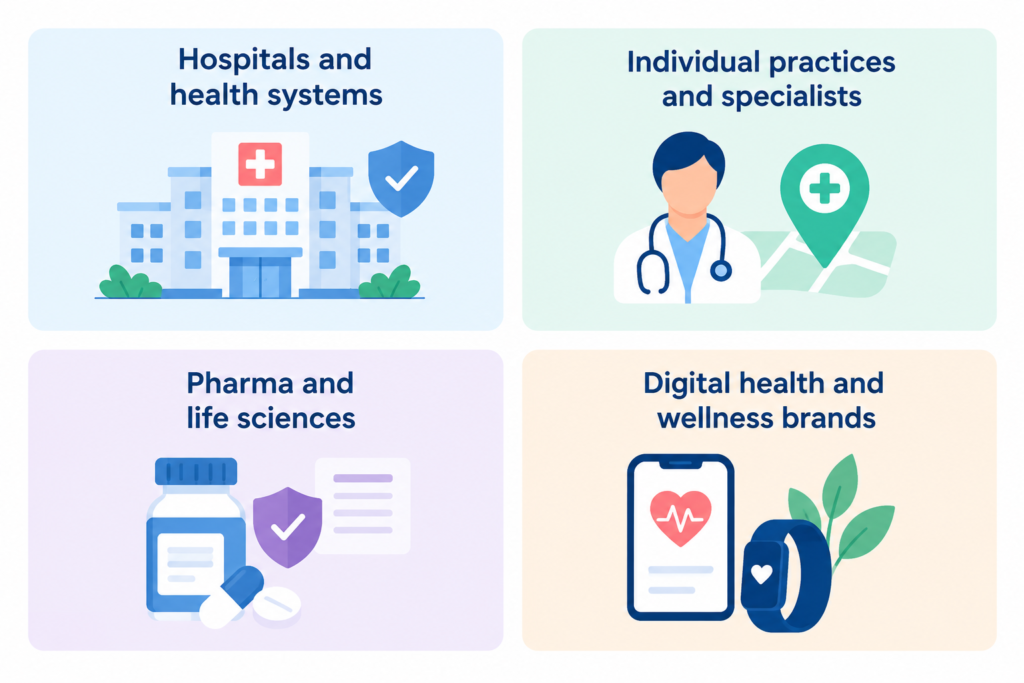
Hospitals and health systems concentrate effort on schema and E-E-A-T signals across condition, department, and physician-bio pages, the goal being inclusion in AI-generated care recommendations.
Individual practices and specialists focus heavily on “near me” and specialist-search queries, prioritizing consistent NPI-linked data (name, specialty, location, hours, insurance accepted) across every online listing.
Pharma and life sciences run compliance-first GEO programs built around unbranded educational content, paired increasingly with AI-based compliance monitoring; some teams describe this as using “AI to watch AI,” since the FDA’s own enforcement arm is now using AI tools to surveil digital promotional content.
Digital health and wellness brands move the fastest and most aggressively, often treating GEO as a growth-marketing channel with dedicated analytics rather than primarily a compliance concern.
RankingBite’s Approach to Healthcare AEO & GEO
RankingBite helps healthcare companies improve their visibility across AI search through a combination of AEO, GEO, content optimization, entity optimization, and AI visibility monitoring. The approach focuses on understanding the healthcare queries patients are asking, optimizing content to provide clear and direct answers, strengthening healthcare entity and trust signals, and identifying where competitors are being mentioned or cited.
RankingBite also tracks AI visibility across platforms such as ChatGPT, Perplexity, Gemini, and Google AI features, helping healthcare brands monitor metrics such as AI mentions, citation rates, citation sources, and competitor gaps. This gives healthcare marketing teams a clearer view of where their brand is visible and where further AEO and GEO improvements are needed.
Who Owns This Work Internally
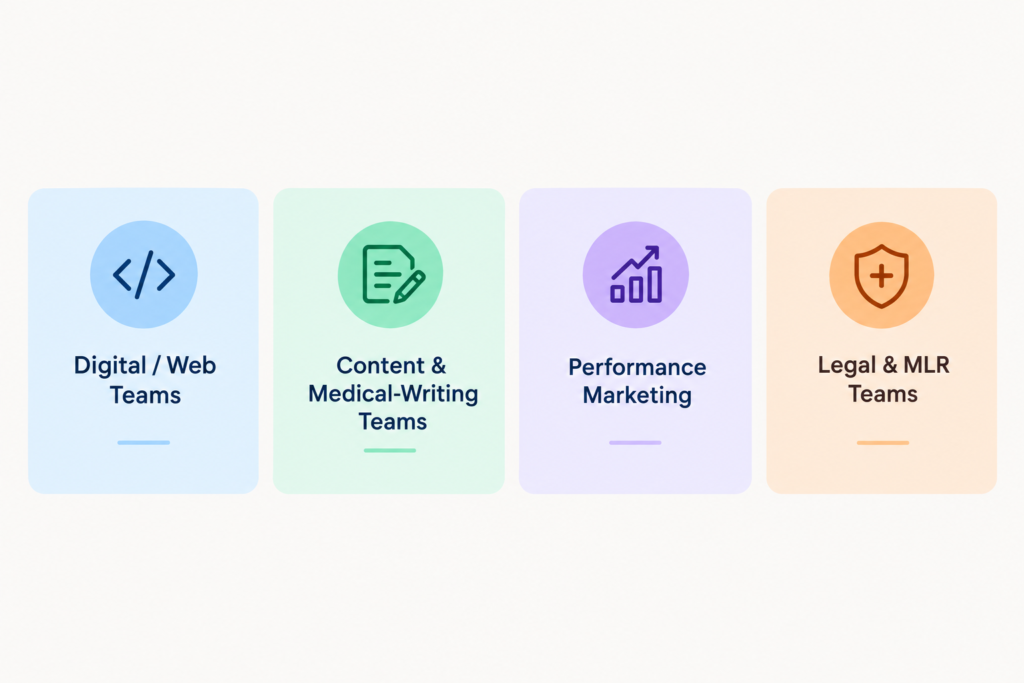
GEO sits at an intersection that doesn’t map cleanly onto any single existing team:
- Digital/web teams typically own schema implementation and llms.txt work
- Content and medical-writing teams own the Q&A rewrites, usually still requiring clinical sign-off before publishing
- Performance marketing is increasingly taking ownership of citation monitoring and AI-referred traffic analysis
- Legal and MLR teams, especially in pharma, need to be embedded at the content-creation stage rather than reviewing after the fact, since GEO content has to clear the same promotional-review bar as any other published asset
Risks That Are Still Unresolved
- Hallucination and off-label risk – an AI system can generate inaccurate or effectively off-label framing of a product, creating regulatory exposure even though no marketer wrote that specific wording
- Opacity in review – black-box AI outputs are difficult for a compliance team to document as having gone through a defensible review process
- Regulatory lag – most existing FDA and FTC guidance was written for product development or general advertising, not for AI-mediated marketing specifically, leaving real gray areas
- Data privacy exposure – any AI tooling that touches HCP or patient data carries HIPAA and GDPR risk if anonymization isn’t airtight
- Consistency drift – content that gets frequently reworked to chase AI visibility is harder to keep uniform in tone and legal accuracy than a single, once-approved static asset
The position most serious healthcare marketing organizations have settled on: AI should support qualified medical, legal, and regulatory judgment, not substitute for it.
A Practical Starting Checklist
- Audit current AI visibility by running core condition, provider, and service queries through ChatGPT, Perplexity, and Gemini to see what’s already being cited
- Fix foundational schema, implemented server-side rather than through a tag manager
- Rewrite top-priority pages around real patient phrasing, with a direct answer near the top
- Add visible clinician credentials and “last medically reviewed” dates, both in visible copy and in schema
- Route all AI-facing content through the same clinical and legal review process everything else already goes through
- Stand up recurring citation monitoring rather than a one-time audit, since AI answers to the same query shift over time
FAQs
- How long until GEO shows results?
Weeks to months slower than SEO, since AI models don’t recrawl instantly, and timing varies by platform. - Can small practices compete with big hospital systems?
Yes, often. GEO rewards accuracy and specificity over size, especially for local “near me” queries. - Can you correct wrong info an AI cites about your brand?
Not directly. There’s no dispute channel like Google Business. You fix it by republishing accurate content and waiting for recrawl. - Do patients fully trust AI health answers?
Mostly as a starting point, not a final word many still plan to confirm with a doctor. - Is there legal liability if AI misrepresents a healthcare brand?
Mostly unsettled. Liability usually sits with the AI provider, but reputational risk still falls on the brand.
