

Among the best AI visibility tracking tools in 2026 are Profound for enterprise analyst teams, Peec AI for growing and multi-language brands, and Otterly.AI for small businesses and agencies. They aren’t the whole story, though. One lesser-known tool further down tracks 500 prompts for $79 a month, and one big-name option has a catch most buyers miss until after they sign up.
Every AI visibility tracking tool runs a set of buyer prompts through answer engines like ChatGPT, Google AI Overviews, AI Mode, Perplexity, Gemini, Claude and Copilot on a schedule. It then records how each engine mentions or cites your brand. Instead of “where does our page rank?”, the question becomes “when a buyer asks AI for the best option, are we in the answer, and what does it say about us?”
AI Visibility Tracking Tools Compared at a Glance
Prices were checked against vendor pages and dated third-party pricing audits in November 2026. Pricing in this category changes every few months, so verify before you buy.
| Tool | Best for | Entry Price (Monthly) | Prompts at Entry | Engines at Entry | Main Limitation |
|---|---|---|---|---|---|
| Profound | Enterprise analyst teams | Custom quote; 7-day free trial | 50 daily (trial) | 3 on trial; up to 9 on Enterprise | No self-serve paid tier since August 2026 |
| Peec AI | Mid-market and multi-language brands | $95 (Starter) | 50 | 3 of your choice | Claude is Enterprise-only; Perplexity is a paid add-on |
| Scrunch | B2B teams acting weekly | $300 (Starter, US) | 350 | 7 (US layout) | Two pricing layouts by region |
| Otterly.AI | Small businesses and agencies | $29 (Lite) | 15 | 4 | Gemini, AI Mode and Claude are paid add-ons |
| Knowatoa | Small teams and content marketers | $59 (Starter) | 30 | 3 | Claude, Gemini and Perplexity need the $199 tier |
| LLMrefs | Lean teams seeking value | $79 (All in One) | 500 | 10+ | Weekly refresh; shallower analytics |
| Semrush AI Visibility Toolkit | Existing Semrush customers | $99 per domain | 25 | Not consistently stated | Semrush’s own pages disagree on engines and billing |
| Ahrefs Brand Radar | Existing Ahrefs customers | Included from Ahrefs Lite; standalone from $50 | 5 (Lite) | Multiple, including Claude | Small prompt allowance on Lite |
Sources: Rework pricing audit, October 2026 · Industry Lens price index, November 2026 · Layer3 Labs, October 2026
How We Evaluated AI Visibility Tracking Tools
We scored each tool on five criteria that predict whether its numbers are trustworthy and usable. Feature count was not one of them.
- Sampling rigor: prompts, runs per prompt, refresh interval, and whether the vendor states a meaningful-change threshold.
- Engine coverage at the real tier: the engines included at the price you’ll pay, not the engines on the Enterprise slide.
- Measurement quality: brand mentions reported separately from source citations, sentiment scoped to your brand, and position reported as frequency or not at all.
- Reporting and portability: access to raw answer text, per-engine detail, and exports you can leave with.
- Total value: the subscription plus the cost of the person who acts on it.
Each tool was scored using vendor documentation, published pricing pages and independent pricing audits, all checked in November 2026.
Disclosure: RankingBite offers a managed AI visibility service, so we’ve excluded ourselves from these rankings.
What Are the Best AI Visibility Tracking Tools in 2026?
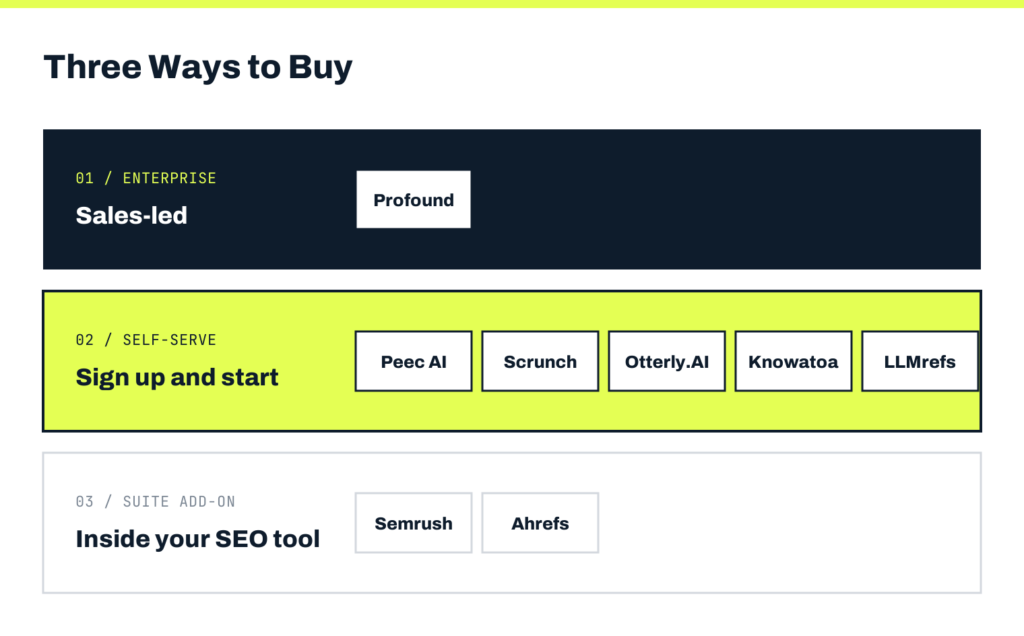
The eight AI visibility tracking tools below are reviewed on verdict, pricing, key limitation and who should skip them, starting with the most powerful and ending with the SEO-suite add-ons.
1. Profound: Best for Enterprise Analyst Teams
Profound is the deepest AI visibility platform for enterprises with dedicated analysts. It tracks mentions, citations, sentiment and competitors across up to 9 engines, with Profound Agents for automated workflows. It raised a $180M Series D at a $1.8B valuation in September 2026.
- Pricing: 7-day free trial, then a custom Enterprise quote. Its $99 and $399 self-serve tiers were retired after August 2026.
- Limitation: No published price, and smaller teams pay for depth they won’t use.
- Skip it if: nobody on your team will spend several hours a week inside the platform.
2. Peec AI: Best for Multi-Language Brands and Growing Teams
Peec AI is a Berlin-based tracker with daily refreshes, unlimited seats and unlimited languages on every plan. You choose 3 engines per plan from ChatGPT, AI Mode, AI Overviews, Copilot, Gemini and Naver AI.
- Pricing: Starter $95 (50 prompts), Pro $245 (150 prompts), Advanced $495 (350 prompts).
- Limitation: Claude is Enterprise-only, and a 4th engine, including Perplexity, costs extra.
- Skip it if: your buyers mainly use Claude or Perplexity.
3. Scrunch: Best for B2B Funnel Tracking
Scrunch is a monitoring platform that models personas and buyer-journey stages, now owned by Sitecore. Its Agent Experience Platform serves a machine-readable version of your site to AI crawlers.
- Pricing: In the US, Starter is $300 (350 prompts, 7 engines) and Growth is $500. Some regions see a $250 Core plan with 125 prompts.
- Limitation: Two pricing layouts are live, so confirm which one you’re offered.
- Skip it if: you need a sub-$100 entry point.
4. Otterly.AI: Best for Small Businesses and Agencies
Otterly.AI is the cheapest credible self-serve tracker, with unlimited workspaces and a white-label agency program. It includes ChatGPT, Google AI Overviews, Perplexity and Copilot.
- Pricing: Lite $29 (15 prompts), Standard $189 (100 prompts), Premium $489 (400 prompts).
- Limitation: AI Mode, Gemini and Claude are add-ons that nearly double the Standard price.
- Skip it if: your buyers live in Gemini, AI Mode or Claude.
5. Knowatoa: Best for Content Marketers on a Small Budget
Knowatoa is a lightweight tracker that generates prompts from your keywords and shows which URLs AI already cites. It offers a free audit before you pay.
- Pricing: Starter $59 (30 prompts, 3 engines), Growth $199 (100 prompts, 7 engines).
- Limitation: Claude, Gemini and Perplexity unlock only on Growth, and there’s no action layer.
- Skip it if: you need more than 100 prompts.
6. LLMrefs: Best Value per Prompt
LLMrefs is a flat-price tracker covering 10+ engines and 500 generated prompts for $79 a month, the lowest cost per prompt in this list.
- Pricing: One All in One plan at $79, with a 7-day trial.
- Limitation: Prompts are keyword-generated, refreshes are weekly, and analytics are shallower.
- Skip it if: you need daily data or hand-written buyer prompts.
7. Semrush AI Visibility Toolkit: Best for Existing Semrush Customers
The Semrush AI Visibility Toolkit is an add-on that places AI visibility data beside your Semrush SEO reports.
- Pricing: $99 per domain with 25 prompts. 50 extra prompts cost $60/month.
- Limitation: Semrush’s own pages disagree on billing, trial and engines, and per-domain pricing adds up.
- Skip it if: you don’t already pay for Semrush.
8. Ahrefs Brand Radar: Best for Existing Ahrefs Customers
Ahrefs Brand Radar is an AI visibility module built on Ahrefs’ search and backlink data, and it covers Claude.
- Pricing: Included on paid Ahrefs plans (5 prompts on Lite, 20 on Advanced). Standalone starts around $50/month.
- Limitation: Small prompt allowances on lower plans, and pricing varies by region.
- Skip it if: you need more than a few dozen prompts without Enterprise.
What Do AI Visibility Tracking Tools Measure?
Every AI visibility tool runs prompts, parses the answers, scores placement and sentiment, and trends the results over time. The quality gaps hide in the first step: how many prompts, how many runs each, API or real interface, and which model versions.
The most important distinction is in parsing. Strong tools keep two events separate:
- Brand mention: your name appears in the answer text. This reflects what the model associates with the topic.
- Source citation: your URL is cited as a source. This reflects what the retrieval layer fetched and trusted.
The gap between them is diagnostic. High mentions with low citations means you have category recognition but your pages aren’t being retrieved. That’s usually a content-structure problem, often fixable in weeks. Low mentions with high citations means your content is quotable but your brand isn’t tied to the category. That’s a slower entity and authority problem. A tool that reports one blended “visibility” score has thrown that diagnosis away.
Earned media explains much of the first pattern. About 84% of AI citations come from earned and third-party sources such as journalism, reviews and research, according to Muck Rack’s October 2026 What Is AI Reading? report. Your own site can be flawless and still show a thin citation count.
No tool measures what an individual user was shown, or whether an AI answer produced a sale. Every number is a sample of prompts you chose, on dates you chose.
Who Should Use an AI Visibility Tracking Tool?
Buy an AI visibility tool when AI already shapes buying decisions in your category and someone on your team will act on the findings. Without both, a manual audit gives you the same insight for free.
Buy one when:
- Buyers ask AI which product to choose. Examples include B2B software, professional services, healthcare and finance.
- You already invest in content or SEO. The tool then measures spend you’re making anyway.
- Competitors are visible and you’re not. That gap is specific and fixable.
Wait when:
- You’ve never measured at all. Run the manual audit below first.
- Nobody owns follow-through. Measurement without action is theatre with a monthly invoice.
- You expect the tool to fix the problem. None of them do.
In a 1,000-person survey by Neil Patel, 28% of teams are actively optimizing for AI search but only 9% measure the results. That gap is why follow-through matters more than the tool.
How Do You Choose the Right AI Visibility Tracking Tool?
Choose an AI visibility tool by sample size, engine coverage at your price tier, whether it has an action layer, and whether you can export your history. Feature grids are the weakest way to compare tools here.
| Stage | Who Acts | Budget | What to Buy |
|---|---|---|---|
| Pre-program | Nobody yet | $0 | A manual audit |
| Early | One person, part-time | $29–$79/month | An entry tier as a smoke test |
| Growth / Mid-market | A team acting monthly or weekly | $79–$300/month | A mid tier with daily data |
| Enterprise | Dedicated headcount and procurement | Custom | Profound or Scrunch Enterprise |
| Agency | The report is the deliverable | Per-client cost | Otterly.AI, Peec AI agency plans or LLMrefs |
Budget by Responses, Not Prompts
The unit you’re buying is responses:
Responses per cycle = Prompts × Runs per prompt × Number of engines
Vendors advertise prompts, but runs per prompt control your margin of error, and they’re usually low and undisclosed. Ask each vendor directly.
In the SparkToro and Gumshoe.ai study, each prompt ran 60–100 times per platform. A 100-prompt library at 60 runs across 5 engines is 30,000 responses per cycle, while entry tiers offer 15–125 prompts at far fewer runs. That gap is the category’s economics, but it’s yours to manage.
Historical data is the real switching cost, because trendlines rarely port between vendors. Buy the cheapest tool that answers your core question, then upgrade on evidence.
How to Run a Manual AI Visibility Audit
A manual AI visibility audit takes one afternoon: 20–30 real buyer questions, run several times each across 4 engines, logged in a spreadsheet. It also gives you a baseline to test any paid tool against.
- Write 20–30 prompts in your buyers’ words, covering “best X for Y,” comparisons and problem questions.
- Pick 4 engines, such as ChatGPT, Google AI Overviews, Perplexity and Gemini.
- Run each prompt at least 3 times per engine in a fresh session.
- Log brand mentioned, URL cited, competitors named, cited sources and sentiment.
- Calculate mention rate and citation rate per engine, kept separate.
- Repeat monthly with the same prompts.
Manual tracking is enough for under 50–100 prompts and monthly reporting. Upgrade when you track hundreds of prompts, multiple brands or markets, or report to executives or clients.
Common Mistakes When Comparing AI Visibility Tools
- Trusting a ranking position number. The SparkToro study found ChatGPT and Google AI Overviews returned the same brand list in under 1% of repeated runs. Visibility percentage held up; position did not. Even City of Hope, which appeared in 97% of cancer-care responses, landed in widely varying positions.
- Comparing tools on one metric. Compare citation rate, share of voice and sentiment, and check that the tool separates mentions from citations.
- Skipping manual validation. Check whether a tool’s numbers survive contact with your own audit spreadsheet.
What Should You Ask a Vendor Before Buying?
Rand Fishkin, SparkToro co-founder, advised marketers to make their provider show the math. Ask these five questions:
- How many runs per prompt, per engine, per cycle, and what change do you treat as meaningful?
- Do you separate brand mentions from source citations?
- How is sentiment classified, and is it validated?
- Can I see the raw answer text behind any data point?
- Do you also sell the fix? That isn’t disqualifying, ours included, but it should shape how you read the findings.
A vendor that’s open about uncertainty is a better sign than one that sounds certain.
Frequently Asked Questions
Are there free AI visibility tracking tools?
Yes. Knowatoa offers a free audit, and Profound and LLMrefs offer 7-day trials. A manual spreadsheet audit is also free and often enough for under 50 prompts.
What is an AI visibility score?
An AI visibility score is a vendor’s summary of how often your brand appears in AI answers across its tracked prompts and engines. Each vendor calculates it differently, so scores aren’t comparable across tools.
How often should you track AI visibility?
Track monthly for reporting and weekly when a team is actively changing content. Daily refreshes help only when each prompt runs enough times per cycle to smooth out variation.
What is the difference between GEO, AEO and AI visibility tracking?
Generative engine optimization (GEO) and answer engine optimization (AEO) are the practice of improving how AI engines describe and cite you. AI visibility tracking is the measurement layer that shows whether that work is moving the numbers.