Search has evolved beyond blue links. Today, people discover information through search engines, AI answer engines, and generative AI assistants, each relying on different methods to surface content. SEO, AEO, and GEO all aim to increase content visibility, but they optimize for different discovery systems. SEO focuses on ranking web pages, AEO focuses on providing direct answers, and GEO focuses on becoming a trusted source for AI-generated responses.
Understanding these differences helps me choose the right optimization strategy based on where my audience is searching.
What is SEO?
Search Engine Optimization (SEO) is the practice of improving a website so it appears higher in traditional search engine results. The goal isn’t simply to rank for keywords it’s to make content easier for search engines to crawl, understand, and present to users searching for relevant information.
Goals
- Increase organic visibility in search results
- Drive qualified traffic to the website
- Improve rankings for relevant keywords
- Enhance user experience and site performance
How Search Engines Use SEO
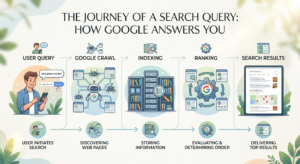
Traditional search engines such as Google and Bing crawl and index web pages before ranking them based on signals like relevance, content quality, backlinks, page experience, and search intent. Users are then presented with a list of results and choose which page to visit.
Example: If someone searches “best running shoes for beginners,” Google ranks the most relevant pages, allowing the user to compare different websites before making a decision.
Why SEO Remains the Foundation of Online Visibility
SEO is the foundation of online visibility because it helps search engines crawl, index, and rank your content. Strong SEO also supports AEO and GEO by making content easier for answer engines and generative AI to discover, understand, and retrieve.
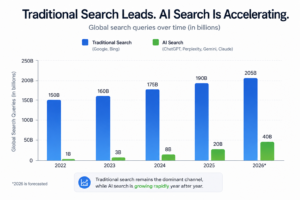
According to Cloudflare’s Radar 2025 Year in Review, Google remained the world’s most visited internet service, demonstrating that traditional search continues to be the primary discovery channel despite the rise of AI.
What is AEO?
Answer Engine Optimization (AEO) is the practice of creating content that can be easily retrieved and presented as a direct answer. Instead of optimizing only for rankings, AEO focuses on making information clear, structured, and easy for answer engines to extract.
Conductor’s analysis of 21.9 million searches found that AI Overviews appear most frequently for informational queries, making answer-focused optimization increasingly important.
Goals
- Increase visibility in AI-generated answers
- Earn featured snippets and AI Overviews
- Improve visibility in voice search
- Provide concise, authoritative answers
Where AEO is Used
AEO is commonly associated with experiences that provide immediate answers rather than lists of links, including:
Google announced that AI Overviews are used by more than 1.5 billion users every month across over 200 countries and territories, making them one of the world’s largest AI-powered search experiences.
- Featured Snippets
- Google AI Overviews
- Voice assistants such as Google Assistant and Siri
- Other answer-focused search experiences
These systems typically retrieve content that directly answers a question and present it in a summarized format.
Example: For the query “What is SEO?”, an answer engine may display a short definition at the top of the page instead of requiring users to open multiple websites.
What Is GEO?
Generative Engine Optimization (GEO) is the practice of optimizing content so it becomes a trusted source for generative AI systems. Rather than ranking pages or extracting a single answer, GEO focuses on helping AI models retrieve, synthesize, and cite reliable information when generating responses.
Semrush’s AI Toolkit now analyzes 289 million AI prompts every month across ChatGPT, Gemini, Claude, and Perplexity, reflecting the rapid growth of AI-native search behavior.
Goals
- Increase AI citations and recommendations
- Improve brand visibility in AI-generated responses
- Build topical authority and entity recognition
- Create content that AI can easily retrieve and verify
Where GEO Is Used
GEO focuses on generative AI platforms that create conversational responses, including:
- ChatGPT
- Gemini
- Claude
- Perplexity
These systems retrieve information, evaluate multiple sources, and generate responses using the most relevant supporting evidence. Content that is well-structured, factually accurate, and supported by trustworthy sources is more likely to be selected.
Example: When a user asks “How does Retrieval-Augmented Generation (RAG) work?”, a generative AI assistant may synthesize information from several trusted sources and cite them within its response instead of simply linking to a single webpage.
AEO vs GEO vs SEO Comparison
| Factor | SEO | AEO | GEO |
|---|---|---|---|
| Goal | Improve search rankings | Earn direct answers | Earn AI citations and recommendations |
| Search | Search results | Answer-first search | Conversational AI |
| Platforms | Google, Bing | AI Overviews, Featured Snippets, Voice Assistants | ChatGPT, Gemini, Claude, Perplexity |
| Content Type | Web pages and blogs | FAQs, definitions, how-to guides | Research-backed, structured content |
| Ranking Signals | Keywords, backlinks, UX | Relevance, structure, answer quality | Relevance, authority, entities, corroboration |
| Output | Ranked web pages | Direct answers | AI-generated responses |
| Success Metrics | Rankings, traffic, CTR | Featured snippets, AI visibility | AI citations, AI referrals, Share of AI Voice |
| Optimization Focus | Search engines | Answer engines | Generative AI systems |
How SEO, AEO, and GEO Work Together
SEO, AEO, and GEO address different stages of content discovery but work best as a unified strategy. SEO helps users find your content, AEO helps answer engines surface it as a direct response, and GEO helps generative AI retrieve, cite, and recommend it. Together, they maximize visibility across both traditional and AI-powered search.
SEO Creates Discoverability
SEO makes content easier for search engines to crawl, index, and rank. By improving technical SEO, content quality, and relevance, it builds the foundation for visibility in organic search results.
AEO Increases Answer Visibility
AEO organizes content into clear, concise, and structured answers that answer engines can easily extract. This improves visibility in AI Overviews, featured snippets, and voice search results.
GEO Increases AI Citations and Recommendations
GEO focuses on creating trustworthy, well-supported content that generative AI can confidently retrieve and reference. Strong entity signals, credible sources, and topical authority increase the chances of your content being cited or recommended in AI-generated responses.
Is SEO Still Worth It in the AI Era?
SEO remains the foundation of online visibility, even as AI transforms search. While answer engines and generative AI change how information is delivered, they still rely on discoverable, high-quality content. AEO and GEO build on SEO—they don’t replace it.
Why “SEO Is Dead” Is a Myth
SEO is evolving, not disappearing. Search engines continue to drive website discovery, while AI answer engines rely on web content to generate accurate responses. Strong SEO remains essential for long-term visibility.
Gartner predicts that traditional search engine volume will decline by 25% by 2026 as users increasingly turn to AI assistants, but this represents a shift in discovery not the disappearance of SEO.
Why AI Still Depends on Search Infrastructure
AI systems retrieve information from crawlable, indexed, and well-structured content before generating answers. Without strong SEO fundamentals, content is less likely to be discovered, retrieved, or cited.
How SEO Supports AEO and GEO
SEO creates the foundation by improving crawlability, relevance, and content quality. AEO builds on that foundation to increase answer visibility, while GEO helps content become a trusted source for AI citations and recommendations. Together, they improve visibility across both search engines and AI platforms.
Which Strategy Do You Need?
The right strategy isn’t choosing between SEO, AEO, and GEO it’s understanding how they work together. Your priorities may vary, but SEO remains the foundation, while AEO and GEO expand your visibility across answer engines and generative AI.
Short Verdict
Start with SEO to build discoverability, add AEO to increase visibility in answer-first experiences, and use GEO to improve AI citations and recommendations. For most websites, the strongest approach is combining all three.
New Websites
Focus on SEO first to build crawlability, indexability, and topical authority. Once a solid foundation is in place, optimize key pages for AEO and GEO.
Growing Businesses
Combine SEO with AEO to improve both search rankings and answer visibility. As brand authority grows, GEO can help increase AI citations and recommendations.
SaaS Companies
Prioritize all three strategies. SEO drives qualified traffic, AEO captures informational queries, and GEO improves visibility in AI-generated product comparisons and recommendations.
Publishers
Focus on creating original, well-structured, and authoritative content. Strong SEO attracts readers, while AEO and GEO increase the likelihood of content being surfaced and cited by AI.
Local Businesses
Build a strong SEO presence for local search while using AEO to answer common customer questions. GEO can strengthen visibility as AI assistants increasingly recommend local businesses.
Enterprise Brands
An integrated SEO, AEO, and GEO strategy delivers the broadest visibility. Large brands benefit from strong technical SEO, structured content, and consistent authority signals that improve both search performance and AI recognition.
Common Misconceptions
AI-driven search has created confusion around SEO, AEO, and GEO. These misconceptions can lead to ineffective strategies, so it is important to understand what actually influences visibility.
AEO Doesn’t Replace SEO
AEO works alongside SEO. Strong technical SEO and quality content remain the foundation for visibility in both search engines and answer engines.
GEO Isn’t Prompt Engineering
GEO focuses on making content discoverable, trustworthy, and citable by AI systems. It is not about writing better prompts.
Rankings Don’t Equal AI Visibility
A high search ranking does not guarantee AI citations. AI systems also evaluate relevance, authority, and how easily information can be extracted.
Citations Aren’t Backlinks
AI citations and backlinks are different. A citation shows that AI used your content as a source, while a backlink directs users from another website.
More Content Isn’t Better
Publishing more content does not automatically improve AI visibility. Well-researched, structured, and useful content performs better than high-volume low-quality pages.
Best Practices Across SEO, AEO, and GEO
Although SEO, AEO, and GEO have different goals, they rely on many of the same fundamentals. Following these best practices helps improve visibility across traditional search engines, answer engines, and generative AI platforms.
Build Strong Technical Foundations
Ensure your website is crawlable, fast, mobile-friendly, and easy to navigate. A strong technical foundation helps both search engines and AI systems access your content.
Create Content That Answers Questions
Write clear, accurate, and well-structured content that directly addresses user queries. Concise answers and logical formatting make information easier to retrieve.
Strengthen Entity Signals
Use consistent brand names, author details, and organizational information across your website and other trusted platforms. Clear entity signals help AI understand and recognize your content.
Demonstrate Experience and Authority
Support claims with reliable sources, publish original insights, and showcase subject-matter expertise. Trustworthy content is more likely to rank, be cited, and be recommended.
Measure Performance Across Search and AI
Monitor rankings, organic traffic, AI citations, recommendations, referral traffic, and brand visibility to understand how your content performs across both search engines and AI platforms.
Frequently Asked Questions
1. Can a website rank well but not appear in AI answers?
Yes. Search rankings and AI visibility use different signals. A page may rank highly but lack the structure, context, or authority needed for AI systems to select it.
2. Does AI citation improve SEO rankings?
AI citations do not directly improve traditional search rankings. However, they can increase brand visibility, credibility, and potential referral traffic.
3. How long does it take to see results from GEO?
GEO results depend on factors such as content quality, authority, brand recognition, and how frequently AI systems update their sources. There is no fixed timeline.
4. Do AI platforms crawl every website?
No. AI systems may rely on different data sources, crawling permissions, partnerships, and retrieval methods. Making content accessible improves the chances of discovery.
5. Can small businesses benefit from AEO and GEO?
Yes. Small businesses can improve visibility by creating helpful content, answering customer questions clearly, and building consistent brand information across the web.
6. Is traditional keyword research still useful for AEO and GEO?
Yes. Keyword research helps understand user intent and topics, but AEO and GEO require a stronger focus on answering questions, providing context, and building trust.

kashish
Passionate about SEO, AI search, and content marketing, sharing practical insights on search trends, AI visibility, and digital growth.