AI answer engines choose their sources by retrieving, evaluating, and comparing information before generating a response. Rather than selecting sources at random, they rely on retrieval systems, ranking methods, and grounding techniques to identify the most relevant and trustworthy content.
Understanding this process helps explain why some pages are cited while others are not. This guide covers how Retrieval-Augmented Generation (RAG), query fan-out, and the retrieval-to-citation pipeline work, along with the key factors that influence AI source selection.
What is an AI Answer Engine?
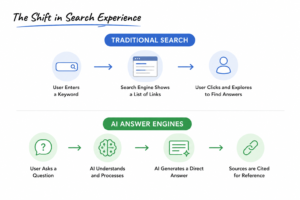
An AI answer engine is a search system that generates direct answers by retrieving, evaluating, and synthesizing information from multiple sources. Instead of presenting a list of web pages, it aims to answer the user’s question in a conversational format, often with citations to the sources used.
How AI Answer Engines Differ from Traditional Search Engines
Traditional search engines rank and display web pages for users to explore, while AI answer engines generate a summarized response based on retrieved information. Rather than requiring users to visit multiple websites, they combine relevant information into a single answer and may cite the sources that informed it.
Why AI Answer Engines Are Changing Search
AI answer engines are changing how people discover information by providing faster, more direct answers. As users increasingly rely on AI-generated responses, creating content that is clear, accurate, and easy to retrieve has become essential for improving visibility and earning AI citations.
According to Bain & Company, about 80% of consumers now rely on AI-generated results for at least 40% of their searches, reducing clicks to traditional websites by an estimated 15% to 25%.
What is Retrieval-Augmented Generation (RAG)?
Retrieval-Augmented Generation (RAG) is a technique that enables AI answer engines to retrieve relevant information before generating a response. Rather than relying solely on their training data, they search for relevant content, retrieve the most useful passages, and use that information to produce a grounded answer.
Why Retrieval Happens Before Generation
Retrieval comes before generation because the AI first needs reliable information to answer the user’s query. The retrieved content is then passed to the language model, which synthesizes it into a coherent response. This retrieval-first approach improves factual accuracy and allows AI systems to incorporate more current information.
Why AI Retrieves Passages, Not Pages
Instead of retrieving entire web pages, RAG retrieves specific passages that directly address the query. Focusing on smaller, relevant sections reduces unnecessary information and helps the model generate more precise answers.
For example, a query about query fan-out is more likely to retrieve the paragraph explaining that concept than an entire article.
By grounding responses in retrieved evidence, RAG helps AI answer engines generate answers that are more accurate, relevant, and easier to support with citations.
What is Query Fan-Out?
Query fan-out is the process of expanding a user’s question into multiple related searches before retrieving information. Instead of searching for only the exact query, AI answer engines generate several variations to explore different aspects of the topic.
For example, if a user asks, “How do AI answer engines choose their sources?”, the system may also search for “What is RAG?”, “How does AI retrieve information?”, or “AI source selection factors.” The results from these related queries are combined to build a more complete answer.
How Query Fan-Out Expands Source Discovery
By searching across multiple query variations, query fan out improves source discovery and increases the likelihood of retrieving relevant, high quality information before the answer is generated.
Retrieval to Citation: Five Steps
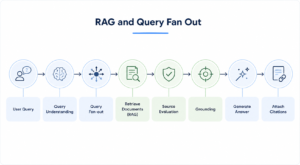
Modern AI answer engines follow a retrieval-first workflow to decide which sources to use and cite. While implementations vary across platforms, the process generally follows five key steps.
Step 1 Fan-Out: The original query is expanded into multiple related searches to improve coverage.
Step 2 Retrieval: The system searches its knowledge sources or the web and retrieves the most relevant passages, creating a candidate set.
Step 3 Reranking: The retrieved passages are evaluated and reordered based on their relevance, quality, and usefulness for the query.
Step 4 Grounding: The language model generates an answer using the highest-ranked evidence, ensuring the response is based on retrieved information rather than memory alone.
Step 5 Attribution: When supported, the AI attaches citations or links to the sources that informed the answer.
Does This Work the Same Across ChatGPT, Perplexity, AI Overviews, and Copilot?
The overall retrieval process is similar across AI answer engines, but the way they retrieve, rank, and cite information differs. Most platforms retrieve relevant content, evaluate supporting evidence, and generate grounded responses before displaying citations.
The main differences lie in the sources they access, how they rank retrieved content, and how citations are presented. As a result, the same query may produce different answers and cited sources across ChatGPT, Perplexity, Google AI Overviews, and Microsoft Copilot, even though they follow a similar retrieval-first approach.
Factors That Influence AI Source Selection
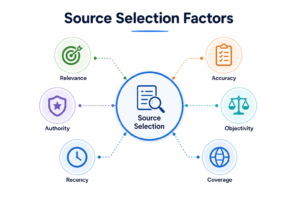
AI answer engines evaluate multiple signals before selecting information to generate and cite in a response. While the exact ranking methods vary across platforms, they consistently prioritize content that is relevant, trustworthy, well-structured, and easy to interpret.
Relevance to the User’s Query
AI prioritizes content that directly answers the user’s question instead of mentioning the topic broadly. For example, a page explaining how AI citations work is more likely to be used than a general SEO guide.
Content Extractability
Content with descriptive headings, short paragraphs, bullet points, and clear definitions is easier for AI to retrieve and quote accurately. A concise step-by-step explanation is often more extractable than a long block of text.
Entity Clarity and Context
Clearly identify entities such as brands, products, people, or organizations and explain how they relate to the topic. This helps AI correctly interpret and attribute the information.
Third-Party Corroboration
AI is more likely to trust information that is consistently supported by multiple credible sources. When several reputable websites agree on the same fact, confidence in that information increases.
Profound analyzed more than 30 million AI citations and found that answer engines cited third-party websites 6.5 times more often than brand-owned domains, showing that independently verified information is significantly more likely to be referenced.
Content Freshness and Accuracy
Current, well-maintained content is more likely to be selected, especially for topics that change frequently, such as AI models, search features, or industry statistics.
Source Authority and Trust Signals
AI favors content from reputable sources that demonstrate expertise, cite reliable evidence, and maintain editorial standards. Trust signals such as author information, references, and factual accuracy strengthen credibility.
Mistakes That Reduce AI Citation Chances
Certain content and formatting issues can make it harder for AI answer engines to retrieve, understand, and trust your information. Avoiding these common mistakes improves both user experience and your chances of being selected as a cited source.
Vague Introductions
Vague introductions delay the main answer, making it harder for AI to identify the page’s primary topic. Start with a clear definition or direct answer, then provide supporting context and details.
Example: Instead of opening with general information about AI, begin with: “AI answer engines choose sources by retrieving, ranking, and grounding relevant information before generating a response.”
Large block of Text
Large blocks of text reduce readability and make key information difficult to extract. Use descriptive headings, short paragraphs, bullet points, and tables to present information in a scannable format.
Missing Context
Missing context makes it difficult for AI to understand the meaning and relationships between concepts. Define important terms, identify relevant entities, and explain how they connect to the topic before discussing them further.
Unsupported Claims
Unsupported claims reduce content credibility because AI systems prefer information backed by reliable evidence. Cite reputable studies, official documentation, or trusted industry sources to support factual statements.
Outdated Statistics
Outdated statistics can reduce the accuracy and reliability of your content. Review and update data regularly, especially for topics such as AI models, search features, and industry trends where information changes quickly.
Clickbait Headings
Clickbait headings create misleading expectations and often fail to reflect the content accurately. Write descriptive, intent-focused headings that clearly communicate what users will learn and match the information provided.
Frequently Asked Question
-
Can a new website get cited by AI?
Yes. If it provides accurate, original, and well-structured information, a new website can be cited even without a long history.
-
Do AI answer engines only use the top Google results?
No. AI systems may retrieve information from various trusted sources, not just pages ranking first in traditional search results.
-
Does adding schema markup guarantee AI citations?
No. Schema helps machines understand your content, but it does not guarantee that AI systems will select it as a source.
-
How often should I update content for AI visibility?
Review important pages regularly and update them whenever information changes, statistics become outdated, or new developments occur.
-
Are AI citations the same as backlinks?
No. A backlink is a hyperlink from another website, while an AI citation is a reference or attribution used in an AI-generated response. A page can receive one without necessarily receiving the other.
-
How can I check if my content is being cited by AI?
Search for your target queries in AI-powered search experiences, monitor referral traffic, and use AI visibility tracking tools to identify mentions and citations.

kashish
Passionate about SEO, AI search, and content marketing, sharing practical insights on search trends, AI visibility, and digital growth.