An AI search agency (also called a GEO, AEO, or AI visibility agency) helps brands get found, cited, and recommended inside AI-generated answers on platforms like ChatGPT Search, Google AI Overviews, Google AI Mode, Gemini, and Perplexity. Unlike traditional SEO which optimizes pages to rank for keywords an AI search agency audits how AI systems currently describe a brand, builds content and authority signals around the actual questions buyers ask, fixes technical barriers to AI crawlers, and tracks mention rate, citation rate, and share of voice against named competitors over time.
Why AI Search Changes the Visibility Game
AI search is changing how people discover brands, products, services, and information. Instead of scanning a page of blue links, users now ask conversational questions and receive synthesized answers from systems such as ChatGPT, Google AI Overviews, Google AI Mode, Gemini, and Perplexity.
Google says its AI search features continue to rely on foundational SEO practices, while AI Overviews and AI Mode surface relevant links from across the web. ChatGPT Search similarly returns answers with linked sources, creating another discovery channel entirely separate from the traditional results page.
This creates a new challenge: ranking in traditional search is no longer the only visibility goal. Brands also need to be understood, mentioned, cited, and recommended by AI systems that never show a full page of results at all, just one synthesized answer.
That’s where a specialized AI search agency comes in.
What Is an AI Search Agency?
An AI search agency specializes in improving how a brand appears across AI-powered search and answer engines, the AI equivalent of an SEO agency, but focused on how large language models find, interpret, and cite a brand rather than how a page ranks in a list of links.
Depending on the agency, this discipline goes by several names:
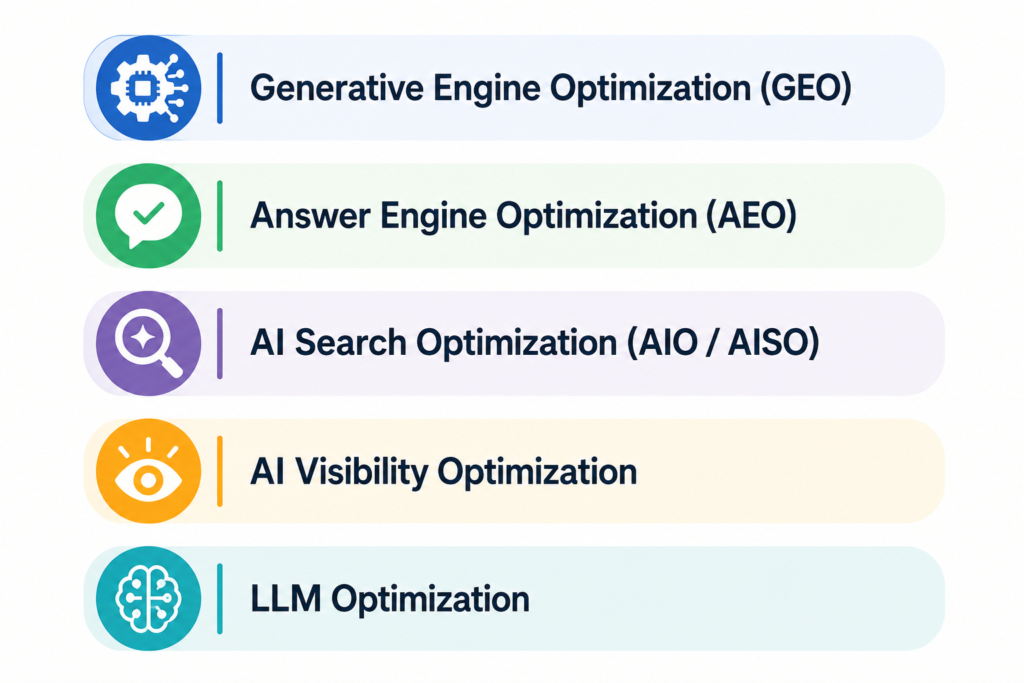
These terms overlap heavily and are often used interchangeably by agencies, so don’t treat the label as a meaningful differentiator and ask about the actual deliverables instead .
The objective isn’t simply to get a webpage to rank for a keyword. It’s to improve the likelihood that AI systems recognize the brand as a relevant, credible source when generating an answer.
A traditional SEO strategy might target:
“best CRM software for startups”
An AI search strategy also investigates full, conversational prompts such as:
“What are the best CRM platforms for an early-stage SaaS company?” “Which CRM is best for a startup with a small sales team?” “Compare the leading CRM tools for B2B startups.”
This distinction matters because users increasingly type or speak complete questions into AI tools rather than short keyword fragments.
AI Search vs. Traditional SEO
| Factor | Traditional SEO | AI Search Optimization |
|---|---|---|
| Goal | Rank a page in search results | Get mentioned, cited, or recommended in an AI-generated answer |
| Unit of optimization | Keywords and pages | Prompts, entities, and facts about the brand |
| Success signal | Ranking position, organic clicks | Mention rate, citation rate, share of voice, sentiment |
| Content style | Keyword-targeted pages | Direct, extractable answers, definitions, comparisons, data |
| Trust signals | Backlinks, domain authority | Consistent facts across the web, third-party corroboration |
| Crawlers to satisfy | Googlebot, Bingbot | Googlebot, OAI-SearchBot, PerplexityBot, ClaudeBot, and others |
The 12 Core Services an AI Search Agency Provides
A specialized agency treats AI visibility as a continuous optimization process, not a one-time content project.
1. Auditing Your Existing AI Visibility
The starting point is understanding how a brand currently appears. An agency tests a large set of relevant prompts across multiple AI platforms and documents:
- Whether your brand is mentioned at all
- Whether competitors are mentioned instead
- Whether your website is cited as a source
- Which specific pages get cited
- Which third-party sites are shaping the answer
- How your brand is described (accurately or not)
- Sentiment positive, neutral, or negative
- Mention frequency across the full prompt set
- Which competitors are winning more visibility, and by how much
This becomes the baseline against which every future improvement is measured. Agencies typically pair this manual audit with an AI visibility tracking tool platforms like RankingBite are built specifically to automate prompt-level monitoring across ChatGPT, Google AI Overviews, Gemini, and Perplexity, so mention rate and citation rate can be tracked continuously rather than re-checked by hand every few weeks. RankingBite’s case study on MaTrack offers a concrete look at how this plays out for a real brand moving from ad-hoc checks to continuous AI-visibility tracking.
2. Building a Prompt Universe Around the Buying Journey
AI search optimization shouldn’t chase random prompts, it should map to how real buyers actually search. A useful prompt universe typically spans:
Tracking mentions across each category shows exactly where a brand is visible and where competitors are winning the conversation.
3. Improving Brand Understanding and Consistency
AI systems need enough consistent information to actually understand what a company does. If a brand calls itself an “AI-powered platform” on one page, a “marketing analytics solution” on another, and a “growth platform” elsewhere, the model has no clean signal to work from.
Agencies work to align positioning across:
- Website and product pages, and About pages
- Author profiles and knowledge bases
- Industry publications and company profiles
- Review platforms and social profiles
- Third-party mentions and press coverage
4. Building Content That Directly Answers Real AI Queries
This isn’t about adding more keywords, it’s about making content easy for a model to extract, quote, and trust. Effective content is restructured around:
- Direct, one-paragraph answers up top (like the Quick Answer box above)
- Clear definitions
- Comparisons and pros/cons
- Step-by-step explanations
- Original research and statistics
- Expert commentary
- FAQs written as real questions with self-contained answers
A connected cluster gives both search engines and AI systems a larger, mutually-reinforcing body of evidence about the topic which is exactly what increases citation odds.
5. Increasing the Chances of Being Cited
Being mentioned is useful. Being cited with a clickable link back to your page adds a further layer of credibility and traffic. ChatGPT Search responses can include citations and source links, and Google AI Overviews link out to supporting pages.
Tactics that increase citation odds include:
- Publishing original research and unique statistics
- Deepening topical coverage rather than skimming it
- Strengthening demonstrated author expertise
- Earning authoritative backlinks
- Keeping facts, pricing, and specs current (outdated pages get skipped)
- Building pages that answer one high-value question thoroughly
6. Strengthening Third-Party Brand Signals
A common mistake is treating the company website as the only source of AI visibility. AI systems draw on the broader web, so third-party visibility matters just as much:
- Industry publications and news coverage
- Review sites and business directories
- Interviews, podcasts, and expert articles
- LinkedIn and Reddit discussions
- Partner and comparison websites
The goal isn’t to manipulate mentions, it’s to build a legitimate, consistent ecosystem of information about the company that independently corroborates what the brand says about itself.
7. Fixing Technical Barriers
AI visibility isn’t only a content problem; a technically sound website still matters because AI systems largely depend on the same search indexes and crawlers.
Google requires pages to meet its normal technical requirements and be indexed to be eligible as supporting links in AI Overviews or AI Mode. OpenAI similarly asks site owners to allow OAI-SearchBot to crawl their content if they want it discoverable and citable in ChatGPT Search. Other AI crawlers worth checking for and explicitly allowing in robots.txt where desired include PerplexityBot, ClaudeBot, and GoogleOther.
A technical audit typically covers:
- robots.txt rules for AI crawlers specifically (not just Googlebot)
- Indexability, crawlability, and canonicalization
- XML sitemaps and internal linking
- Structured data (schema markup Organization, Product, FAQPage, Article)
- JavaScript rendering issues that hide content from crawlers
- Duplicate content and metadata
8. Monitoring Competitors in AI Answers
It’s not enough to know whether your brand appears, you need to know who appears instead of you. Agencies track competitors across the same prompt set and compare hard numbers:
| Metric | Your Brand | Competitor |
|---|---|---|
| Mention Rate | 35% | 62% |
| Citation Rate | 18% | 41% |
| Share of Voice | 22% | 48% |
| Positive Sentiment | 81% | 87% |
| Average Citation Position | 3.2 | 1.8 |
Exact metrics and methodology vary by platform and tool, but the principle holds: measure visibility against the companies actually competing for the same AI recommendations.
9. Turning AI Visibility Data Into an SEO and Content Strategy
Say an agency discovers competitors are consistently cited for “best cybersecurity platforms for enterprises,” but your brand is rarely mentioned. The investigation typically works backward:
- Which pages are competitors cited from?
- What information do those pages contain that yours doesn’t?
- Which third-party sources mention those competitors?
- What are users actually asking?
- What’s missing from your site?
- Is a technical issue limiting discoverability?
- Is your brand positioning unclear or inconsistent?
- What content or digital PR would close the gap?
This turns AI visibility data into an actionable roadmap instead of a vanity metric.
10. Managing AI Reputation
Visibility and reputation are closely linked. A brand appearing frequently isn’t a win if AI systems consistently describe it inaccurately or unfavorably. Agencies monitor for:
- Incorrect product descriptions or pricing
- Outdated company information
- Negative or unfair competitor comparisons
- Missing product details
- Unclear or contradictory positioning
The fix is always to improve the underlying information ecosystem, not to attempt to force a particular AI output, which isn’t reliably possible and isn’t a legitimate long-term strategy.
11. Measuring Business Impact
AI visibility should ultimately connect to revenue, not just sit as an isolated dashboard metric. Useful measurements include:
- AI mention rate, citation rate, and share of voice
- Referral traffic from AI platforms (ChatGPT allows this to be tracked in standard analytics when OAI-SearchBot is permitted)
- Assisted conversions and leads sourced from AI referrals
- Branded search growth
- Conversion rate specifically from AI-driven traffic
12. Building Internal AI Capability (Where Relevant)
Some agencies extend beyond visibility work into helping teams use AI internally custom GPTs for content or support workflows, prompt-writing training, and AI automation for lead generation or customer service. This isn’t core to AI search optimization itself, but it’s worth asking about if your team wants a single partner for both.
What Results Actually Look Like
A short, realistic example: a B2B SaaS company selling project-management software starts an AI visibility program at a 12% mention rate across its core prompt set, with almost no citations and two competitors dominating comparison-style questions. Over a typical engagement, expected movement looks like:
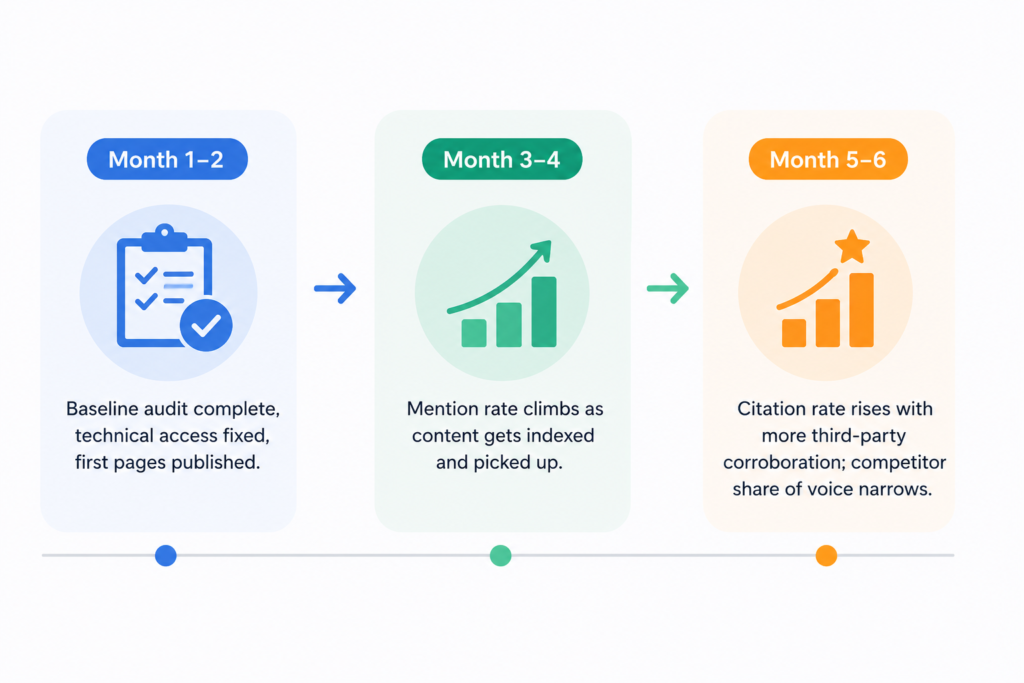
- Month 1–2: Baseline audit complete, technical crawler access fixed (robots.txt was silently blocking OAI-SearchBot), first comparison and definition pages published.
- Month 3–4: Mention rate begins climbing as new content gets indexed and picked up by crawlers; citation rate is still low.
- Month 5–6: Citation rate starts rising as third-party corroboration (reviews, comparison sites, press mentions) accumulates; competitor share of voice narrows.
Timelines vary by category competitiveness, content velocity, and how much third-party authority already exists but this is a realistic shape, not an overnight fix.
How Long Does AI Search Optimization Take?
Most brands see measurable movement in mention rate within 6–10 weeks of technical fixes and initial content going live, since AI crawlers re-index far faster than traditional link-based ranking cycles.
Citation rate and share of voice typically take 3–6 months to shift meaningfully, because citations depend on third-party corroboration building up across the web, not just on-site changes. Highly competitive categories (finance, SaaS, healthcare) tend toward the longer end; niche B2B categories with less AI-optimized competition can move faster.
FAQ
What’s the difference between GEO and AEO?
The terms are largely used interchangeably. Generative Engine Optimization (GEO) tends to describe optimizing for AI-generated summaries broadly, while Answer Engine Optimization (AEO) emphasizes structuring content to directly answer specific questions. In practice, most agencies deliver the same core work under either label.
Can I do AI search optimization myself without an agency?
Yes, for a small brand with a narrow category and limited competition. It requires manually testing prompts across multiple AI platforms, auditing technical crawler access, and restructuring content for extractability all doable in-house, just time-intensive at scale.
Does AI search optimization replace SEO?
No. Google and other engines still rely on core SEO signals indexing, crawlability, backlinks, and content quality as an input to their AI features. AI search optimization is an additional layer on top of SEO, not a replacement for it.
How do I know if my brand is already being mentioned by AI tools?
Manually run your category’s core prompts through ChatGPT, Google AI Mode, Gemini, and Perplexity and note whether you’re mentioned, cited, and how you’re described. This is the same first step a specialized agency would run, just at a smaller scale. For ongoing tracking rather than a one-off check, a dedicated tool like RankingBite can run this across your full prompt set automatically and flag changes in mention rate, citation rate, and sentiment over time.
