RankingBite
Blog

How AI Search Is Changing the B2B Buyer Journey

The B2B buyer journey has changed. Instead of relying only on Google searches, review sites, vendor websites, and sales conversations, buyers are increasingly using AI assistants like ChatGPT, Gemini, Claude, and Perplexity to research business problems, compare solutions, and evaluate vendors. AI has become a new layer in the buying process, helping buyers find answers […]

Written bykashish
Published 28 Jul 2026 Last updated 23 Jul 2026 9 min read
ai search and b2b buying

The B2B buyer journey has changed. Instead of relying only on Google searches, review sites, vendor websites, and sales conversations, buyers are increasingly using AI assistants like ChatGPT, Gemini, Claude, and Perplexity to research business problems, compare solutions, and evaluate vendors. AI has become a new layer in the buying process, helping buyers find answers faster and reducing the number of websites they need to visit.

This shift matters because it changes where buying decisions begin. Buyers are no longer discovering brands only through search engines or traditional marketing channels. Many now start with AI-generated answers that summarize information from multiple sources before they ever visit a company’s website or speak with a sales representative.

This article explores how AI search is reshaping the B2B buyer journey, how buyer behavior is changing at every stage, and what these changes mean for content strategy.

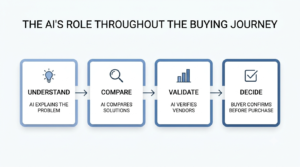
Before AI search became part of everyday research, most B2B buying journeys followed a predictable path. Buyers gathered information from multiple sources, compared vendors independently, and often spent weeks moving from problem identification to a final purchase decision.
b2b buyer journey through ai search

How Buyers Researched Solutions

Research typically started with a search engine. Buyers searched for industry challenges, product categories, or potential vendors before expanding their research across multiple channels.

A typical research journey included:

  • Google Search to discover educational content and vendors
  • Vendor websites to explore products, pricing, and documentation
  • Analyst and review platforms such as Gartner, G2, and Capterra for independent evaluations
  • Blog articles and industry publications for expert insights
  • YouTube videos, webinars, and product demonstrations
  • Whitepapers, case studies, and research reports
  • Sales conversations to answer remaining questions before making a decision

Each source provided a different piece of the buying puzzle, requiring buyers to combine information from many places before they felt confident enough to move forward.

Why This Journey Was Often Slow

The traditional buying process required significant time and effort because information was scattered across dozens of sources. Buyers frequently repeated similar searches, compared conflicting opinions, and switched between multiple websites before building a complete understanding of the market.

Several factors contributed to this slower process:

  • Information was spread across many websites and platforms.
  • Buyers had to compare multiple vendors manually.
  • Vendor websites naturally highlighted their own strengths, making independent validation necessary.
  • Sales teams often became involved before buyers had finished their research, adding another step to the evaluation process.

As B2B purchasing became more complex, buyers looked for faster ways to gather reliable information. AI search has emerged as a response to that need, helping buyers summarize, compare, and evaluate information before moving deeper into the buying journey.
How AI Search Is Reshaping Every Stage of the Buyer Journey

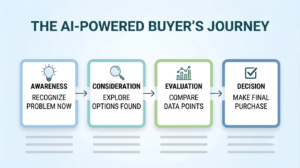
AI search is changing how buyers move through the B2B buying process. Instead of visiting multiple websites at every stage, buyers ask AI assistants direct questions and receive summarized answers with recommended sources. This reduces research time and influences which brands make it into the buyer’s consideration set.

Stage 1: Awareness – Buyers Use AI to Understand the Problem

The awareness stage begins when buyers recognize a business challenge but are not yet looking for a specific product. Instead of searching through multiple articles, they ask AI to explain the problem and identify possible solutions.

Examples

  • Why is our SaaS churn increasing?
  • How can manufacturers reduce supply chain delays?

Content implication

To appear at this stage, brands should publish:

  • Educational guides that answer common industry questions
  • Beginner-friendly explainers with clear definitions
  • Research-backed insights supported by credible sources
  • Content organized with descriptive headings and concise answers

Stage 2: Consideration – Buyers Compare Solutions with AI

Once buyers understand the problem, they begin exploring different ways to solve it. AI helps by comparing products, categories, and approaches in a single response, reducing the need to manually review multiple websites.

Examples

  • Best CRM for healthcare companies
  • ERP vs CRM for growing businesses

Content implication

To support buyers during consideration, brands should create:

  • Product comparison pages
  • Alternative and competitor comparison content
  • Category pages that explain solution types
  • Feature comparison tables
  • Industry-specific use case content

Stage 3: Evaluation – Buyers Validate Vendors Before Contacting Sales

During evaluation, buyers use AI to narrow their shortlist and verify whether a vendor meets their requirements. Rather than relying on marketing claims alone, they look for evidence from multiple trusted sources.

Examples

  • Compare HubSpot and Salesforce pricing
  • Best endpoint security platforms for mid-sized businesses

Content implication

Brands should strengthen:

  • Customer case studies and success stories
  • Detailed product documentation
  • Independent reviews and third-party coverage
  • Original research and data-driven content
  • Expert commentary and industry recognition

Stage 4: Decision – Buyers Verify Before Making a Purchase

AI supports the final decision, but buyers still validate important details before committing. They typically visit the vendor’s website to confirm information and reduce purchase risk.

Buyers commonly review:

  • Pricing pages
  • Product documentation
  • Customer reviews
  • Demo or trial information

Content implication

To support the decision stage, brands should provide:

  • Transparent pricing and feature information
  • Up-to-date documentation
  • Easy access to demos and contact options
  • Consistent information across owned and third-party sources

stage of buyer journey

The New Sources Buyers Trust

AI search has expanded the number of places where buyers discover and evaluate brands. Instead of relying on a single search engine, buyers now combine AI-generated answers with trusted sources to make purchasing decisions.

Research Stage Traditional Buyer Journey AI-Assisted Buyer Journey
Starting Point Google search AI conversation
Research Method Visit multiple websites Receive summarized answers
Information Gathering Manual comparison AI synthesizes information
Vendor Evaluation Review sites and analyst reports AI compares vendors with supporting sources
Decision Support Sales calls and demos AI research before engaging sales

This shift doesn’t mean traditional channels are becoming irrelevant. Buyers still rely on search engines, vendor websites, analyst reports, and review platforms. The difference is that AI has become the starting point for research, helping buyers discover, compare, and evaluate information before they engage directly with vendors.

What This Means for B2B Content Strategy

As buyers increasingly rely on AI throughout the buying journey, content needs to support every stage of their research. Instead of creating content only for search rankings, businesses should publish resources that help buyers understand problems, compare solutions, and evaluate vendors.

Create Educational Content for Early Research

Answer common industry questions with clear, practical content that helps buyers understand challenges before they begin evaluating products.

Publish Comparison Content for Evaluation

Create comparison pages, alternative pages, and category guides that help buyers understand the differences between solutions and vendors.

Support Claims with Research and Evidence

Use original research, expert insights, case studies, and credible sources to make content more reliable for both buyers and AI-generated answers.

Build Trust Beyond Your Website

Earn mentions in industry publications, analyst reports, review platforms, and trusted third-party websites. Independent validation helps buyers verify your credibility.

New Metrics B2B Teams Should Watch

Traditional SEO metrics like organic traffic and keyword rankings remain valuable, but they no longer tell the full story. As buyers increasingly use AI assistants to research solutions, B2B teams need to measure how often their brand appears throughout AI-assisted buying journeys.

Key metrics to track include:

  • AI citations: How often AI directly references your content as a source.
  • AI mentions: How often your brand is included in AI-generated answers, even without a citation.
  • Brand recommendation frequency: How often AI recommends your brand for relevant commercial and informational queries.
  • Share of voice in AI answers: Your visibility compared to competitors across important prompts.
  • Referral traffic from AI platforms: Visits generated from AI assistants that link back to your website.
  • Assisted conversions from AI-driven visits: Leads or sales influenced by visitors who first discovered your brand through AI.

Content Mistakes That Limit B2B AI Visibility

As AI becomes part of the B2B buying journey, many businesses continue to optimize only for traditional search. This often limits their visibility during AI-assisted research and evaluation.

Treating AI Search as a Replacement for SEO

AI search complements SEO rather than replacing it. Brands still need strong search visibility while also creating content that AI can understand and reference.

Focusing Only on Rankings and Traffic

High rankings do not guarantee visibility in AI-generated answers. Teams should also measure AI citations, mentions, recommendations, and AI-driven traffic.

Creating Content Only for Search Engines

Buyers ask complete questions during AI conversations. Content should answer those questions clearly instead of focusing only on keywords.

Ignoring Mid- and Bottom-Funnel Content

Educational articles alone are not enough. Buyers also need comparison pages, case studies, pricing information, and product documentation as they move toward a purchase.

Assuming AI Replaces Buyer Verification

AI speeds up research, but buyers still validate information by reviewing websites, documentation, customer reviews, and other trusted sources before making a decision.

Frequently Asked Questions

  • Does AI search replace Google for B2B buyers?

No. AI search complements Google by helping buyers research, compare, and summarize information before visiting websites or contacting vendors.

  • Which AI platforms do B2B buyers use for research?

Common platforms include ChatGPT, Gemini, Claude, Perplexity, and AI-powered search experiences like Google AI Overviews and Microsoft Copilot.

  • Why are buyers using AI during the research process?

AI saves time by summarizing information, comparing options, and answering questions in a single conversation, reducing the need to visit multiple websites.

  • How does AI search affect B2B marketing?

It expands where brands need to be visible. Businesses should create content that is useful for both traditional search engines and AI-powered search experiences.

  • What types of content are most useful for AI-assisted buyers?

Clear educational guides, product comparisons, case studies, original research, and well-structured documentation help buyers make informed decisions.

  • Can AI influence B2B purchasing decisions?

Yes. AI often shapes the early stages of research and vendor evaluation, but buyers typically verify information before making a final purchase.

Written by
kashish

Passionate about SEO, AI search, and content marketing, sharing practical insights on search trends, AI visibility, and digital growth.

Want this run as a programme?

Send your domain and we will tell you whether links, technical work or AI visibility is the actual constraint, and whether we are the right firm for it.

No sequence. One reply from a strategist.