
AI Search Statistics 2026: Usage, Share and Click-Through

AI search statistics point in two directions at once. Usage keeps climbing: 49% of US adults now use AI chatbots, up from 33% in 2024. Clicks keep falling: 68.01% of US Google searches ended without a click in early 2026.
More than 1 billion users now reach each of the four largest AI search products, ChatGPT’s market share is falling as Gemini and Claude grow, and searchers click about half as often when an AI answer appears.
Every figure below carries its date and comes from public research or the platforms’ own disclosures.
Key takeaways
- Usage: the four largest AI search products each report at least 1 billion users, and 49% of US adults use AI chatbots, led by adults under 50.
- Top use: looking things up is the fastest-growing use of AI assistants, rising from 14% to 24% of ChatGPT messages in one year.
- Market share: ChatGPT leads on every measure, but its share of US AI prompts fell from 70% to 50% in 2026 as Gemini grew to 27% to 28% of AI web visits.
- AI vs Google: Google search still dominates and keeps growing, with only 0.34% of US Google searches moving into AI Mode.
- AI answers in Google: AI Overviews appear on 13.7% to 48% of searches, depending on the study, and most often on long, question-style searches.
- Click-through: 68.01% of US Google searches end without a click, and an AI summary cuts clicks on regular results from 15% to 8% of visits.
- Referrals and conversions: AI referral traffic grew 117.4% in a year but is still about 1% of website traffic, while AI-referred shoppers convert 54% better.
- For marketing teams: track visibility across ChatGPT, Gemini and Google, and judge AI traffic by conversions, not volume.
How many users does AI search have in 2026?
AI search reaches 1 billion weekly ChatGPT users and more than 2.5 billion monthly users of Google AI Overviews, and 49% of US adults now use AI chatbots. No single count covers every platform, because each company reports its audience in a different unit.
AI search users by platform
The four largest AI search products each report at least 1 billion users, three of them owned by Google:
| Platform | Latest Figure | Unit | Date |
|---|---|---|---|
| ChatGPT | 1 billion | Weekly users | August 2026 |
| Google AI Overviews | More than 2.5 billion | Monthly users | May 2026 |
| Google AI Mode | More than 1 billion | Monthly users | July 2026 |
| Gemini app | More than 1 billion | Monthly users | August 2026 |
Among US adults, 44% use ChatGPT, 24% Gemini, 17% Copilot, 14% Meta AI, 8% Grok and 6% Claude. Paid use stays small: 4.5% of US consumers paid for a personal ChatGPT, Gemini or Claude subscription in August 2026, up from 2.1% a year earlier.
AI search adoption by age group
Adoption is highest among adults under 50: 66% of 18 to 29 year olds and 61% of 30 to 49 year olds use AI chatbots, against 23% of adults 65 and older.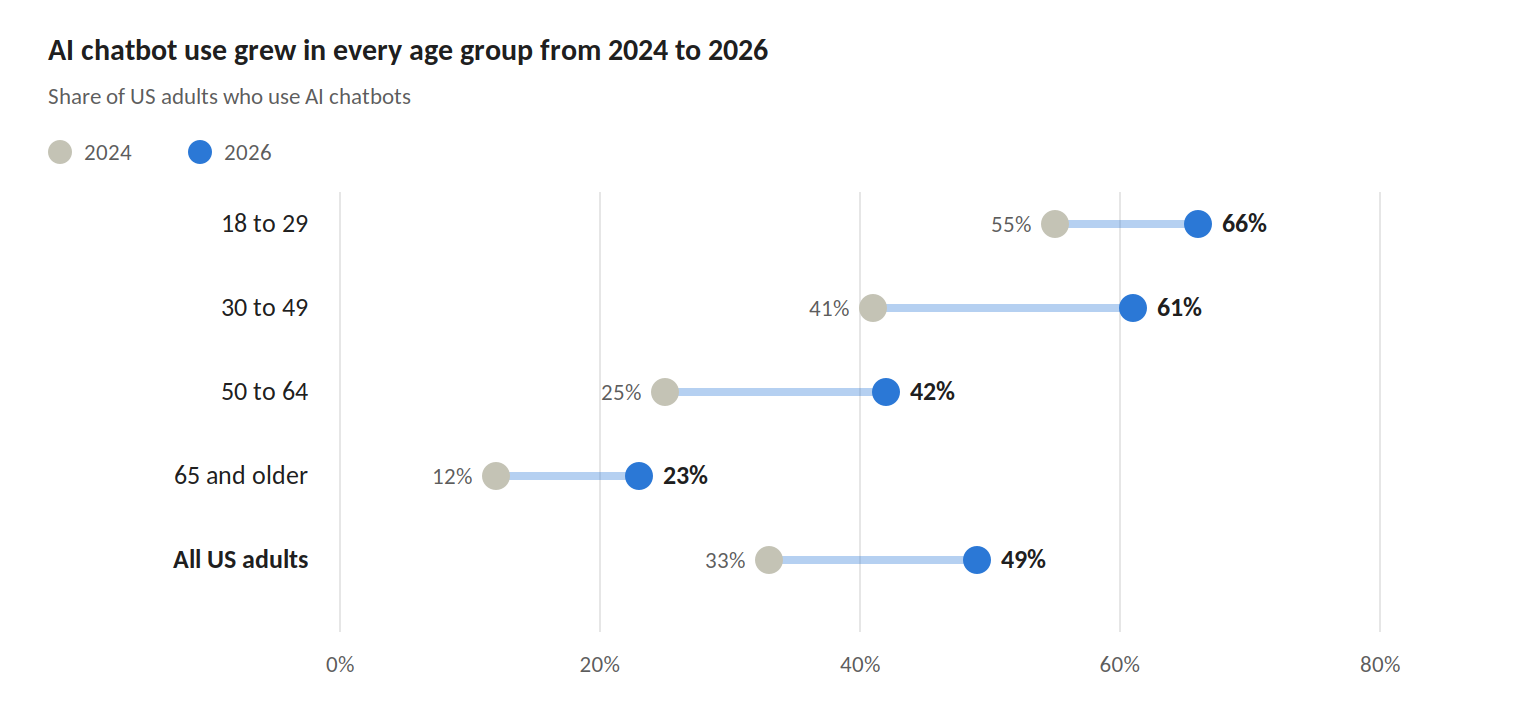
Daily use, search use and AI summary reading follow the same age pattern (February 2026):
| Age Group | Use Chatbots Daily | Use Chatbots to Search for Information | Read AI Search Summaries |
|---|---|---|---|
| 18 to 29 | 31% | 54% | 72% |
| 30 to 49 | 34% | 53% | 68% |
| 50 to 64 | 19% | 37% | 59% |
| 65 and older | 7% | 20% | 38% |
| All US adults | 24% | 42% | 60% |
Every age group reads AI summaries more often than it uses chatbots. Older searchers meet AI answers mainly inside Google, not in a chatbot.
What AI search users ask for
Information lookups are the fastest-growing use of AI assistants. Four data points show the mix:
- Looking things up grew from 14% to 24% of ChatGPT messages between July 2024 and July 2025
- Non-work messages rose from 53% to 73% of ChatGPT use between June 2024 and June 2025
- 39% of US consumers have used AI assistants for online shopping (June 2026)
- Weekly use of AI chatbots for news rose from 7% to 10% across markets in one year (June 2026)
For brands, shopping is the use to watch. With 39% of US consumers already using AI assistants for online shopping, product pages, reviews and comparisons now compete for a buyer’s attention inside AI answers, before that buyer reaches any website.
What is the AI search market share in 2026?
ChatGPT still leads AI search on every measure, but its share fell sharply in 2026 as Gemini and Claude grew. ChatGPT’s share of US AI prompts dropped from 70% in January to 50% in June 2026.
ChatGPT vs Gemini vs Claude market share
ChatGPT’s lead ranges from 50% to 80%, depending on what each measure counts:
| Measure | ChatGPT | Gemini | Claude |
|---|---|---|---|
| Chatbot referrals to tracked sites, worldwide, September 2026 | 80.48% | 10.91% | 0.95% |
| Chatbot referrals to tracked sites, US, September 2026 | 75.17% | 13.26% | 1.81% |
| Visits to generative AI websites, May 2026 | About 53% | 27% to 28% | About 9% |
| US AI prompt volume, June 2026 | 50% | 30% | 11% |
The first two measures count the visits chatbots send to websites, the third counts visits to the AI sites themselves, and the fourth counts prompts in a US consumer panel. Gemini gained the most, rising from under 9% to 27% to 28% of generative AI web visits in a year.
AI search vs Google search
Google search still handles far more searches than AI tools, and its own volume is still growing. Three figures show the gap:
- Only 0.34% of US Google searches moved into AI Mode between January and April 2026
- 35% of US desktop users and 29% of mobile users visited an AI assistant in June 2026, up from 25% and 12% in January 2025
- Google Search queries hit an all-time high in Q1 2026, and Alphabet’s Search revenue grew 17% in Q2 2026
AI search is adding a second place for answers, not replacing the first one.
How often AI answers appear in Google results
AI Overviews appear on between 13.7% and 48% of Google searches, depending on which searches a study measures. US desktop searches showed an AI Overview 39.4% of the time in June 2026, up from 25.8% in July 2025.
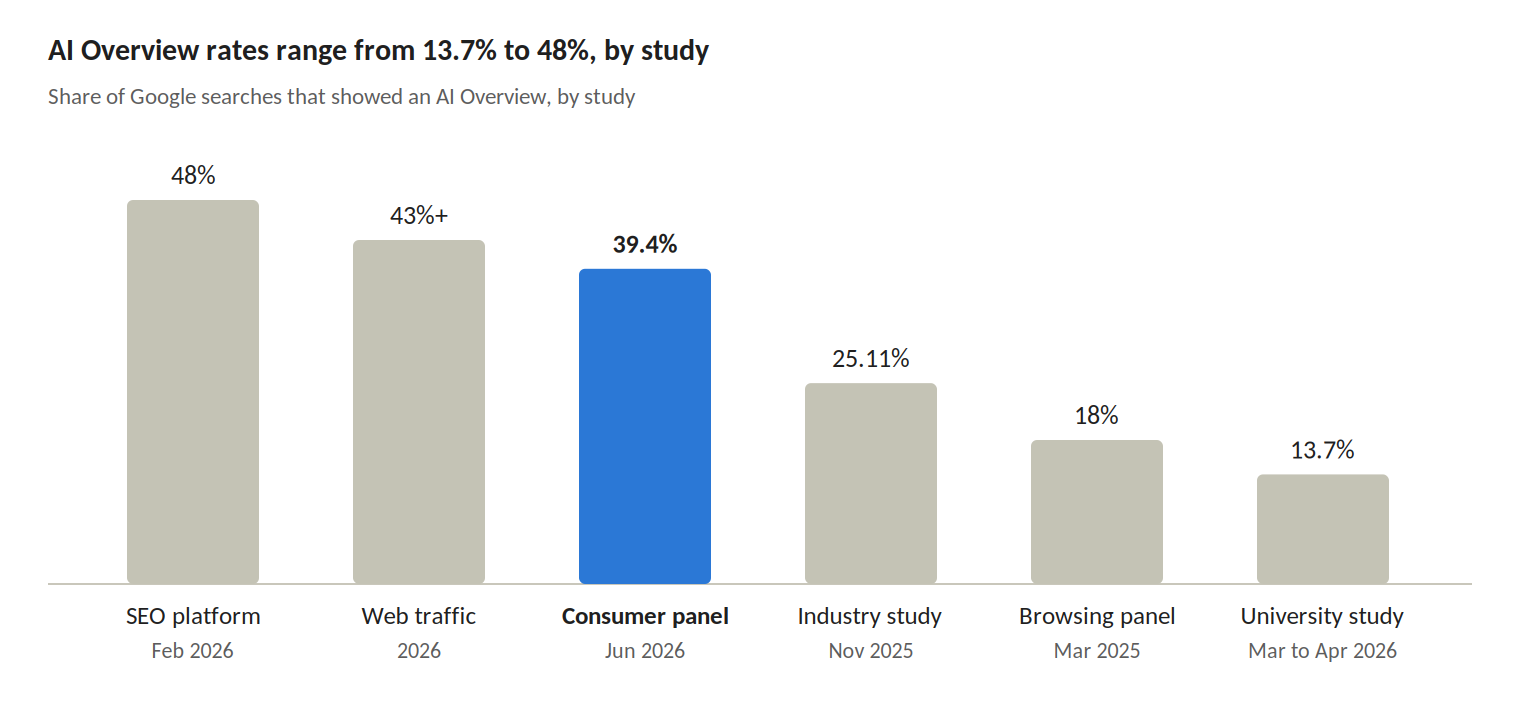
Query wording explains most of the spread. AI summaries appeared on 53% of searches with 10 or more words, against 8% of one- or two-word searches, and on nearly 65% of question-form queries. On Bing, Copilot Search answers appeared on 17.3% of US searches in June 2026.
How does AI search affect click-through rates?
AI search cuts clicks to websites: 68.01% of US Google searches ended without a click in early 2026, and searchers click a regular result about half as often when an AI summary appears. The clicks that remain convert better.
Zero-click searches
Zero-click searches are searches that end without a click to any website, and they now make up 68.01% of US Google searches (January to April 2026). The share stood at 60.45% in 2024 and about 45% ten years earlier. Searches that led to any click fell 9.51 points between 2024 and 2026, a 22.9% drop.
Searcher clicks when an AI summary appears
Searchers who saw an AI summary clicked a regular result on 8% of visits, against 15% for those who saw none, in browsing data from March 2025.
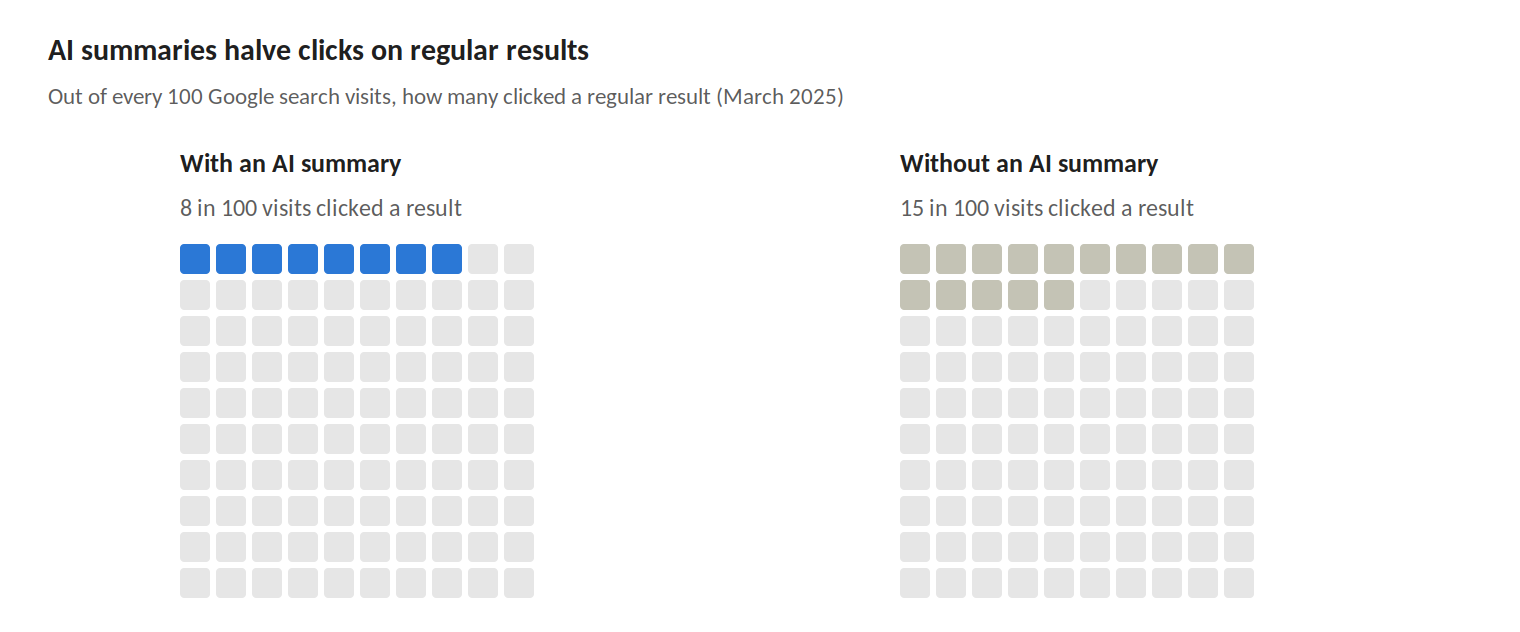
Searchers who saw an AI summary also ended their browsing session on 26% of pages, against 16% when no summary appeared.
Links inside the AI summary drew a click on just 1% of visits. Chatbots show the same pattern: across 27 markets, 4% of chatbot users say they always or often click through to the original source (June 2026).
Referral traffic from AI platforms
AI platforms sent an average of 770.7 million referral visits a month worldwide between June 2025 and May 2026, up 117.4% year over year. That growth starts from a small base. AI referrals made up 1.08% of website traffic across 3.3 billion sessions (November 2025), while Google accounts for about 88% of referral traffic on one of the largest content delivery networks (July 2026).
ChatGPT sent 87.4% of AI referrals in the same sample. Its answers also link out more often: the share of US ChatGPT prompts answered with a citation grew from about 1.6% to 6.8% between June 2025 and May 2026.
How AI-referred visitors convert
AI-referred visitors convert better than other traffic on US retail sites. In May 2026, they converted at a 54% higher rate and generated 53% more revenue per visit than other visitors. AI-driven traffic to US retail sites grew 138% year over year, and AI-referred shoppers viewed 23% more pages per visit.
What these numbers mean for SEO and marketing teams
The 2026 data splits AI search into two goals: being visible inside AI answers, and winning the fewer, higher-value clicks that remain. Four takeaways follow:
- Track more than ChatGPT. ChatGPT handles 50% of US AI prompts, so monitoring one assistant covers half the picture.
- Treat AI answers as a first impression. 60% of US adults read AI summaries, while only 1% of visits include a click inside one.
- Judge AI traffic on conversions, not volume. AI referrals make up about 1% of website traffic, but AI-referred shoppers convert 54% better on US retail sites.
- Keep Google SEO strong. Google still sends about 88% of referral traffic on one of the largest content delivery networks, and AI Overviews draw on Google’s own index.
Budgets are already moving. 94% of enterprise CMOs plan to increase investment in AEO (answer engine optimization) and GEO (generative engine optimization) in 2026, after putting an average of 12% of digital marketing budgets into AEO in 2025 (January 2026). Brands can follow how ChatGPT, Gemini and Google describe them through AI brand monitoring.
FAQs
How many US teens use AI chatbots?
64% of US teens use AI chatbots, and 57% have used them to search for information (February 2026).
Do users trust AI search answers?
Only partly. Just 20% of news users worldwide trust news from AI chatbots (June 2026), and 39% of Americans believe AI does more harm than good (July 2026).
How accurate are Google AI Overviews?
Mostly accurate, but not fully. About 11% of verifiable claims in AI Overviews lacked support from, or contradicted, their cited sources (2026).
Is more web traffic now coming from AI bots than from humans?
Yes. More than 50% of internet traffic became non-human in 2026, and 52% of crawler requests were for AI training in June 2026.