The Citation Paradox: Cited as a Source, Not Recommended as a Vendor
AI visibility is often measured by how frequently a brand appears in AI-generated responses. However, being cited does not always mean being recommended. A…
AI visibility is often measured by how frequently a brand appears in AI-generated responses. However, being cited does not always mean being recommended. A brand may be referenced as a trusted source for informational queries yet remain absent when users ask which product or service they should choose.
The paradox exists because AI answer engines respond differently to informational and commercial queries. Informational prompts often retrieve authoritative sources that explain a topic, while buying oriented prompts compare multiple vendors before making a recommendation. As a result, strong citation visibility does not always translate into commercial visibility.
Understanding this distinction helps marketers measure AI performance more accurately. Instead of evaluating citations alone, brands should also assess how often they are recommended in purchase-focused conversations.
What Is the Citation Paradox?
The Citation Paradox describes the gap between being recognized as a reliable source of information and being recommended as the best solution to buy or use. While both contribute to AI visibility, they represent different outcomes and should not be measured interchangeably.
According to Google research (2022), 53% of shoppers say they always do research before buying to ensure they are making the best possible choice. This shows that discovery and decision-making happen at different stages, where brands need visibility beyond informational content
Being Cited Doesn’t Mean Being Chosen
A citation shows that AI considered a brand’s content useful for supporting an answer. A recommendation, however, indicates that AI selected the brand as a suitable option to solve a user’s problem or meet their needs.
For example, an AI assistant may cite a CRM company’s research when explaining customer relationship management, but recommend a different vendor when a user asks for the best CRM for a startup.
Why the Two Are Different
Citations and recommendations serve different purposes within an AI-generated response.
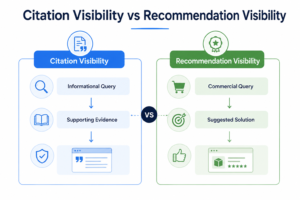
- Citation visibility reflects how often a brand is used as supporting evidence for informational queries.
- Recommendation visibility reflects how often a brand is presented as a solution for commercial or decision-making queries.
- A brand can perform well in one area without achieving the same level of visibility in the other. Recognizing this difference is the first step to understanding why citation performance alone does not reflect a brand’s competitive position in AI search.
Quick Comparison
| Basis | Citation Visibility | Recommendation Visibility |
|---|---|---|
| Purpose | Supports AI-generated answers with evidence | Helps users choose a product, service, or vendor |
| Role | Appears as a cited source | Appears as a recommended solution |
| User Intent | Informational and educational queries | Commercial and buying queries |
| What It Measures | Brand authority and topical expertise | Competitive visibility and buying influence |
| Typical Prompt | "What is HubSpot?" |
"Which CRM is best for startups?" |
| Success Looks Like | Your content is cited in AI responses | Your brand is recommended over competitors |
Why the Citation Paradox Happens
The Citation Paradox occurs because AI answer engines adapt their responses to the user’s intent. A brand that is highly visible for informational questions may compete in a very different environment when the conversation shifts toward product selection or purchasing decisions.
Branded Queries Inflate Citation Share
Branded queries already identify the company the user wants to learn about. Questions such as “What is HubSpot?” or “How does Notion work?” naturally retrieve information from or about those brands, increasing their citation visibility.
Category Buying Queries Change the Competition
Category-based buying queries expand the set of possible answers. Searches such as “Best CRM for startups” or “Best project management software” require AI to evaluate multiple vendors, comparison articles, expert reviews, and buying guides before recommending a solution. This reduces the advantage of simply being a well-cited brand.
AI Responds to User Intent
The same brand can receive different levels of visibility depending on the type of question being asked.
- Informational intent focuses on explaining a topic, making citations more likely.
- Commercial intent focuses on helping users evaluate options, making recommendations more important.
As user intent changes, so does the way AI selects and presents brands. This shift creates the gap between citation visibility and recommendation visibility that defines the Citation Paradox.
Where Brands Lose Share of Voice
Brands lose share of voice when AI shifts from answering questions about a specific company to helping users evaluate and choose between multiple options. In these situations, every relevant vendor competes for visibility, making recommendation presence more difficult to earn than citation presence.
A 2022 study by Backlinko analyzing Google search results found that the top organic result receives approximately 27.6% of all clicks, showing that visibility drops significantly as more results compete for user attention.
Comparison Prompts
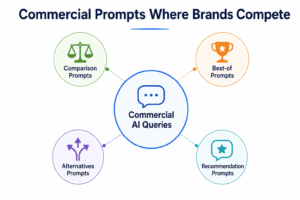
Comparison prompts ask AI to evaluate two or more competing brands. Queries such as “HubSpot vs Salesforce” or “Notion vs ClickUp” require AI to compare features, pricing, strengths, and limitations before presenting a recommendation. Even well-known brands can lose visibility if competitors better match the user’s requirements.
Best-of Prompts
Best-of prompts identify the strongest options within a category rather than focusing on a single brand. Questions such as “Best CRM for startups” or “Best AI writing tool” require AI to shortlist multiple vendors based on factors such as functionality, pricing, ease of use, and customer needs. Every brand competes for inclusion in the final recommendation.
Alternatives Prompts
Alternative prompts are used when users want to replace or compare an existing product. Queries such as “Alternatives to HubSpot” or “Alternatives to Canva” encourage AI to introduce competing vendors, creating opportunities for challengers while reducing the visibility of the original brand.
Recommendation Prompts
Recommendation prompts ask AI to suggest the most suitable solution for a specific requirement. Questions such as “Which CRM should a small business use?” or “What is the best project management software for remote teams?” require AI to evaluate multiple vendors before recommending one or more options that best match the user’s needs.
Brands that consistently appear across these commercial prompt types are more likely to increase recommendation visibility. Those that remain visible only for branded or informational queries often experience the Citation Paradox, where they are recognized as trusted sources but overlooked during purchase decisions.
How to Measure the Citation Paradox
The Citation Paradox can only be measured by comparing citation visibility with recommendation visibility. Measuring only one metric provides an incomplete picture of AI performance. A brand may appear frequently as a trusted source while rarely being recommended when users are evaluating products or services. Comparing both metrics helps identify whether authority is translating into commercial visibility.
Track Citation Share
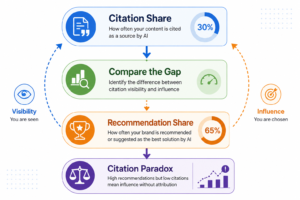
Citation share measures how often your brand appears as a supporting source in AI-generated responses. A high citation share indicates that AI consistently recognizes your content as credible evidence for informational queries and uses it to support its answers.
Track Recommendation Share
Recommendation share measures how often AI suggests your brand in commercial, comparison, and buying-focused queries. A high recommendation share indicates that your brand is consistently considered a suitable solution when users are making purchase decisions.
Compare the Gap
Comparing citation share with recommendation share reveals whether your AI visibility is balanced across both informational and commercial queries.
For example:
- Citation Share: 42%
- Recommendation Share: 8%
In this example, the brand is frequently cited as a trusted source but is recommended far less often when users ask for the best solution. This gap indicates that the brand has built authority but has not converted that authority into competitive visibility. The larger the difference between these two metrics, the more pronounced the Citation Paradox becomes.
How to Close the AI Citation Gap
Closing the AI citation gap requires more than publishing content on your own website. Brands need to increase the number of trusted signals AI systems can verify across the web. This means improving how your brand appears in its category, earning independent recognition, and creating content that matches the way users search through AI platforms.
Improve Category Visibility
Category visibility helps AI understand where your brand fits and what topics it is associated with. Strengthen this by creating authoritative resources, publishing industry insights, and building consistent signals around your core expertise.
Focus on:
- Creating topic-focused content around your category.
- Publishing original insights and research.
- Maintaining consistent brand information across platforms.
Earn Comparison and Evaluation Coverage
Comparison coverage helps AI understand how your brand relates to competitors and alternatives. Since users often ask AI tools for recommendations, being included in comparison content increases the chances of appearing in decision-making responses.
Focus on:
- Creating transparent comparison resources.
- Earning mentions in industry comparison articles.
- Building visibility across review and recommendation platforms.
Strengthen Independent Recommendations
Independent recommendations provide stronger trust signals because they come from sources outside your control. AI systems are more likely to trust brands that are recognized by experts, publications, and relevant communities.
Focus on:
- Earning expert mentions.
- Building relationships with industry publications.
- Encouraging genuine reviews and testimonials.
Expand Commercial Prompt Coverage
AI users often search with purchase-focused questions such as “best,” “top,” “alternative,” or “which one should I choose.” Brands need visibility beyond informational queries to appear during these commercial decision stages.
Focus on:
- Creating content targeting comparison and buying queries.
- Answering common customer decision questions.
- Building presence on trusted recommendation sources.
Frequently Asked Questions
1. Can a brand be cited by AI without being recommended?
Yes. AI may cite a brand as a reliable source of information but recommend another vendor for purchase-related queries.
2. Why are branded and category queries different?
Branded queries focus on a specific company, while category queries compare multiple vendors before making a recommendation.
3. Does high citation visibility guarantee commercial visibility?
No. A brand can earn frequent citations yet have low recommendation visibility for buying-focused prompts.
4. How can brands identify the Citation Paradox?
Compare citation visibility with recommendation visibility. A significant gap between the two indicates the Citation Paradox.
5. Should brands measure citations and recommendations separately?
Yes. They measure different outcomes authority and buying influence and should be evaluated independently.

kashish
Passionate about SEO, AI search, and content marketing, sharing practical insights on search trends, AI visibility, and digital growth.