Does Your Link-Building Program Produce Any AI Visibility?
For years, link-building success has been measured by backlinks, search rankings, referral traffic, and domain authority. These metrics still matter, but they don’t tell…
For years, link-building success has been measured by backlinks, search rankings, referral traffic, and domain authority. These metrics still matter, but they don’t tell you whether your links help your content appear in AI-generated answers.
That world has changed. AI-powered search and chat tools like ChatGPT, Perplexity, and Google’s AI Overviews don’t browse the web the way a human does by clicking through search results. They pull from a mix of indexed content, structured data, and sources they’ve learned to “trust” over time, and a link can rank beautifully on Google while being completely invisible to these systems.
That’s the gap this article addresses. A guest post can carry a strong backlink profile, sit on a high-authority domain, and still never get surfaced, cited, or referenced by an AI model. Traditional SEO metrics won’t tell you that. You need a different lens.
You’ll learn how to audit your link-building efforts, identify invisible links, evaluate placements across the same domains, and optimize future campaigns for greater AI visibility.
What Does AI Visibility Mean for Link Building?
AI visibility means: how likely is it that AI tools like ChatGPT, Perplexity, or Google AI Overviews actually use content from your backlinks or guest posts when they answer someone’s question? It has nothing to do with rankings or Domain Rating. It’s about whether these tools find your content worth using at all.
To make sense of this, it helps to break the process into three separate steps:
- Backlink placement: the link is live. Your guest post got published, simple as that.
- AI retrieval: an AI tool actually finds and reads that content while looking for an answer.
- AI citation: the AI goes a step further and actually uses that content in its answer.
Here’s the catch: a link can easily clear step one and never make it to step two or three. And most link-building reports only track step one, which is why the real problem stays hidden.
That’s what we mean by an invisible link. It’s a placement that looks perfectly fine from the outside live, indexed, maybe even ranking well on Google but never shows up in any AI-generated answer. Not the page, not even the domain gets mentioned when relevant questions are asked. It exists, but as far as AI is concerned, it might as well not.
The AI Visibility Audit: A Step-by-Step Framework
Now that you understand the difference between placement, retrieval, and citation, here’s how to actually check where your links stand. This is a five-step process you can run manually with no special tools required, just some organization and patience.
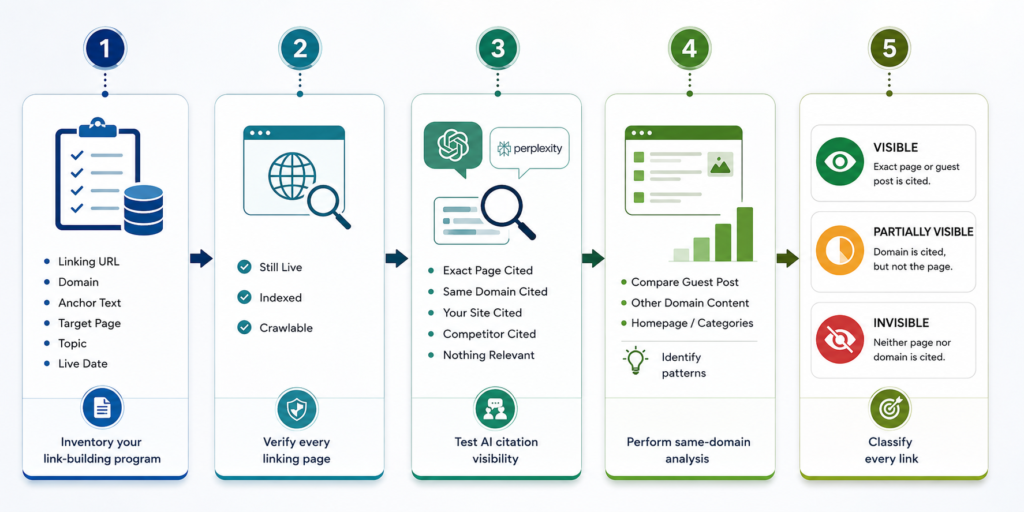
Step 1: Inventory Your Link-Building Program
Before you can audit anything, you need to know exactly what you’re auditing. Pull together every link your program has earned, across every type:
- Guest posts
- Editorial backlinks
- Digital PR placements
- Resource page links
- Niche edits
- Brand mentions (if they’re linked)
For each one, record the basics: the linking URL, the domain it’s published on, the anchor text used, which page on your site it points to, the topic it covers, and when it went live.
This might feel tedious if you’ve been building links for years, but it’s the foundation for everything that follows. A spreadsheet works fine; you don’t need anything fancy at this stage.
Step 2: Verify Every Linking Page
Links decay over time. Sites get redesigned, articles get deleted, domains get sold and a link you earned two years ago might not even exist anymore.
Go through your list and check each page for three things:
- Is it still live and accessible?
- Is it indexed by search engines?
- Is it crawlable, or has it been blocked by a robots.txt rule or a noindex tag?
While you’re at it, flag anything broken in your spreadsheet: dead pages, removed content, redirected URLs, or links that have simply disappeared.
If a page fails this check, either remove it from your audit or mark it for replacement there’s no point testing AI visibility on a page that no longer exists.
Step 3: Test AI Citation Visibility
This is where the real audit begins. For each surviving page, pick a handful of prompts that match its topic questions a real user might actually type into ChatGPT or Perplexity.
Run those same prompts across a few different AI platforms and note what happens:
- Does the exact guest post get cited?
- Does a different page from the same domain get cited instead?
- Does your own website show up, even if that specific page doesn’t?
- Does a competitor get cited in your place?
- Or does nothing relevant come up at all?
One distinction matters here: a citation and a mention are not the same thing. A citation means the AI names or links your page as the source of the specific claim it’s making. A mention is looser your brand or domain comes up in the answer without being credited as the source. Log which one you’re actually seeing, not just whether your name appeared somewhere in the output. That difference is what separates a placement that’s genuinely earning trust from one that’s just floating nearby.
Log everything in a spreadsheet as you go. You’re building a dataset here, and patterns only become obvious once you can compare results side by side.
Step 4: Perform a Same-Domain Analysis
Sometimes a guest post doesn’t get cited, but the domain it’s on does just for other content. This step helps you figure out why.
Compare three things: your guest post, other articles on that same domain, and the site’s homepage or category pages. Then ask what’s different about the content that AI does prefer.
You’re looking for patterns like:
- AI consistently favoring certain content types (data-driven pieces over opinion pieces, for example)
- Higher-quality or more detailed articles getting picked over thinner ones
- Pages that are part of a strong topical cluster getting cited more than standalone posts
This step matters because it tells you where the problem actually sits. If the domain gets cited regularly but your post doesn’t, the issue is probably with your content or how it was framed, not the publisher.
If the whole domain is invisible to AI, the issue is bigger than any one placement.
Step 5: Classify Every Link
With your data in hand, sort every link into one of three buckets:
Visible: the exact page or guest post shows up in AI-generated citations. This is your best-performing content, worth studying and replicating.
Partially Visible: the domain gets cited, but not your specific page. This tells you the publisher is trusted by AI; your content just isn’t the piece they’re pulling from. (Make sure this bucket only includes true citations of the domain, not unlinked mentions otherwise you’ll overstate how trusted the publisher actually is.)
Invisible: neither your page nor the domain shows up anywhere, for any relevant query. This is your weakest tier, and it’s where you’ll want to focus improvements or reconsider future placements.
Once every link has a category, you’ll have a clear, evidence-based picture of your program not guesswork, but actual data on where your link building is paying off in AI search and where it’s quietly going nowhere.
Why Some Links Remain Invisible to AI
The invisible bucket is rarely random. Certain kinds of content and placements consistently fail to earn AI trust, and once you know the patterns, they’re easy to spot in your own audit.
- The content is thin, generic, or reads like an ad. AI models are trained to pull from content that actually answers a question well. A 500-word guest post that skims the surface of a topic, or one that’s clearly written to plug a product, doesn’t give the AI much to work with. It’s not useful enough to cite.
- The post was written to get a backlink, not to help anyone. This is the root cause behind a lot of invisible links. When the goal is “get published, get the link,” the content quality often takes a back seat. AI systems are essentially filtering for helpfulness, and content built around a link instead of a reader tends to show it.
- There’s nothing original in it. If your guest post is just repeating what’s already been said elsewhere, no new data, no expert opinion, no fresh angle there’s no reason for an AI to pick your version over the dozens of similar articles already out there. Original research or genuine insight is one of the strongest signals you can offer.
- The topic doesn’t quite match the page it’s linking to. Sometimes a link gets placed on a page that’s only loosely related to your target topic. Even if the article itself is decent, that mismatch weakens the signal. AI tools are looking for tight, clear relevance between a query and the source it’s pulling from.
- The publishing site itself isn’t trusted. Not every website carries the same weight with AI systems. A domain with little authority, thin content history, or a reputation for low-quality publishing is less likely to be treated as a reliable source, no matter how good your individual guest post is.
- The publisher’s site has a weak structure. Poor internal linking, disorganized categories, and a lack of clear topical clusters make it harder for AI (and search engines in general) to understand what a site is really about. If the publisher’s own architecture is messy, your content can get lost in it.
- The content hasn’t been touched in years. AI systems tend to favor content that’s current, especially for fast-moving topics. A guest post that hasn’t been updated since it was published while competitors are refreshing similar content regularly starts to look outdated by comparison, even if the core information is still technically accurate.
Taken together, these factors explain why a technically live, indexed, even well-ranking link can still be invisible to AI. It’s less about any single mistake and more about whether the content and its home on the web actually earn trust.
What to Do If Your Links Are Invisible
Finding invisible links isn’t the end goal. Fixing them is.
Improve Existing Link Assets
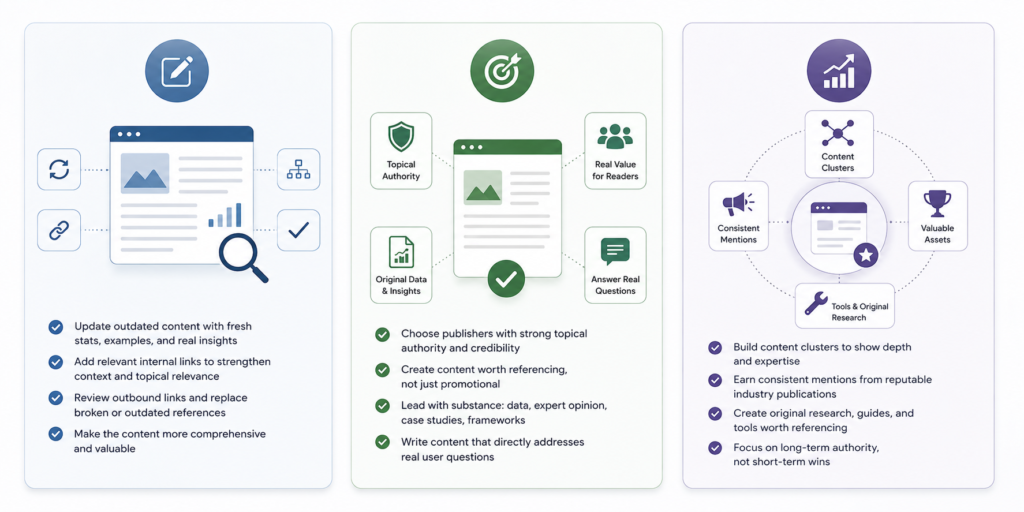
Refresh what’s outdated. If the publisher allows edits, update old guest posts with fresher stats, current examples, and something the original lackeda real insight, a number, an example from actual experience.
Strengthen the page’s own connections. A guest post linked to other relevant articles on the same site looks like part of something bigger; a standalone piece doesn’t carry the same weight.
Check what it links out to. Old studies or dead pages referenced inside the post drag the whole thing down, even if your section of it is solid.
Improve Future Link Placements
Be pickier about where you publish. A site with genuine topical authority beats one with just traffic.
Rethink what you’re producing. Promotional content with a link attached isn’t the goal; something people would bookmark or reference on their own is.
Lead with substance. Original data, a real expert take, a case study, a usable framework give the AI something worth pulling from.
Write toward what people actually ask about AI tools. Content that reads like a direct answer gets picked up far more than content written to hit a word count.
Strengthen Your Overall Topical Authority
No single placement fixes this alone. AI systems trust depth in a body of work, not one great article.
Build supporting content clusters on your own site. A single strong page surrounded by thin or unrelated content doesn’t carry the same weight as one that’s part of a coherent topic.
Earn consistent mentions from publications that matter in your industry. One guest post proves little; the same name showing up repeatedly does.
Create things worth referencing in the first place. Original research, a genuinely useful guide, a tool people actually reach for this is what earns visibility you’re not constantly chasing.
What Metrics to Track After the Audit
Running the audit once helps. Tracking it over time is where you see what’s actually working.
- The Visible / Partially Visible / Invisible split. Your starting point, and what you’ll compare against later.
- How many AI platforms cite you. ChatGPT alone is fine. ChatGPT, Perplexity, and AI Overviews together means more.
- How often citations repeat. One mention could be luck. The same page cited across different prompts means it’s earned some trust.
- Which domains keep showing up. A few publishers will appear again and again. Those are worth prioritizing next.
- Regular search performance too. AI visibility runs alongside SEO, not instead of it. A page doing well in both is the real win.
- Referral traffic from strong placements. Citations should still send real clicks. If they’re not, dig into why.
- Whether visibility improves after a fix. Refresh a page, check back in a few weeks if it starts showing up, the work paid off.
Track these consistently, and the audit stops being a one-time task. It becomes a loop that shows you what’s actually working.
Conclusion
Traditional SEO metrics backlinks, Domain Rating, rankings, referral traffic aren’t going anywhere, and they shouldn’t. But they only tell half the story now. The other half is whether AI platforms actually use what you’ve built, and that’s not something those metrics were ever designed to answer. This audit fills that gap: a clear, evidence-based view of which placements are earning real AI citations, and which ones despite looking solid on paper are sitting invisible.
This isn’t a one-time exercise. Run it regularly, fix the placements that keep coming up invisible, and prioritize content that’s genuinely worth citing: well-researched, useful, published on sites with real authority. Do that consistently, and your link-building program starts working for both search engines and AI systems, not just one of them.
