Branded search comes from users who already know your company. Non-branded search comes from users who do not. The two halves answer different questions, move for different reasons, and require different decisions. One organic traffic line merges them and hides both.
The split matters more in 2026 than in any previous year. AI Overviews absorb non-branded informational clicks while leaving branded queries intact. SparkToro, using Similarweb data, measured 68% of US Google searches ending without an external click between January and April 2026. A brand cited inside an AI Overview earns awareness without a session, and that awareness surfaces later as a branded search.
This article covers how to segment the two halves, what each half means when it moves, why rising branded search signals that AI visibility works, and which reporting mistakes produce false conclusions.
What is Branded vs Non-Branded Search?
What is Branded Search?
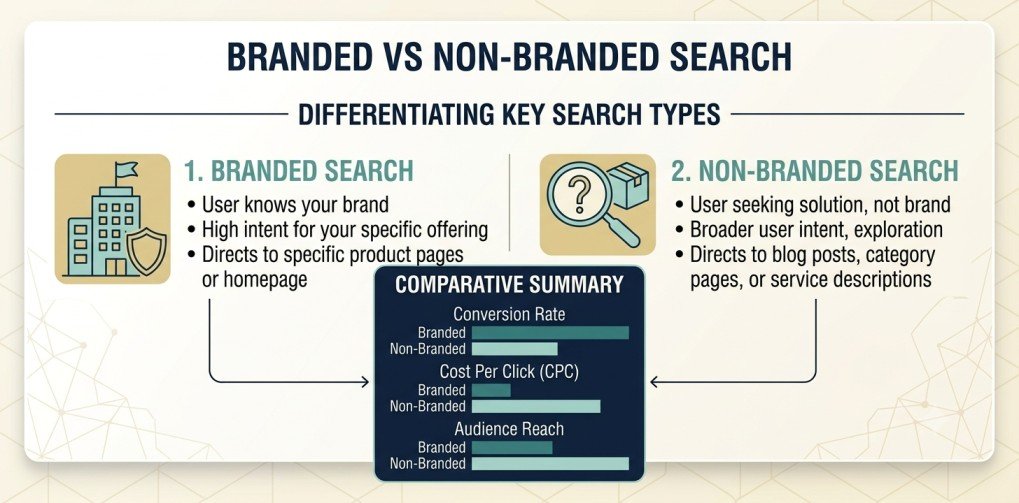
Branded search is any query containing your company name, product names, or their variants. Examples include “RankingBite,” “RankingBite pricing,” “rankingbite reviews,” and common misspellings.
Branded queries carry existing awareness. The user learned your name somewhere else, then used Google as a navigation tool.
What is Non-Branded Search?
Non-branded search is any query describing a problem, category, or need without naming your company. Examples include “seo agency in kanpur,” “what is zero-click search,” and “best rank tracking tools.”
Non-branded queries carry no prior awareness. The user knows the problem. The user does not know you.
Why Does the Difference Matter?
The two halves measure different assets:
- Non-branded search measures discovery. It answers whether new people find you.
- Branded search measures demand. It answers whether people already want you.
Non-branded queries convert lower and cost more to win. Branded queries convert higher and require no ranking fight. A campaign that grows one and shrinks the other has not failed. It has traded.
Why Does the Split Matter More in AI Search?
Zero-Click Search Changes the Funnel
AI Overviews trigger on 39.4% of informational queries and 4% of e-commerce queries. Informational queries are almost entirely non-branded. The absorption therefore lands on one half of your split.
The funnel did not shrink. The top of it moved inside Google. Discovery now happens without a session.
AI Visibility Often Creates Brand Demand
A citation inside an AI Overview delivers brand exposure without a click. The user reads the answer, notices the source, and closes the tab. Days later, that user searches your brand name directly.
Branded impressions record this path. Non-branded clicks never do. A team measuring only sessions reports the first event as a loss and never connects it to the second.
Why Rankings Alone Don’t Tell the Whole Story
Position 1 no longer guarantees inclusion in an AI answer. Pages ranking in positions 11 to 20 earn citations when they answer a sub-query better. Rank trackers report position. Position no longer predicts visibility.
Google confirmed the underlying mechanism in its May 2026 generative AI optimization guide: AI Overviews and AI Mode run on core Search ranking and quality systems. Ranking controls retrieval eligibility. Citation controls what the user actually sees.
AI Citations Can Increase Brand Demand Without Driving Clicks
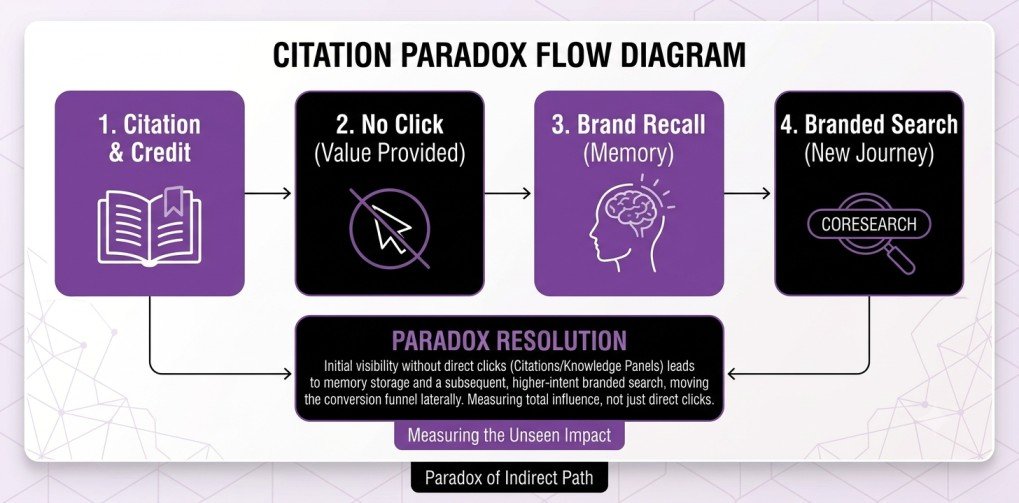
This is the citation paradox: visibility rises, clicks fall, and demand grows anyway. Seer Interactive found brands cited inside an AI Overview earn 35% more clicks than uncited brands on the same query. The clicks that never happen still deposit brand recall.
Branded search growth is the downstream receipt.
How Do You Segment Branded and Non-Branded Search?
Using Google Search Console
Search Console is the only source with query-level data. Build two saved filters:
- Open the Performance report and select Search results.
- Add a Query filter using Custom (regex).
- Branded filter: match your brand name plus misspellings. Example pattern:
rankingbite|ranking bite|rankingbight. - Non-branded filter: use the same regex with “Doesn’t match” selected.
- Save both as separate views and export monthly.
Record impressions, clicks, CTR, and average position for each half.
Using GA4 and Other SEO Tools
GA4 does not report search queries. Google withheld query data from analytics platforms starting with the 2011 “(not provided)” rollout, and GA4 inherits that limit. Two workarounds exist:
- Link Search Console to GA4. The integration adds limited query reports and connects landing pages to sessions.
- Segment by landing page instead. Homepage and brand pages approximate branded intent. Category and guide pages approximate non-branded intent.
Third-party tools estimate the split from their own keyword databases. Treat those figures as proxies, not measurements. Search Console holds the actual data.
Creating a Consistent Reporting Framework
One inconsistent regex produces months of unusable trend data. Fix four rules before you report:
- Freeze the brand regex. Add new misspellings only at quarter boundaries.
- Use the same date windows every month, compared year over year.
- Report four metrics per half: impressions, clicks, CTR, conversions.
- Store the exported data. Search Console retains 16 months.
How Do You Read Non-Branded Search Performance?
What Growth Usually Indicates
Rising non-branded impressions indicate expanding discovery. New queries reach your pages. Topical coverage is working.
Rising non-branded clicks indicate discovery plus retained CTR, which in 2026 means your pages sit on queries AI Overviews have not absorbed.
Warning Signs to Watch For
Three patterns require action:
| Pattern | Diagnosis |
|---|---|
| Impressions up, clicks down, informational queries only | AI Overview absorption. Rankings held. |
| Impressions and clicks falling together, all query classes | Ranking loss. Diagnose as algorithm or technical. |
| Impressions flat, clicks down, conversions down | Intent mismatch. Pages rank for the wrong queries. |
Only the second and third patterns describe damage. The first describes a changed SERP.
Metrics That Matter Beyond Rankings
Track five numbers on the non-branded half:
- Impressions by query class
- CTR by query class
- Conversions from non-branded landing pages
- Conversion rate per non-branded visit
- Citation rate on your priority prompt set
Conversion rate per visit rises during absorption. Low-intent visitors stop arriving, and the remaining visitors carry intent.
How Do You Read Branded Search Performance?
Rising branded search indicates growing demand. Rising branded search does not prove SEO caused it. This distinction separates honest reporting from credit-taking.
Interpret Branded Search Alongside Other Marketing Channels
Branded search is a shared outcome. Six inputs move it: SEO citations, PR coverage, paid campaigns, social content, offline marketing, and word of mouth. Reporting branded growth in an SEO deck without naming the other five overstates the channel.
Branded Search Isn’t Always a Sign of SEO Success
Branded volume also rises for reasons no one celebrates. A product outage sends users searching your name. A pricing change triggers “brand + refund” queries. A competitor’s campaign naming you produces comparison searches.
Read the query mix, not the total. “Brand + pricing” and “brand + reviews” indicate purchase intent. “Brand + cancel” and “brand + complaint” indicate a different problem.
Offline Marketing Can Increase Branded Searches
Billboards, events, print, radio, and sponsorships produce branded searches with no digital trace. A conference appearance generates a branded spike three days later that no SEO activity caused.
Map offline activity dates against branded impression spikes before attributing the lift.
PR, Social Media, and Paid Campaigns Also Influence Brand Demand
A press mention reaching a large audience moves branded search within 48 hours. A paid campaign running on your brand terms cannibalizes branded organic clicks while total branded impressions rise. Social content produces branded searches from users who never click the post.
Each of these confounds the SEO reading. Each also feeds AI visibility, because generative systems ingest text and unlinked mentions corroborate your entity.
Why Attribution Matters When Reading Branded Search
Branded search sits at the end of a path that started elsewhere. Attribution answers where. Three methods help:
- Time-lag analysis. Compare branded spikes against a dated log of PR, campaigns, and offline activity.
- Assisted conversions. Multi-touch reports capture the non-branded touch that preceded the branded conversion.
- Holdout testing. Pause a channel in one region and measure the branded delta.
None of these is exact. All of them beat assuming.
Always Compare Multiple Performance Signals
Read branded search against four other signals before drawing a conclusion: non-branded impressions, citation rate on your prompt set, dated marketing activity, and direct traffic. Branded growth alongside rising citation rate and no marketing spend indicates AI visibility working. Branded growth during a paid campaign indicates the campaign.
Which Mistakes Should You Avoid When Reading the Split?
Looking Only at Organic Traffic
One organic sessions line merges a 39.4% AI exposure class with a class carrying almost none. The line falls, the report says failure, and the branded half that grew stays invisible.
Ignoring AI Visibility
Citation rate is the input that produces branded demand. Search Console does not report it, and as of 2026 no AI Overview dimension exists in the Performance report. A team that never measures citations cannot explain its own branded growth.
Assuming Every Branded Search Comes From SEO
Six channels move branded demand. Claiming all of it inside an SEO report inflates the channel and misdirects budget. State what SEO plausibly contributed, name the other active inputs, and show the citation data that supports the claim.
Frequently Asked Questions
Is branded search better than non-branded search?
Neither is better. Branded search converts higher and measures existing demand. Non-branded search converts lower and measures new discovery. A business with only branded search has no growth engine. A business with only non-branded search has no brand.
Why is my branded traffic increasing while organic clicks are falling?
AI Overviews absorb non-branded informational clicks while leaving branded queries intact. Users read your citation, click nothing, and search your brand later. Rising branded impressions alongside falling non-branded clicks indicates AI visibility converting into demand.
Can AI Overviews increase branded searches?
Yes. A citation places your brand name inside the answer the user reads. Seer Interactive found cited brands earn 35% more clicks than uncited brands, and the users who do not click still retain the name.
How often should I report branded vs non-branded performance?
Monthly, compared year over year, using frozen regex filters. Branded search responds to campaigns within days and to SEO within quarters. Weekly reporting captures noise.
Which metric should businesses prioritize?
Prioritize conversions and revenue per half. Branded conversions measure demand capture. Non-branded conversions measure demand creation. Sessions measure the query class AI Overviews absorbed.
Conclusion
Branded and non-branded search serve different purposes and require different readings. Non-branded search measures whether new people discover you. Branded search measures whether people already want you. Merging them into one organic line destroys both signals.
In 2026 the split carries a specific diagnostic. Non-branded informational clicks fall because AI Overviews answer those queries directly. Branded impressions rise because citations deposit brand recall without a session. Read together, that pattern indicates AI visibility working, not SEO failing.
Report the caveat with the win. Six channels move branded demand, and SEO is one of them. Name the others, show the citation data, and let the numbers carry the claim.

Farhan khan
Farhan is an SEO writer covering content strategy, search visibility, and brand discovery across search engines and AI platforms.