Information can reach thousands of people within minutes, but accuracy does not always spread at the same speed. A statistic without a source, a quote taken out of context, or an outdated claim can quickly be repeated across websites, social media, and even AI-generated responses. Once incorrect information is published, it often becomes difficult to correct.
That is why Fact-Check and Source Content should be part of the writing process from the very beginning, not just the final edit. Verifying facts, checking original sources, and confirming context help ensure that every claim is accurate before it reaches readers. These habits build credibility and reduce the risk of sharing misleading or unsupported information.
This article explains why fact-checking matters, what information should always be verified, how to choose trustworthy sources, and a simple workflow for checking facts before publishing. It also covers proper source attribution, common sourcing mistakes, ways to build a repeatable verification process, how fact-checking fits into your overall content framework, and a practical checklist to review every article before it goes live.
Why Fact-Checking Matters More Than Ever
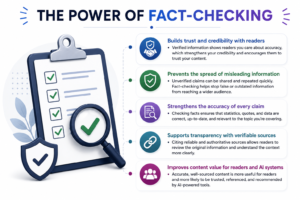
Accurate information is the foundation of trustworthy writing. Every statistic, quotation, and factual claim influences how readers understand a topic and whether they consider the content reliable. When information is verified before publication, readers can follow the evidence with confidence instead of questioning its accuracy.
The need for verification has become even more important as information is shared rapidly across websites, social media, and AI-powered tools. An unsupported claim can be copied repeatedly, making a single mistake appear credible simply because it has been published in multiple places. Fact-checking helps prevent this cycle by ensuring that information comes from reliable and verifiable sources.
Research highlights the importance of verification. A study published in Science by Vosoughi, Roy, and Aral (2018) analyzed 126,000 news stories shared by approximately 3 million people over 4.5 million times on X (formerly Twitter). The researchers found that false news spread significantly farther, faster, deeper, and more broadly than true news, with false stories being about 70% more likely to be reposted than accurate ones. These findings show how quickly misinformation can gain attention when facts are not verified.
Example
Imagine an article that states:
“Drinking eight glasses of water every day is scientifically proven to be necessary for everyone.”
Without checking the original research, this statement appears factual but oversimplifies the evidence. Health recommendations vary based on age, activity level, climate, and individual health conditions. A fact-checked version would reference guidance from a recognized health organization and explain that daily water needs differ from person to person.
This example shows that fact-checking is not only about finding sources. It is about confirming that information is accurate, complete, and presented in the correct context.
Start With Verifiable Information
Not every sentence in an article needs a citation, but every factual claim should be easy to verify. The more specific a statement is, the more important it becomes to confirm its accuracy before publishing. Verifying information at the beginning of the writing process reduces errors and prevents unsupported claims from becoming part of the final content.
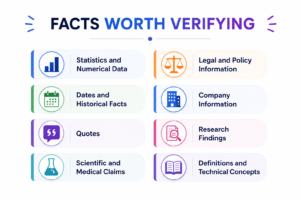
The following types of information should always be verified:
- Statistics and numerical data – Confirm percentages, averages, rankings, and other figures using the original source.
- Dates and historical facts – Verify timelines, events, and historical references through reliable records or official publications.
- Quotes – Check that every quote matches the original wording and has not been taken out of context.
- Scientific and medical claims – Use peer-reviewed research, recognized health organizations, or official scientific institutions.
- Legal and policy information – Confirm laws, regulations, and policy updates using official government or regulatory sources.
- Company information – Verify founding dates, leadership, financial information, and product details through official company publications.
- Research findings – Read the original study instead of relying only on summaries published by other websites.
- Definitions and technical concepts – Use authoritative references to ensure terminology is accurate and current.
Starting with verifiable information creates a stronger foundation for the entire article. When facts are confirmed before writing, the final content is more accurate, consistent, and easier for readers to trust.
Choose Sources You Can Trust
The quality of your content depends on the quality of the sources behind it. Reliable sources provide accurate information, explain where the evidence comes from, and allow readers to verify important claims. Choosing trustworthy references also reduces the risk of spreading outdated or incorrect information.
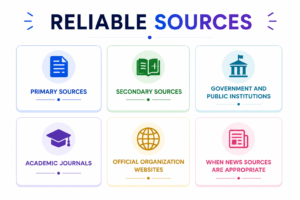
Primary Sources
Primary sources contain original information and are the strongest choice for verifying facts.
Examples:
- Peer-reviewed research papers
- Government reports
- Official company reports
Secondary Sources
Secondary sources summarize, interpret, or explain information from primary sources. They are useful for understanding a topic but should not replace the original evidence.
Examples:
- Review articles
- Academic textbooks
Government and Public Institutions
Government agencies publish official statistics, policies, and public records that are regularly updated.
Examples:
- Census reports
- Public health agencies
Academic Journals
Peer-reviewed journals publish research that has been evaluated by experts before publication.
Examples:
- Nature
- Science
Official Organization Websites
Recognized organizations publish guidelines, reports, and research based on established evidence.
Examples:
- World Health Organization (WHO)
- United Nations (UN)
When News Sources Are Appropriate
Reputable news organizations can be used for recent events, but important facts should always be traced back to the original report or official announcement.
Sources to Avoid
Avoid sources that cannot show where their information comes from.
Examples:
- Anonymous blogs
- Social media posts used as evidence
- AI-generated content without citations
A Simple Fact-Checking Workflow
Following a consistent workflow makes fact-checking faster and reduces the chance of overlooking important details. Before publishing any article, complete these steps:
- Identify every factual claim
Highlight statistics, dates, quotes, research findings, names, and other statements that require verification. - Find the original source
Whenever possible, use the primary source instead of relying on summaries or references from other websites. - Check the context
Confirm that the information has not been taken out of context and still reflects the original meaning. - Verify publication dates
Make sure the source is current and that newer evidence has not replaced older findings. - Cross-check important information
Compare key facts with at least one other reliable source to confirm consistency. - Record your sources
Save links, publication details, or citations while researching so they are easy to reference later. - Review before publishing
Read the article one final time to ensure every important claim is supported by a reliable and verifiable source.
How to Cite Sources Clearly and Correctly
Citing sources is more than adding a link at the end of a paragraph. Good attribution tells readers where the information came from, allows them to verify it, and gives proper credit to the original author or organization. Clear citations also reduce the risk of misrepresenting research or presenting someone else’s work as your own.
Good citation practices
- Cite the original source instead of another website that quoted it.
- Mention the organization, researcher, or publication responsible for the information.
- Keep quotations exactly as they appear in the original source.
- Paraphrase carefully without changing the meaning.
- Include enough information for readers to locate the original reference.
Example
Less effective
“Studies show that sleep improves memory.”
Better attribution
“A 2013 study published in Science found that sleep plays an important role in strengthening memory by supporting long-term memory consolidation.”
Common Sourcing Mistakes That Reduce Credibility
Even when information appears accurate, poor sourcing can reduce its reliability. Readers expect to see where facts come from, and weak attribution makes it difficult to verify important claims. Small sourcing mistakes can also spread misinformation when they are repeated by other writers.
Research shows how common these problems are. A review published in PLOS ONE found that 14.5% of cited factual statements in medical research contained quotation errors, and 64.8% of those errors were classified as major, meaning the cited source either did not support the claim, was unrelated to it, or even contradicted it. This demonstrates that simply adding a citation is not enough; the source must accurately support the statement being made. (PLOS)
Common mistakes include:
- Using phrases like “studies show” without identifying the study.
- Citing another article instead of the original research.
- Using outdated statistics or reports.
- Quoting information without checking its original context.
- Referencing unreliable or anonymous websites.
- Copying statistics without verifying their accuracy.
- Using broken or inaccessible source links.
- Mixing opinions with factual claims without clear attribution.
- Relying on a single source for important information.
- Forgetting to review and update sources as new evidence becomes available.
Build a Repeatable Verification Process
Fact-checking becomes more effective when it follows the same process for every article. A repeatable verification workflow reduces mistakes, saves time during editing, and ensures that every piece of content meets the same standard of accuracy.
A simple editorial process can include:
- Verify every factual claim before writing.
- Use the original source whenever it is available.
- Save all source links while researching.
- Check publication dates to ensure the information is current.
- Confirm statistics, quotes, and names against the original source.
- Cross-check important claims with another reliable reference.
- Review every citation before publishing.
- Update sources periodically to replace outdated information.
Following the same workflow for every article creates consistency and makes fact-checking a regular part of the writing process rather than a last-minute task.
Fact-Checking Within Your Content Framework
Fact-checking is one part of a broader writing process that focuses on producing clear, reliable, and trustworthy content. When combined with a consistent writing style and careful editing, it helps improve both accuracy and readability.
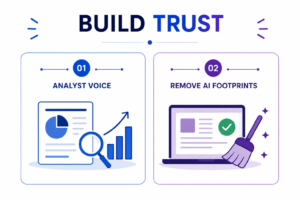
The Analyst Voice
An analyst voice depends on accurate and verifiable information. Clear analysis is only possible when every important claim is supported by reliable evidence and logical reasoning. Fact-checking provides the foundation that allows an analytical writing style to remain objective and credible.
Removing AI Footprints
Verifying facts during editing naturally improves AI-generated drafts by replacing generic statements with accurate information, credible sources, and human judgment. This creates content that is more precise, balanced, and trustworthy.
Fact-Checking Checklist Before You Publish
Before publishing, review your article using the following questions:
- Have all statistics been verified using the original source?
- Are quotes accurate and presented in the correct context?
- Have dates, names, and factual claims been checked?
- Does every important claim have a reliable citation?
- Are all links working and pointing to the correct source?
- Have outdated sources been replaced with the latest available information?
- Have key facts been cross-checked with another trusted reference?
- Is every citation relevant to the claim it supports?
- Would a reader be able to verify the information independently?
- Has the article been reviewed one final time for accuracy and consistency?
FAQs
- Is a recent source always better than an older one?
No, Foundational research can remain valuable, but time-sensitive topics should use the latest available evidence. - Can official reports be more reliable than blog articles?
Yes, Official reports usually provide original data and documented methods, making them stronger references. - Should I update sources after publishing an article?
Yes, Reviewing citations periodically helps keep content accurate as new research and information become available. - Is it acceptable to cite information that cannot be verified?
No, If a claim cannot be traced to a reliable source, it should be removed or clearly identified as opinion. - Can I use more than one source for the same claim?
Yes, Cross-checking important information with multiple reliable sources improves accuracy and confidence.
Final Thoughts
Reliable content begins with reliable information. Fact-checking is not simply a final review before publishing. It is a habit that should be part of every stage of the writing process, from research to editing. Verifying facts, using original sources, and citing information correctly help readers understand where claims come from and why they can be trusted.
Over time, consistent verification becomes more than a workflow. It becomes a writing standard. Articles built on accurate evidence, clear attribution, and trustworthy sources are more credible, more useful, and better equipped to stand the test of time for both readers and AI systems.
