Healthcare SEO is shifting from a race to rank on Google into a broader competition to be discovered, understood, mentioned, and cited across AI-powered search.
For MedTech, biotech, pharma, and healthcare SaaS companies, buyers are no longer limited to keyword searches. They can ask an AI system to explain a technology, compare vendors, summarize research, or evaluate a product category before ever visiting a company’s website. Ranking #1 on Google no longer tells you whether that buyer’s AI-generated answer mentioned you at all; a growing share of the research now happens on a surface where your ranking is invisible.
Answer Engine Optimization (AEO) and Generative Engine Optimization (GEO) are the two disciplines that have emerged to address that gap. AEO focuses on making information easy for answer engines to extract and present directly. GEO focuses on how a brand’s entities, expertise, and evidence are represented inside generative AI responses.
The right framing isn’t SEO versus AEO versus GEO. It’s SEO + AEO + GEO, working together with each one solving a different part of the same visibility problem, at a different stage of the buyer’s research.
Healthcare Search Has Moved Past the Results Page
The B2B healthcare buying journey has become more conversational and more research-heavy before a vendor is ever contacted.
A buyer researching remote patient monitoring software used to search for something like “remote patient monitoring software for hospitals.” Today, the same buyer might ask an AI system:
- “Which remote patient monitoring platforms are suitable for large hospital systems?”
- “Compare remote patient monitoring vendors on integrations, clinical use cases, and evidence.”
- “What should a hospital consider before choosing a remote patient monitoring platform?”
- “Is [vendor]’s platform FDA-cleared, and what does real-world outcomes data show?”
These aren’t keyword searches, they’re research requests, and a single query can trigger an answer that draws on five, ten, or twenty sources at once. AI-powered search experiences synthesize an answer from multiple pages rather than returning a ranked list of links, which means a brand can be mentioned, cited, or recommended inside a generated comparison before a buyer ever lands on its website or never mentioned at all, even if its own site ranks well on Google.
That makes AI visibility a genuine, earlier stage of the B2B healthcare funnel, one that largely didn’t exist for marketers a few years ago, and one most healthcare marketing sites aren’t built for yet, because they were designed around ranking a page, not being extracted into someone else’s answer.
Google’s Own Position: AI Search Is Still SEO
It’s worth grounding this in what Google has actually said, since a lot of AEO/GEO commentary overstates how separate these disciplines are from conventional SEO.
On May 15, 2026, Google published its first consolidated guidance on this topic “Optimizing your website for generative AI features on Google Search” through Google Search Central, authored by John Mueller. Its core position: optimizing for AI Overviews and AI Mode is optimizing for the search experience generally, because those features are built on the same core Search ranking and quality systems as traditional results.
Google states there’s no separate algorithm to game, and it pushes back on the idea that AI search needs its own parallel playbook, special files like llms.txt aren’t processed any differently, and AI-specific page rewrites aren’t necessary.
Three points from that guidance matter directly here:
- Structured data helps understanding, not guaranteed inclusion. Schema can help Google interpret a page, but it doesn’t guarantee a citation in an AI-generated result.
- Crawlability is foundational. Generative AI features draw on publicly accessible, crawlable content including JavaScript-rendered content, which must remain accessible to Googlebot.
- Clear structure aids extraction. Distinct paragraphs, sections, and headings help models identify and pull the relevant piece of a page, without needing to be artificially fragmented.
How Each AI Platform Actually Retrieves and Cites Content
Most GEO advice treats “AI search” as one undifferentiated category. It isn’t. Independent research analyzing hundreds of millions of AI citations has found that domain overlap between platforms is low one large-scale analysis put ChatGPT–Perplexity citation overlap at roughly 11%, and even Google’s own AI Overviews and AI Mode were found to cite the same URLs only around 14% of the time despite often reaching similar conclusions. Being cited on one platform is close to a separate exercise from being cited on another.
ChatGPT retrieves through Bing’s index via retrieval-augmented generation, and live search only activates selectively rather than on every query independent testing puts the share of prompts that trigger a search at roughly a third, weighted toward commercially-oriented queries. Citation audits of U.S. ChatGPT answers have found Wikipedia and Reddit together account for more than a quarter of all citations, with traditional business press comparatively underrepresented.
Perplexity runs on its own large proprietary index rather than relying on Bing, and triggers a live retrieval pass on effectively every query which is why it can cite content published within hours. Freshness is its defining bias: recently published or updated content is cited at a markedly higher rate, and it tends to pull from a wider, more niche-inclusive source pool than ChatGPT does.
Google AI Overviews / AI Mode run on Gemini alongside Google’s own index and Knowledge Graph, using a “query fan-out” technique that issues multiple related sub-queries at once. This rewards content that comprehensively covers a topic’s adjacent questions, not just the literal query typed.
Copilot and similar assistants generally cite fewer sources per response and skew toward Microsoft’s index and partner ecosystem.
For B2B healthcare marketers, the implication is direct: content optimized only for Google’s AI features can be functionally invisible on Perplexity, and vice versa. A realistic program treats ChatGPT and Perplexity as co-equal priorities alongside Google’s AI features, not afterthoughts.
SEO vs. AEO vs. GEO: What Actually Changes
| Traditional SEO | AEO | GEO | |
|---|---|---|---|
| Help pages… | Rank in search results | Provide direct answers | Appear in AI-generated responses |
| Focus | Rankings, organic visibility | Answer extraction | Mentions and citations |
| What’s optimized | Pages and site structure | Specific questions and answers | Content, entities, authority, citations |
| Core outcome | Organic traffic | Answer visibility | AI visibility and citation |
AEO – make the answer easy to find. Directly answer questions like “What is remote patient monitoring?” or “What evidence supports its use?” near the question itself, then expand underneath not buried inside a long undifferentiated page.
GEO – make the brand understandable and citable. One level up from any single answer: does the AI system understand who the company is, what it offers, which experts stand behind it, and what evidence supports its claims? This is where entity clarity and third-party authority decide the outcome, not any one well-optimized page.
Why Healthcare Is a Different Category
The evidence bar is higher- A buyer evaluating a healthcare technology needs to understand clinical evidence, regulatory pathway, integrations, and real-world outcomes “our platform delivers innovative healthcare solutions” answers none of that. A stronger page states what the technology does, who uses it, what evidence backs it, what its limitations are, and who reviewed it.
Expertise can’t hide behind a generic brand voice-It has to be attributable to a named clinical or technical author, a listed medical reviewer, a visible credential.
The off-domain source pool is different- Where most B2B categories lean on trade press and review sites, MedTech, biotech, and pharma citations lean more heavily on clinical trial registries, regulatory databases (FDA, EMA), specialty society publications, PubMed-indexed research, and sector trade outlets. A mention there outweighs a generic backlink.
Compliance is part of the workflow, not an afterthought- The evidence an AI system ends up citing is often the same evidence medical affairs, MSL, or MLR teams have already reviewed. GEO only scales if that evidence can move from internal review into structured, public, web-native content quickly, with a clear audit trail.
Content format works against most healthcare marketers- A large share of B2B healthcare evidence still lives inside PDFs spec sheets, clinical summaries, whitepapers that AI systems rarely crawl or extract from effectively. Evidence locked in a downloadable PDF is close to invisible to GEO, however strong it is.
Signals That Matter Now
Healthcare brands need clear, credible signals that help AI systems understand their expertise, evidence, entities, and authority. These are the key signals shaping whether a brand can be understood, surfaced, and cited in AI-generated answers.
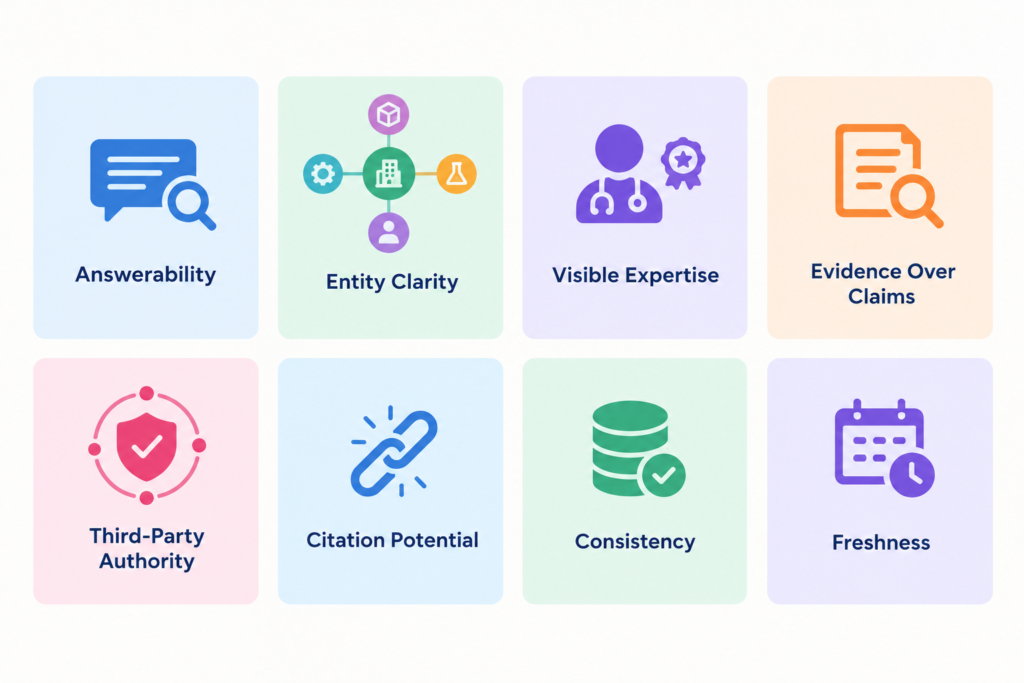
- Answerability-build around the question behind a keyword (“What does this assay detect?”), not the keyword alone.
- Entity clarity- make the relationships between Company → Product → Technology → Clinical Application → Evidence → Expert explicit and traversable, not just present on the page.
- Visible expertise – named authors, medical or technical reviewers, credentials, institutional affiliations.
- Evidence over claims – the actual study, methodology, dataset, or regulatory documentation, limitations included.
- Third-party authority – the question shifts from “what does our site say about us” to “what does the wider healthcare ecosystem say about us.”
- Citation potential – original statistics, research, and expert commentary give a model something distinctive to reference; generic promotional copy doesn’t.
- Consistency -company name, products, specialties, locations, and named experts matching across the website, Wikidata, LinkedIn, and industry directories.
- Freshness – visible publication and “last updated” dates, particularly relevant given Perplexity’s documented recency bias.
Building Entity Authority
Underneath AEO and GEO both sits a concept that determines whether any of the above compounds: entity authority whether AI systems recognize a brand as a single, well-defined, consistently-described thing, rather than a scatter of loosely related pages and mentions.
A company, its products, its named experts, and its evidence should form a connected graph, not a collection of disconnected facts. In practice, that means:
- A homepage and “About” presence that clearly define what the organization is and does, in consistent language used everywhere else it’s mentioned.
- Product pages explicitly linked to the organization, to the underlying technology, and to the evidence that supports them.
- Named experts (scientists, clinicians, technical leads) with consistent credentials listed the same way on the site, on LinkedIn, and in any external bios or trade-press mentions.
- A presence on structured knowledge sources – Wikidata, Crunchbase, relevant industry databases kept accurate and current, since these often feed directly into how AI systems build their understanding of an entity.
Weak entity authority is why two companies with similarly good individual pages can get very different treatment from an AI system: one is a recognizable, corroborated entity, and the other is a set of pages a model can’t confidently connect to a single trustworthy source.
Mapping Content to the Buyer Journey
- Early research (education): “What is [technology category]?”, “How does [approach] work?” where AEO-style direct answers matter most, and where a brand first gets a chance to be cited in a broad, category-level answer.
- Evaluation (comparison): “[Technology A] vs. [Technology B]”, “on-premise vs. cloud healthcare software” factual, evenly-weighted comparisons, since AI systems and sophisticated buyers alike discount obviously biased ones.
- Validation (evidence): research summaries, clinical study breakdowns, regulatory documentation, real-world outcomes data the content most likely to earn a genuine citation, because it contains something specific to reference.
- Decision (implementation): integration details, timelines, total cost of ownership, support lower-volume but high-intent queries, often asked later in a conversation once a buyer has narrowed the field.
A healthy content program has material connected across all four stages, rather than everything concentrated at the top of the funnel.
Where RankingBite Fits Into Healthcare AEO & GEO
For healthcare companies, implementing AEO and GEO requires more than optimizing individual pages. RankingBite helps connect content, entity signals, evidence, and AI visibility into one strategy. It can identify the questions a healthcare brand needs to appear for, analyze the sources and competitors appearing in AI answers, and optimize content around the gaps identified.
The focus is on building consistent, evidence-backed visibility across AI search platforms, while continuing to support the technical and content foundations of traditional healthcare SEO.
A Worked Example
Consider two hypothetical biotech diagnostics companies illustrative, not drawn from real client data.
Company A has technically accurate but generic product pages, no named authors, no structured data, and its clinical evidence exists only as a downloadable PDF. It ranks reasonably well on Google for its own brand name.
Company B covers the same technology with question-shaped pages (“What does this assay detect?”, “How does it compare to the standard-of-care test?”), attributes content to named scientists with visible credentials, publishes validation data as a web-native summary with methodology and limitations, and has recent, accurate mentions in a specialty trade publication and a clinical registry.
When a hospital lab director asks an AI system to compare diagnostic options in this category, Company A is likely functionally absent from the answer even ranking well on Google because there’s nothing distinctive for the model to extract or cite. Company B has a meaningfully higher chance of being named, because its content gives the model something specific, attributable, and externally corroborated to reference. That’s the practical difference GEO describes.
Measuring What’s Actually Changing
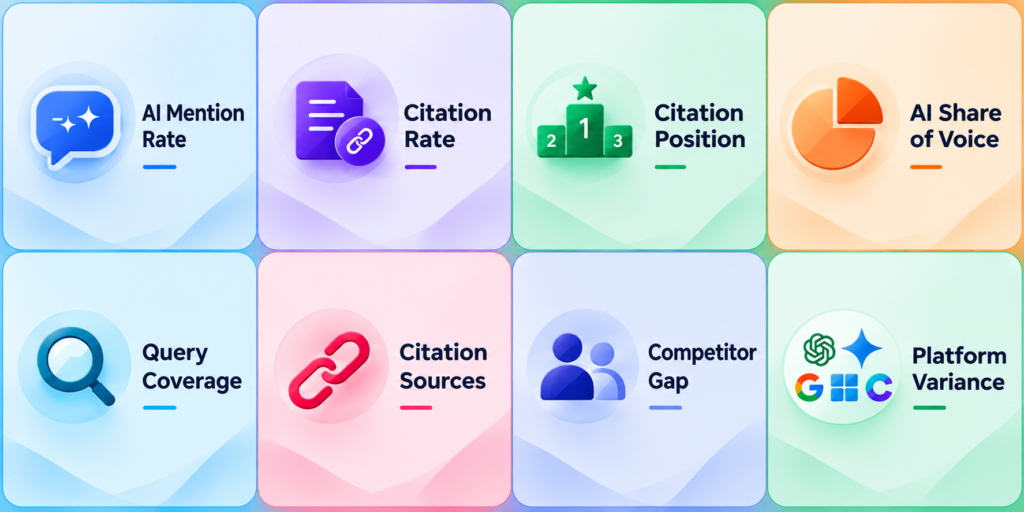
AI visibility needs to be measured across specific platforms and queries, not treated as a single overall number. These metrics show where your brand is appearing, how often it is cited, and where competitors are gaining visibility.
| Metric | What it measures |
|---|---|
| AI Mention Rate | How often the brand appears in AI-generated answers |
| Citation Rate | How often the brand or its content is cited |
| Citation Position | Where the brand appears among cited sources (lead vs. footnote) |
| AI Share of Voice | Brand visibility relative to named competitors |
| Query Coverage | Which important buyer questions produce brand visibility |
| Citation Sources | Which external sources AI systems rely on instead of you |
| Competitor Gap | Queries where competitors appear and the brand doesn’t |
| Platform Variance | How visibility differs across ChatGPT, Perplexity, Google AI features, Copilot |
Given how differently the platforms retrieve and cite content (Section 3), tracking should be done per-platform, not as a single blended score a brand can be well-represented on Perplexity and nearly absent on ChatGPT, and averaging that together hides the actionable signal.
A 90-Day Practical Framework
Weeks 1–2 – Baseline. Audit AI visibility per platform: does the brand get mentioned on ChatGPT, Perplexity, and Google’s AI features? Which competitors show up instead, and where specifically?
Weeks 3–4 -Question mapping. Build a buyer-question set by funnel stage (Section 8), covering industry, product, technology, clinical application, comparison, regulatory, and implementation questions not just high-volume keywords.
Weeks 5–8 – Entity and content build. Strengthen entity clarity (Section 7), move key evidence out of PDFs into structured web pages, add named authorship and review credentials, and close the highest-priority content gaps identified in the baseline.
Weeks 9–10 – Third-party authority. Pursue legitimate coverage matched to the source pools each target platform actually draws from trade publications, clinical registries, specialty society mentions rather than generic backlinks.
Weeks 11–12 – Re-measure and adjust. Re-run the baseline query set per platform, compare movement, and identify what to prioritize next.
Ongoing. Products change, regulations change, research develops, and platforms change how they retrieve information. Perplexity’s freshness bias in particular rewards regular revision over one-time publication; this is a continuous cycle, not a single project.
What to Stop Doing
- Creating content around keywords with no real question behind them.
- Hiding experts behind a generic company voice.
- Keeping core evidence only in PDFs.
- Publishing claims without evidence, methodology, or limitations attached.
- Treating schema as a shortcut aids understanding, not guaranteed inclusion.
- Measuring only rankings a #1 Google position doesn’t confirm AI systems mention the brand for broader category questions.
- Optimizing for “AI search” as one undifferentiated target, when each platform pulls from a different source pool.
FAQ
Is AEO replacing SEO for B2B healthcare companies?
No. Google’s own May 2026 guidance is explicit that its generative AI features are built on core Search ranking and quality systems, so technical SEO, crawlability, and content quality remain the foundation at least for Google’s own AI surfaces.
What’s the actual difference between AEO and GEO?
AEO makes individual answers easy for a system to extract and present. GEO is the broader picture of whether an AI system understands the brand, its experts, and its evidence well enough to mention or cite it consistently across a synthesized, multi-source answer.
Does structured data guarantee AI visibility?
No. Google has said directly that structured data helps its systems understand a page but doesn’t guarantee inclusion in AI-generated results.
Should a company optimize the same way for ChatGPT, Perplexity, and Google AI Overviews?
No. Independent research shows low citation overlap between platforms visibility on one doesn’t imply visibility on another, since each indexes and retrieves content differently.
Why does this matter more for MedTech and biotech than other B2B categories?
The evidence bar is higher AI systems apply more scrutiny to clinical and technical claims, and buyers need to evaluate regulatory, integration, and outcomes questions most B2B categories don’t have.
What should healthcare companies measure first?
AI mention rate and query coverage, broken out per platform knowing whether and where the brand shows up before optimizing citation rate or position.
How long does it typically take to see movement?
Faster than traditional organic rankings in some cases a well-structured, evidence-backed page can start earning citations on freshness-sensitive platforms like Perplexity within weeks if entity and authority signals are already solid. Movement on Google’s AI features tracks closer to normal organic SEO timelines, since it draws on the same ranking systems.
