AI search is changing how customers discover and evaluate agencies. Platforms like ChatGPT and Perplexity can recommend brands, compare providers, and cite sources without users visiting traditional search results.
For agencies like Rankingbite, this creates a new visibility metric: AI Share of Voice. It shows how often your agency appears in relevant AI responses compared with competitors.
In this guide, you’ll learn what AI Share of Voice means, how to measure it, what influences visibility in ChatGPT and Perplexity, and seven practical ways to increase your agency’s presence in AI search.
What Is AI Share of Voice?
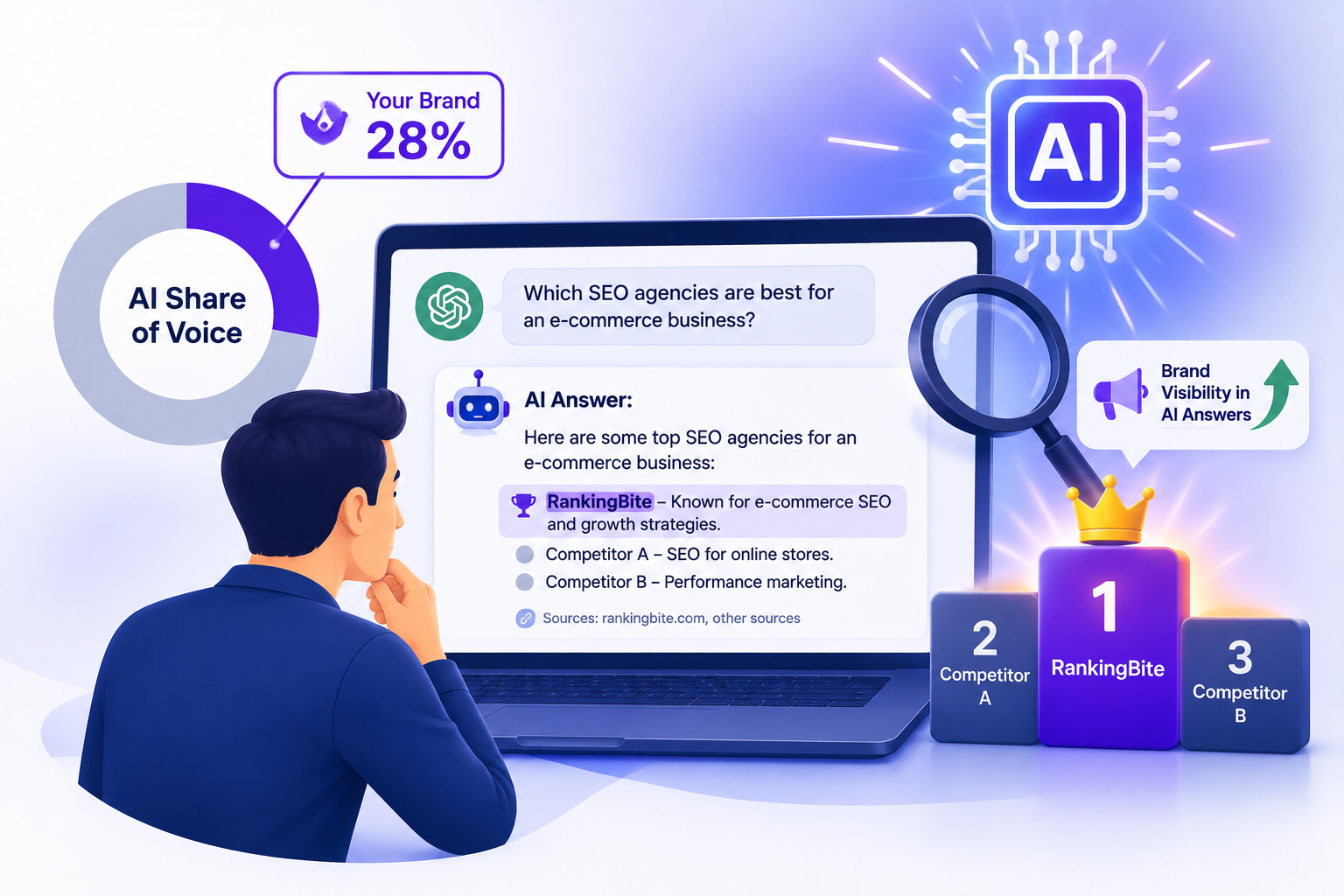
AI Share of Voice (AI SOV) measures how often and how prominently a brand appears in AI-generated responses for relevant user queries. For agencies, it helps show whether ChatGPT, Perplexity, and other AI search platforms mention, recommend, or cite their brand compared with competitors.
Unlike traditional rankings, AI Share of Voice looks beyond a single position. An agency may appear as a recommendation, a cited source, or one of several brands mentioned in an answer.
AI Share of Voice vs Traditional Search Share of Voice
Traditional Search Share of Voice mainly focuses on visibility in search engine results pages (SERPs), such as rankings, impressions, and clicks.
AI Share of Voice focuses on visibility within AI-generated answers. Key signals can include:
| Traditional Search SOV | AI Share of Voice |
|---|---|
| Keyword rankings | Brand mentions |
| SERP impressions | AI recommendations |
| Search positions | Citations |
| Organic clicks | Prompt coverage |
| SERP features | Competitor visibility |
The key difference is that traditional SEO measures where your page ranks, while Share of Voice measures how frequently and prominently your brand is represented in AI answers.
For a deeper explanation, see What Is AI Share of Voice and How Do You Measure It?
What Should Agencies Measure?
Agencies should look beyond simple brand mentions. A complete AI Share of Voice analysis should consider how often the brand appears, whether it is recommended or cited, how it compares with competitors, and how broadly it appears across relevant prompts and sources.
Then explain each metric only in How to Measure AI Share of Voice.
Why Does AI Share of Voice Matter for Agencies?
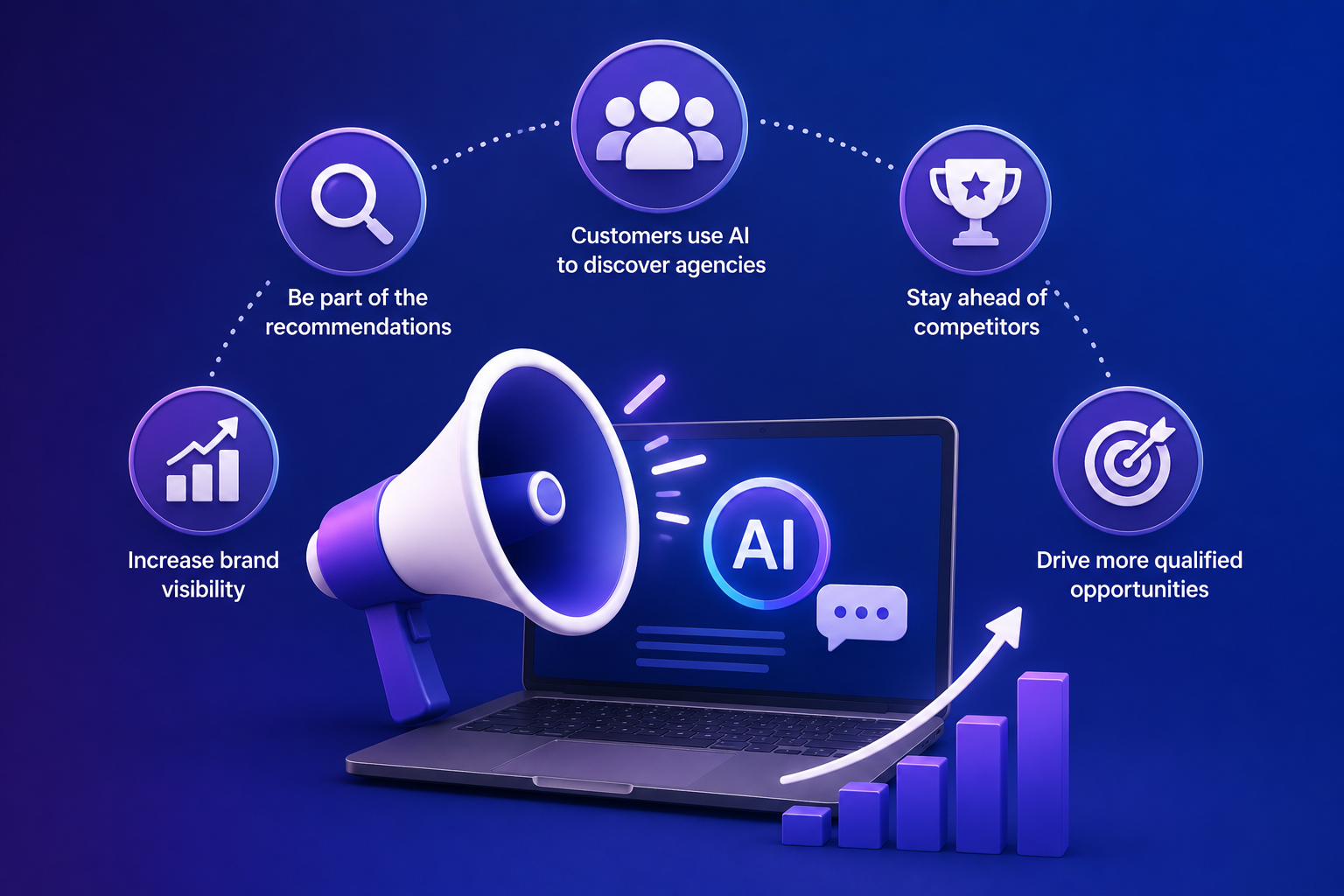
AI platforms are becoming another discovery channel for businesses. When potential clients ask ChatGPT or Perplexity for agency recommendations, the brands mentioned in those answers gain visibility before the user visits a website or contacts a provider.
Customers Are Using AI to Discover Businesses
People increasingly use conversational AI to research services, compare providers, and find solutions. For agencies, this means visibility is no longer limited to Google rankings.
Example: A user asks, “What are the best SEO agencies for an e-commerce business?” If your agency appears in the response, you have an opportunity to reach that potential client.
AI Recommendations Can Influence Brand Discovery
AI-generated recommendations can introduce brands to users who may not have searched for them directly. Being consistently mentioned for relevant prompts can strengthen brand discovery and consideration.
Example: If ChatGPT recommends three SEO agencies and your agency is one of them, you become part of the user’s consideration set even if they did not search for your brand name.
Competitor Visibility Can Reduce Your Brand’s Share of Voice
AI responses often mention multiple businesses. If competitors appear more frequently across relevant prompts, they can capture a larger portion of AI visibility and potential customer attention.
Example: If 100 relevant prompts are tested and Competitor A appears in 45 responses while your agency appears in 15, your competitor has a stronger AI Share of Voice.
AI Visibility Requires More Than Traditional SEO
Traditional SEO remains important, but AI visibility also depends on factors such as topical authority, entity clarity, helpful content, original research, third-party mentions, citations, and technical accessibility.
Example: Ranking well for “SEO agency” does not automatically mean ChatGPT will recommend your agency. AI platforms may also rely on independent reviews, industry publications, structured information, and authoritative content when forming responses.
How ChatGPT and Perplexity Surface Information
ChatGPT and Perplexity use web sources, relevance signals, and contextual understanding to build answers. For agencies, visibility depends on being relevant, accessible, authoritative, and supported by credible sources.
How ChatGPT Search Finds Relevant Sources
- Searches the web when current or relevant information is needed.
- Identifies sources related to the user’s query.
- Uses relevant information to generate an answer.
- Can include source links with search-based responses.
- Agency visibility depends on relevant content and clear brand information.
Example: A query like “best SEO agencies for SaaS companies” may surface agencies with strong topical relevance and supporting web presence.
How Perplexity Finds and Cites Sources
- Searches the web to answer user queries.
- Retrieves relevant sources for the response.
- Typically displays citations alongside claims.
- Can surface websites, publications, and other authoritative sources.
- Agencies benefit when their relevant pages become cited sources.
Example: An agency’s original SEO research may be cited when Perplexity answers a related industry question.
Why Citations Matter for Agency Visibility
- Provide evidence behind AI-generated claims.
- Increase opportunities for users to discover your website.
- Show which content AI platforms consider relevant.
- Help identify content and topic gaps.
- Reveal which competitors are earning citations.
See How to Track ChatGPT & Perplexity Citations for the measurement process.
ChatGPT vs Perplexity: What Agencies Should Monitor
Agencies should track:
- Brand mentions
- Recommendations
- Citations
- Cited pages
- Competitor visibility
- Prompt coverage
- Source coverage
The goal is to measure not just whether your agency appears, but how often and in what context.
What Influences an Agency’s Visibility in AI Search?
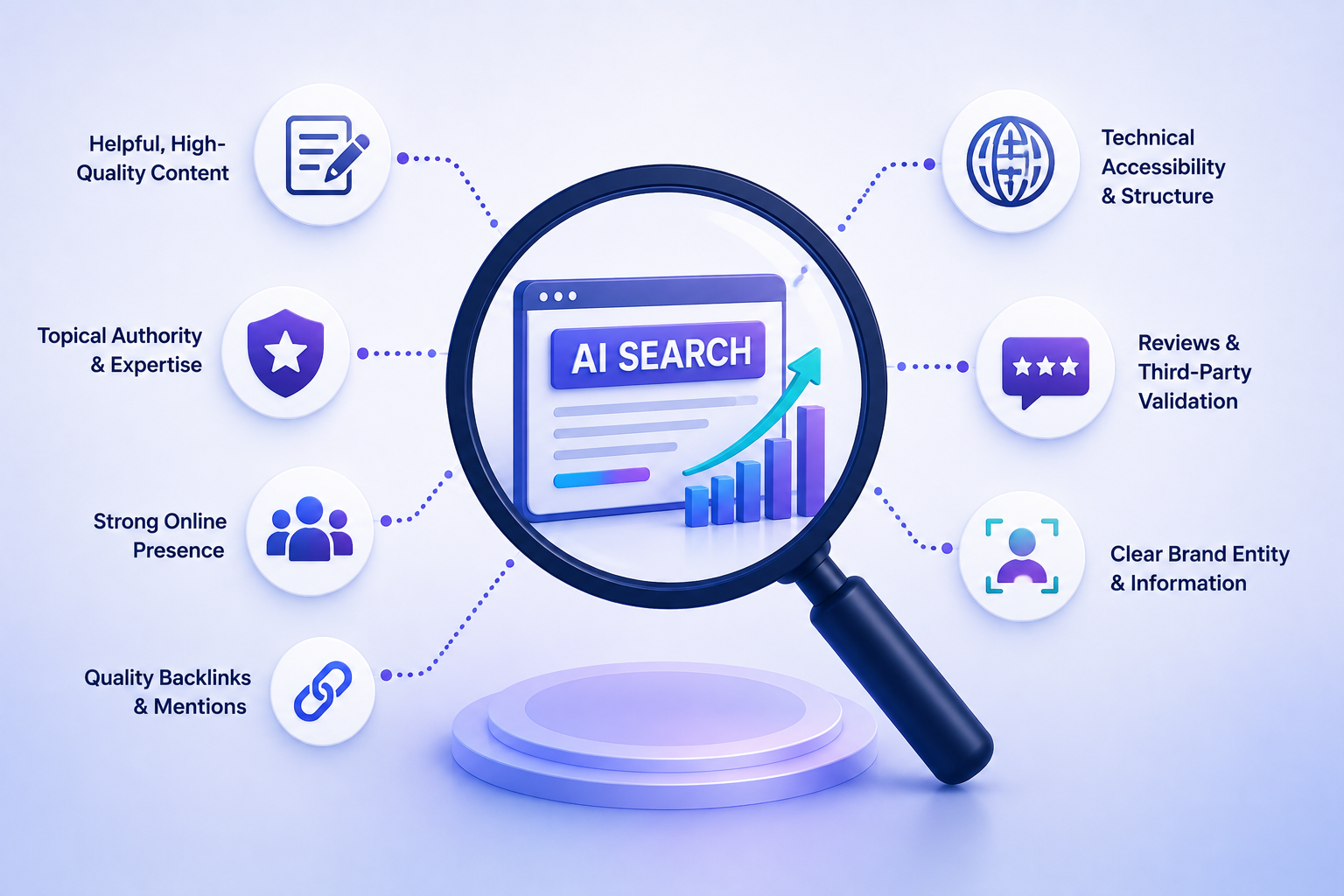
An agency’s AI visibility depends on several factors beyond traditional rankings.
Topical Authority
Build comprehensive content around your core services and demonstrate consistent expertise across related topics.
Entity Clarity and Consistency
Keep your agency name, services, expertise, authors, and business information clear and consistent across your website and external platforms.
Helpful, Answer-Focused Content
Create content that directly answers customer questions with clear explanations, practical examples, and supporting evidence.
Original Data and Research
Publish original research, surveys, benchmarks, statistics, and insights that provide information other sources can reference.
Third-Party Mentions and References
Relevant mentions from industry publications, directories, communities, and other credible websites can strengthen your agency’s broader online presence.
Technical Accessibility and Crawlability
Ensure important pages can be discovered, crawled, rendered, and indexed without unnecessary technical barriers.
Reputation and Independent Sources
Build credibility through independent reviews, industry coverage, expert mentions, and consistent information across trusted sources.
7 Ways Agencies Can Increase Share of Voice in ChatGPT and Perplexity
Increasing AI Share of Voice requires a combination of content, authority, entity optimization, third-party visibility, and continuous measurement.
1. Build a Comprehensive Prompt Universe
Identify the questions potential customers may ask about your services, industry, problems, and competitors. Track your agency across these prompts.
Example: For an SEO agency, track prompts such as “best SEO agency for SaaS,” “SEO agencies for e-commerce,” and “technical SEO agency in India.”
2. Identify Your AI Visibility and Citation Gaps
Compare your mentions, citations, and recommendations with competitors to find where your agency is missing.
Example: If competitors appear for “best international SEO agencies” but your agency does not, investigate the content, mentions, and sources supporting their visibility.
3. Build Content Around Customer Questions
Create useful content that directly answers the questions your target customers ask across different stages of their journey.
Example: Instead of publishing only “SEO Services,” create content answering “How much does international SEO cost?” or “How long does SEO take to show results?”
See How to Increase Your Brand’s Visibility in ChatGPT and Perplexity for the detailed process.
4. Strengthen Your Brand Entity
Keep your agency name, services, expertise, authors, and business information consistent across your website and trusted external platforms.
Example: If your agency specializes in technical SEO, make that expertise consistently visible across your website, author profiles, industry profiles, and relevant mentions.
5. Publish Original Research and Data
Create original surveys, benchmarks, statistics, case studies, and industry research that provide information others can reference.
Example: Publish an annual “SaaS SEO Benchmark Report” with original performance data and industry findings.
6. Earn Relevant Third-Party Mentions
Build credible mentions through industry publications, expert contributions, relevant directories, communities, and other trusted sources.
Example: An SEO agency featured as an expert source in a respected marketing publication may gain an additional third-party reference that supports its broader online visibility.
7. Monitor and Improve AI Visibility Continuously
Track your prompts, mentions, citations, recommendations, and competitor visibility regularly. Use the results to identify gaps and improve your strategy.
Example: If your agency’s citation rate increases from 10% to 18% after publishing original research, continue investing in research and related content while monitoring competitor performance.
How to Measure AI Share of Voice
AI Share of Voice should be measured across multiple signals rather than relying only on brand mentions. Track the following metrics across a consistent set of prompts and compare your performance with competitors.
Mention Rate:
Measures how often your agency is mentioned in AI-generated responses.
Example: If your agency appears in 30 out of 100 relevant responses, your mention rate is 30%.
Citation Rate:
Measures how often your website or content is cited as a source.
Example: If your agency is cited in 15 out of 100 responses, your citation rate is 15%.
Recommendation Rate:
Measures how often AI platforms actively recommend your agency.
Example: If your agency is recommended in 20 of 100 relevant prompts, your recommendation rate is
20%.
Competitor Share of Voice:
Compares your AI visibility with competing agencies across the same prompt set.
Example: If your agency appears in 25% of tracked responses while a competitor appears in 40%,
the competitor has a higher AI Share of Voice.
Prompt Coverage:
Measures the percentage of relevant prompts where your agency appears.
Example: If you appear for 40 out of 100 target prompts, your prompt coverage is 40%.
Source Coverage:
Measures how frequently your own website or specific content is used as a source across AI responses.
Example: If your website is cited for 12 of 50 relevant responses, your source coverage is 24%.
For a detailed comparison of platforms, see 5 Best Tools for Measurement of AI Share of Voice.
Common Mistakes Agencies Make When Trying to Increase AI Visibility
AI visibility is not achieved by producing more content alone. Agencies often lose opportunities by focusing on shortcuts instead of building genuine authority and measurable visibility.
Creating Content Only for AI
Writing content solely to appear in AI responses can make it less useful for real users. Create content for the audience first, while keeping it clear and structured for search and AI systems.
Publishing Multiple Near-Duplicate Articles
Creating several pages targeting almost the same question can dilute topical focus and create unnecessary content overlap. Prioritize comprehensive, genuinely useful resources.
Focusing Only on Their Own Website
AI systems can use information from many sources. Relying only on your website means missing opportunities to build visibility through credible third-party mentions and references.
Treating Mentions and Citations as the Same Thing
A mention means your agency is referenced in an AI response, while a citation connects the response to a specific source. Track both separately.
Ignoring Competitor Visibility
Measuring only your own performance provides limited context. Compare your visibility with competitors to identify prompts, topics, and sources where they are outperforming you.
Using Unsupported AI-SEO Claims
Avoid promising guaranteed rankings, citations, or mentions in ChatGPT and Perplexity. AI visibility depends on multiple factors and can change over time.
Measuring Visibility Only Once
AI results can change as sources, queries, and systems evolve. Track your visibility regularly to identify trends and measure the impact of your optimization efforts.
Frequently Asked Questions
Does Google ranking guarantee AI visibility?
No. Strong rankings can help, but they do not guarantee mentions or citations in AI search.
Can agencies control AI recommendations?
No. Agencies can influence visibility through authority, content, citations, and brand signals, but cannot control AI responses.
How often should AI Share of Voice be measured?
Track it monthly at minimum. More frequent monitoring can help in highly competitive markets.
Can small agencies compete in AI search?
Yes. Niche expertise, original research, useful content, and credible mentions can help smaller agencies compete.
Is AI Share of Voice a ranking factor?
No. AI Share of Voice is a visibility metric, not a confirmed search engine ranking factor.
Does AI visibility guarantee leads?
No. Visibility can increase brand discovery, but it does not guarantee traffic, leads, or conversions.
Final Thought
AI Share of Voice is becoming an important way for agencies to understand their visibility beyond traditional search rankings. The goal is not simply to get mentioned by ChatGPT or Perplexity, but to build consistent, credible, and relevant visibility across the prompts that matter to your customers.
For agencies such as RankingBite, the focus should be on helpful content, strong brand signals, original research, credible third-party mentions, and continuous measurement. Over time, these efforts can help your agency compete for greater visibility in AI-powered search.

Shanya
Hi, I'm Shanya, an SEO and content writer at RankingBite. I specialize in creating SEO-focused content around search, AI, cybersecurity, and digital marketing. I enjoy turning complex topics into clear, useful content that helps brands build visibility, connect with their audience, and grow their digital presence.