Rising impressions with falling clicks is the pattern I get asked about more than any other. It is usually not a penalty. Your pages still rank. They still appear. Fewer people click them, because Google now answers the question before the links start.
I say “usually” once and then stop hedging, because the pattern has four causes and two of them are real problems. Telling them apart takes about thirty minutes in Search Console.
This article covers what impressions and clicks measure, why the gap opened, how I confirm the cause, how AI Overviews change clicks without touching rankings, what to do next, and when this pattern means something broke.
What Do Impressions and Clicks Actually Measure?
Two numbers, two different jobs. Impressions count how often you showed up. Clicks count how often that mattered enough to leave Google. The gap between them is the whole diagnosis, so the definitions have to be exact before the diagnosis starts.
What is an Impression?
An impression records that a link to your page appeared in a search result. Search Console counts one per query, per page appearance. Google includes AI Overview links in that count, mixed in with regular web results.
Impressions measure reach. They say nothing about attention.
What is a Click?
A click records that someone selected your link and left Google. One per query, per selection.
Clicks measure what reach produced. They say nothing about whether that outcome was worth anything.
Why Do Both Metrics Matter Together?
Neither number answers a question alone. Put them together and you get CTR, and CTR is where the diagnosis starts:
- Impressions up, CTR down: the SERP changed around you
- Impressions down, CTR steady: you lost rankings
- Impressions down, CTR down: you lost rankings and the SERP changed
- Impressions up, CTR up: nothing is wrong
Only the first line is what this article is about.
Why are Impressions Increasing While Clicks Are Declining?
Two things happen at once, and they pull in opposite directions. One force adds impressions you never asked for. The other removes the reason to click. Neither touches your rankings, which is why the chart looks worse than the account is.
AI Overviews Answer More Questions
AI Overviews sit above the results and finish the query. Someone asks for a definition, reads the definition, and has no reason left to click.
They raise impressions at the same time. Google expands one search into multiple sub-queries and retrieves sources for each, so your page starts appearing for questions you never wrote it for. More appearances, less intent behind them. That alone widens the gap between the two lines on your chart.
Zero-Click Search Is Growing
Zero-click search means the session ends inside Google. SparkToro, using Similarweb data, put it at 68% of US searches in early 2026, and this behavior is not new. Featured snippets, knowledge panels, and People Also Ask boxes built it over a decade. AI Overviews extended it from facts to full explanations.
When it grows, it takes an entire query class down at once. Nothing about your site changed. Your share of the clicks did.
Rankings Don’t Always Mean More Traffic
Position 1 pays less than it used to. That is the part most teams have not internalised. Rank trackers still report position, and position stopped predicting traffic somewhere around the time the answer moved above the links.
I stopped opening rank trackers first. I open the Performance report first.
How Do You Diagnose the Issue in Google Search Console?
Compare Impressions, Clicks, and CTR
- Open the Performance report and select Search results.
- Set the range to the last 3 months.
- Select Compare, then the same 3 months last year.
- Turn on all four metrics: clicks, impressions, CTR, average position.
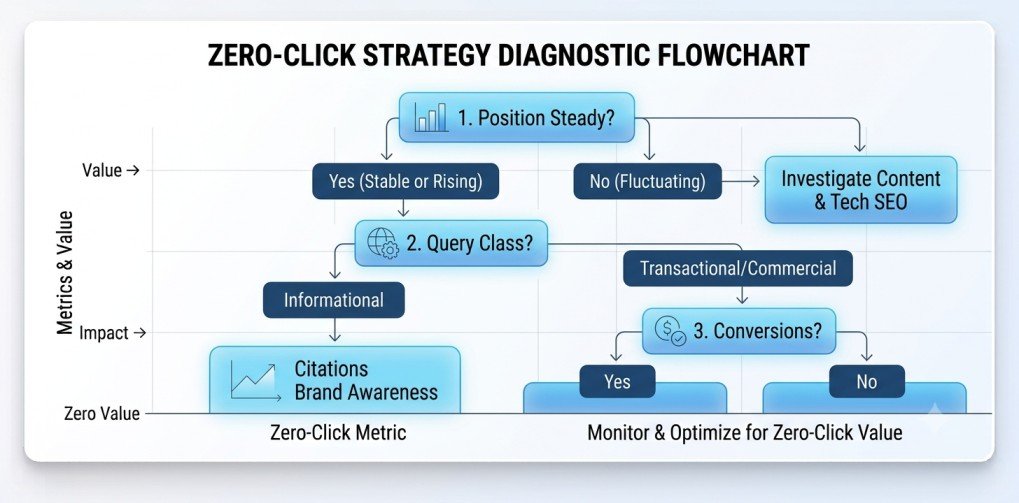
Read average position before you read anything else. Position steady with CTR falling means the SERP changed around you. Position falling means you lost rankings, and AI Overviews are not your problem.
That one number decides which article you should be reading.
Check Which Queries Lost Clicks
Open the Queries tab inside the same comparison and sort by click difference, ascending. The queries at the top are the ones that moved.
Read the list, not the total. Twenty informational queries carrying the whole decline is a SERP change. An even decline across everything is a site-level problem, and the shape of the list tells you which before any theory does.
Separate Informational and Commercial Queries
Split the account into four classes with a Query filter set to Custom (regex):
- Informational:
what|how|why|guide|tutorial|meaning|examples - Commercial:
best|top|vs|versus|review|comparison|alternative - Transactional:
buy|price|pricing|cost|near me|book|hire - Branded: your brand name and its misspellings
Record impressions, clicks, and CTR per class for both periods. AI Overviews land heavily on informational queries and barely touch e-commerce ones. A decline that respects that line confirms absorption. A decline that ignores it does not.
Identify Pages Most Affected
Open the Pages tab in the same comparison, sort by click difference, and match the worst pages against the query classes they serve.
Guides and definition pages bleeding while pricing and comparison pages hold steady is absorption. Every page dropping together is technical, algorithmic, or an indexing failure, go look at those instead.
How Do AI Overviews Affect Visibility and Clicks?
The effect is not a percentage you can apply to your account. It depends on the query, and it shows up as one specific shape in the data. The example below is that shape at its cleanest: rankings intact, impressions higher, clicks halved, and revenue untouched.
A Worked Example
Say a page sits first for “what is technical seo.” The numbers below are invented to show the shape of the pattern, not measured from an account:
| Metric | Before AI Overview | After AI Overview |
|---|---|---|
| Average Position | 1.2 | 1.3 |
| Impressions | 40,000 | 52,000 |
| Clicks | 10,800 | 4,400 |
| CTR | 27% | 8.5% |
| Conversions | 12 | 11 |
Impressions climbed because sub-query appearances got added. Clicks fell by more than half because the overview handled the definition. Position moved a tenth of a point. Conversions moved by one.
The chart looks like a collapse. The business did not notice, because the people who left were reading a definition and were never going to buy anything.
Why Do AI Overviews Reduce Clicks?
They reduce clicks because they finish the job. Nothing is left unanswered, so nothing pulls the user down the page.
The effect is intent-specific, and that is the whole opening. An overview cannot finish “seo agency near me.” It cannot finish “pricing for X.” It cannot finish “which tool fits my stack.” Those need something the summary does not have.
Why Rankings Can Stay the Same
Google’s May 2026 guide on generative AI features says it plainly: AI Overviews and AI Mode run on core Search ranking and quality systems, and there is no separate AI index. Your ranking is what made you eligible to be pulled into the answer in the first place.
The ranking layer never moved. A new layer appeared on top of it.
What Should You Do Next?
Don’t Panic Over CTR Alone
Check conversions before you touch the page. CTR falling while conversions hold is a metric change, not a business change.
The usual mistake is rewriting a page to fix CTR and quietly retargeting it at shallower intent. The graph recovers. The revenue does not. That trade is worse than the problem.
Refresh Content for AI-Friendly Answers
Getting cited wins part of the loss back. Seer Interactive found cited brands earn 35% more clicks than uncited ones on the same query. Four edits move the odds:
- Put a direct answer in the first 100 words of each section
- Turn headings into the questions people actually ask
- Swap adjectives for exact figures, dates, and named methods
- Add something a model cannot produce on its own: your data, your results, your named expertise
Google’s guide names unique, expert-led content as the main driver of visibility in AI search. That is the whole brief.
Focus on High-Intent Queries
Transactional and navigational queries rarely trigger overviews. They kept their clicks, and they sit closest to money.
Point new production at comparison pages, pricing pages, product decision content, and local landing pages.
Strengthen Brand Authority
Branded search is the one class an overview cannot intercept. A citation puts your name in front of someone who clicks nothing today and searches your brand on Thursday.
Build the entity underneath it: one canonical name used everywhere, Organization and Person schema with sameAs references, author bylines with real credentials, and a maintained Google Business Profile, which Google names as a direct input into AI responses for local queries.
When is This Pattern Normal and When is It a Problem?
This is the section the whole article was building toward. Everything above told you how to read the data. This tells you what the reading means, and the answer is binary: either nothing broke, or something did. The conditions below separate the two, and they work as a set, not a menu.
When It’s Normal
Four conditions together, not one:
- Average position held within a point of last year
- The decline sits inside informational queries
- Commercial, transactional, and branded classes held
- Conversions and revenue held or rose
That is absorption. Nothing to fix. Your reporting changed; your site did not.
When It’s a Problem
Three signals mean something broke:
- Average position dropped. You lost rankings. Overviews are not the cause.
- The decline crosses every class. Transactional and branded falling alongside informational points at indexing, technical health, or an algorithmic hit.
- Conversions fell with the clicks. The traffic you lost was converting. That is revenue.
Worked Example: Two Accounts, Same Chart
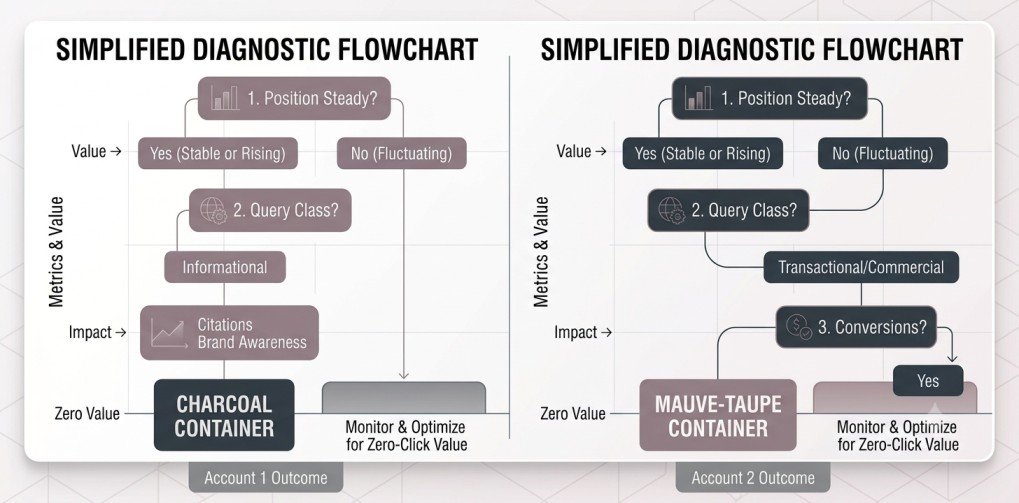
Picture two accounts. Both show impressions up 25% and clicks down 40%. Identical charts. Different problems.
Account A: position 1.4 to 1.5, decline in 18 informational queries, transactional clicks up, conversions up slightly. Absorption. Move new content toward commercial intent and carry on.
Account B: position 3.1 to 7.8, decline across all four classes, conversions down 38%. Ranking loss. Audit indexing, technical health, and content quality against the last core update.
The chart cannot separate those two. The segmentation can, in about ten minutes.
Which Mistakes Should You Avoid When Diagnosing This Pattern?
Three mistakes, and all three come from reading one number instead of three. Each one produces a confident answer that happens to be wrong, which is worse than no answer at all, because a confident wrong answer gets acted on.
Blaming AI Without Checking the Data
Most searches still carry no overview at all. Reaching for AI before checking average position picks the loudest available story instead of the correct one.
Position first. Always. It tells you whether rankings moved before any other explanation gets to apply.
Looking Only at CTR
CTR is a ratio, and ratios fall when the denominator grows. Query fan-out grows the denominator by adding sub-query impressions, so CTR can drop while your actual clicks sit flat.
Read clicks and impressions as two separate numbers before you read the number between them.
Ignoring Conversion Performance
Conversions answer whether any of it mattered. Clicks down with conversions steady means the traffic you lost carried no value. Clicks down with conversions down means it did.
Every diagnosis of this pattern ends in the conversion column.
Frequently Asked Questions
Why are my Google Search Console impressions increasing but clicks decreasing?
Google answers more queries directly, and sub-query appearances push impressions up at the same time. Check average position, then split queries by intent. Position steady with the decline sitting inside informational queries means AI Overview absorption.
Does AI Overview reduce organic clicks?
Yes, on informational queries. It barely touches e-commerce and transactional ones, which is why pricing and product pages usually hold while your guides bleed.
Should I worry if CTR drops?
Check conversions first. CTR down with conversions holding means the traffic that left carried no purchase intent. CTR down with conversions down is a real loss and needs a real diagnosis.
How can I recover lost clicks?
Get cited. Cited brands earn 35% more clicks than uncited ones. Restructure pages for extraction, add data a model cannot generate, and push new production toward commercial and transactional queries where overviews rarely appear.
Is this pattern temporary or permanent?
Permanent for top-funnel informational content. Zero-click behavior has grown for a decade and AI Overviews run on core Search systems. That volume is not coming back.
Conclusion
Impressions up with clicks down is not automatically bad SEO. Most of the time it means your pages still rank while Google answers the question above them. Sometimes it means rankings fell. Both look identical on a chart and separate cleanly the moment you segment.
Diagnose in this order: average position, query class, affected pages, conversions. Position steady, decline inside informational queries, conversions stable, That is absorption, and it needs no rescue.
Then respond to what you found, not to what the chart looked like. Earn citations on the queries that moved, invest where the clicks survived, and report the number that pays for the channel.

Farhan khan
Farhan is an SEO writer covering content strategy, search visibility, and brand discovery across search engines and AI platforms.