Publishing a piece once and letting it sit is no longer a viable strategy. Refreshing content on a set cycle is what keeps AI-powered search engines citing you instead of a competitor. ChatGPT, Perplexity, and Google’s AI Overviews don’t index your content once and remember it forever. They re-evaluate what’s current every time someone asks a question your page could answer.
If your information has gone stale, a competitor’s fresher page steps in and takes the citation instead.
But refreshing content doesn’t mean slapping a new timestamp on an old page. What AI models actually reward is content that stays accurate, complete, and trustworthy over time, updated facts, current pricing, working links, and examples that reflect how things stand today.
A changed publish date with the same outdated substance underneath fools no one. Least of all, a retrieval system built to weigh real signal over cosmetic edits.
This piece breaks the process of refreshing content down into four parts:
- Why recency carries real weight in how AI systems rank and retrieve content
- Exactly what elements of a page are worth refreshing
- How often different content types need attention
- How to turn all of it into a repeatable refresh cycle, not a one-off cleanup
The scale of the gap makes the case on its own. Ahrefs’ analysis of roughly 17 million AI citations found that URLs cited by AI systems average 1,064 days old, compared to 1,432 days for pages ranking organically on Google. AI-cited content is about 25.7% fresher than what traditional search rewards.
That’s not a marginal difference. It’s a clear signal that the rules for staying visible have shifted.
Why AI Systems Value Fresh Content
Retrieval Before Generation
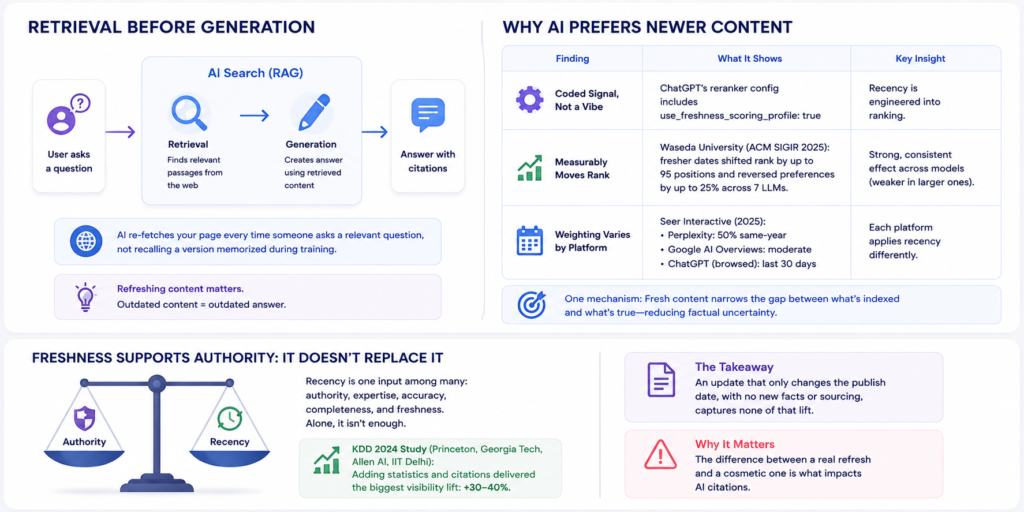
Most AI search tools run on retrieval-augmented generation, or RAG: before generating an answer, the model retrieves candidate passages from the web and grounds its response in them. It’s re-fetching your page every time someone asks a relevant question, not recalling a version memorized during training.
This is exactly why refreshing content matters. If the page the model fetches is outdated, that’s the version shaping the answer.
Why AI Prefers Newer Content
This preference for recency is built directly into ranking mechanics, not a vague trend. Three findings confirm it.
It’s a coded signal, not a vibe. Researcher Metehan Yeşilyurt found that ChatGPT’s reranker config includes a parameter called use_freshness_scoring_profile: true, direct proof that recency is engineered into ranking, not incidental.
It measurably moves rank. Waseda University (ACM SIGIR 2025) tested 7 LLMs using artificial publication dates on identical passages. Fresher dates were consistently promoted, shifting rank by up to 95 positions and reversing pairwise preferences by up to 25%. The effect held across all models, though it was weaker in larger ones.
Weighting varies by platform. Seer Interactive found 50% of Perplexity’s 2025 citations trace to same-year content. Google AI Overviews weighs recency more moderately. ChatGPT’s browsed citations skew toward pages updated in the last 30 days.
Together, these point to one mechanism: refreshing content narrows the gap between what’s indexed and what’s actually true. That’s what reduces factual uncertainty recency as a proxy for accuracy, not a ranking trick.
Freshness Supports Authority: It Doesn’t Replace It
Recency is one input alongside authority, expertise, accuracy, and completeness. Alone, it isn’t enough to earn a citation.
A KDD 2024 study by Princeton, Georgia Tech, Allen AI, and IIT Delhi on Generative Engine Optimization (GEO) found that adding statistics and citations was the single strongest visibility lever tested with a +30–40% boost.
The takeaway: an update that only changes the publish date, with no new facts or sourcing, captures none of that lift. That gap between real refresh vs. cosmetic one is what the “Common Refresh Mistakes” section covers next.
Here’s this section drafted in full, with the table properly formatted and on-page SEO consistent with the rest of the article.
Prioritize What to Refresh, and How Often
Prioritize High-Impact Pages
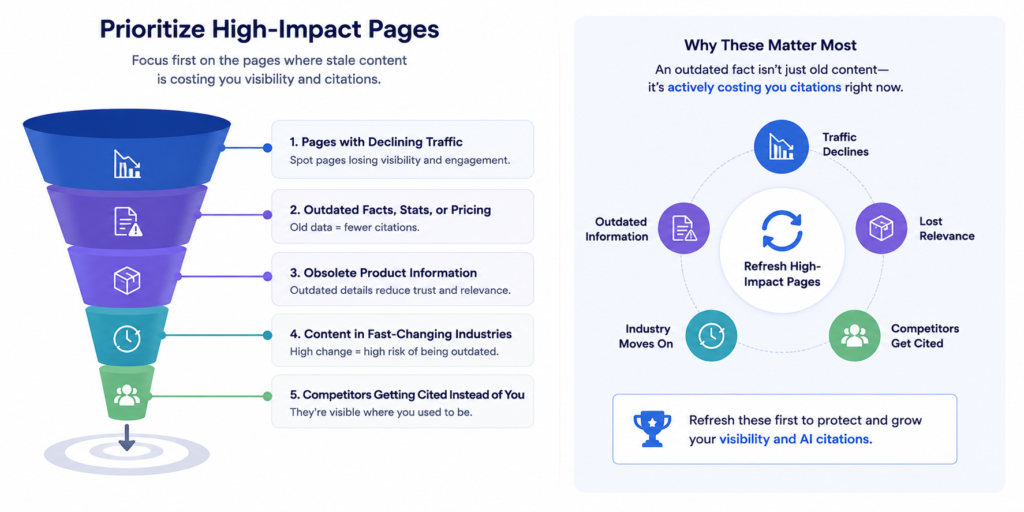
Not every page needs refreshing content at the same time. Start with the pages doing the most damage to your visibility if left stale:
- Pages with declining traffic
- Outdated facts, stats, or pricing
- Obsolete product information
- Content in fast-changing industries
- Pages where competitors are now getting cited instead of you
These are the pages where an outdated fact is actively costing you citations right now — they should top the refresh queue before anything evergreen.
When to Refresh Different Types of Content
Not all content decays at the same rate, so a single fixed schedule doesn’t work across an entire site. The table below breaks down review cycles by content type — and this same cadence guide gets reused later in the refresh workflow, so it’s worth bookmarking.
| Content Type | Review Cycle | Why |
|---|---|---|
| AI & SaaS / Fast-Moving Tech | Monthly | Features, pricing, and the competitive landscape can change weekly. |
| Product Comparisons | Monthly | Pricing and feature updates occur frequently, making outdated comparisons less trustworthy. |
| Statistics & Data-Heavy Content | Monthly–Quarterly (monthly for fast-moving fields) | SE Ranking found that pages refreshed within the last three months averaged 6 AI citations versus 3.6 for older pages—a 67% increase. |
| SEO / How-To Guides | Every 3–6 Months | Search behavior, platforms, and best practices evolve on a similar schedule. |
| Evergreen / Conceptual Content | Every 6–12 Months | Core concepts remain stable, but examples, references, and links become outdated over time. |
| Legal & Healthcare | After Significant Changes | Maintaining accuracy is more important than following a fixed refresh schedule. |
The faster a topic changes, the faster it needs refreshing content. A pricing page and a conceptual explainer don’t belong on the same clock.
What to Refresh: The Content Elements That Matter
Not every element on a page carries equal weight when refreshing content. Some updates move visibility significantly; others just tidy things up. Here’s where to focus:
- Facts, statistics, and research: the single highest-leverage update. Per the GEO study cited earlier, adding current stats and citations drives a +30–40% visibility lift on its own.
- Product info and accuracy: prevents the model from citing a discontinued product or quoting outdated pricing back to a reader.
- Sources and citations: dead or stale links quietly undercut the authority signal a page is trying to build.
- Examples, visuals, and screenshots: a dated UI screenshot is one of the fastest tells that a page hasn’t been touched in a while.
- Internal links: keeping these current supports crawl frequency, which feeds directly into how often a page gets re-indexed (more on this in Measure Success).
Facts and citations do the heaviest lifting here. Everything else on this list matters, but it’s supporting evidence, not the primary driver of the lift.
Build a Repeatable Refresh Cycle
Refreshing content works best as a system, not a one-off cleanup. Here’s the cycle:
- Audit content: identify which pages are underperforming or slipping out of date.
- Prioritize high-impact pages: apply the cadence table from earlier to decide what’s due next.
- Refresh facts, citations, visuals, and links: update in that order of priority, since facts and citations carry the most weight.
- Review and republish substantive updates only: a cosmetic date change with no real edits doesn’t count as a refresh.
- Measure results: track whether the update actually moved citations or traffic.
- Schedule the next review by volatility tier: fast-moving pages loop back sooner; evergreen pages get more runway.
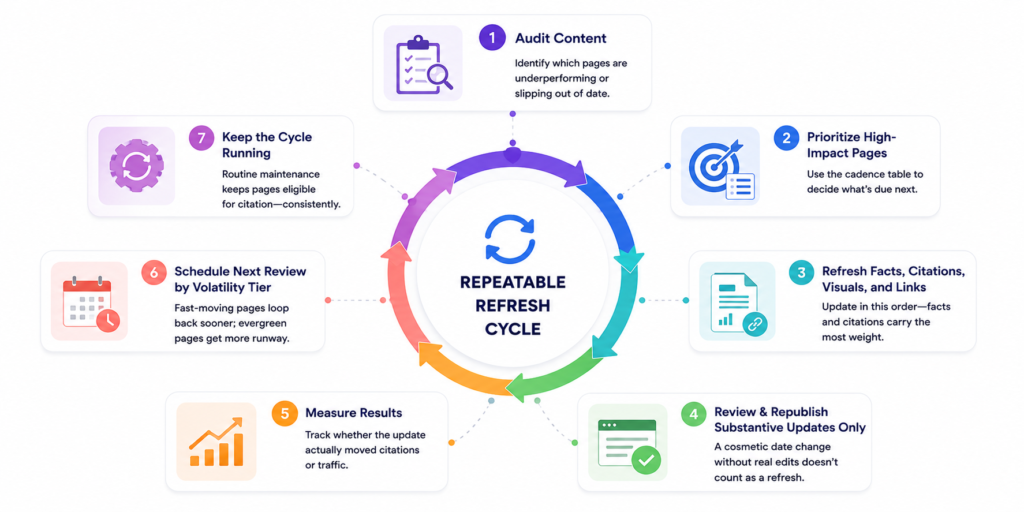
Once this loop is running, refreshing stops being a scramble every few months and becomes routine maintenance, the kind that keeps pages consistently eligible for citation instead of periodically falling behind and needing a rescue.
Measure Success
Knowing whether refreshing content is paying off means tracking two categories of signals, since a refresh can move one without the other.
AI Visibility Signals
- Citations and mentions: how often your page is directly cited in an AI-generated answer
- AI Overview visibility: whether your content appears in Google’s AI Overview panel
- Reference frequency across platforms: how often ChatGPT, Gemini, and Perplexity pull from your page for related queries
Traditional Signals
- Organic traffic: whether refreshed pages see a lift in search-driven visits
- CTR: whether an updated title/meta improves clicks
- Engagement: time on page, scroll depth, return visits
- Backlinks: whether the refresh attracts new links
- Crawl frequency: how often crawlers revisit the page post-update
The Data Behind It
- Ahrefs analyzed 17 million AI citations and found AI-cited URLs average 1,064 days old vs. 1,432 days for organic pages, 25.7% fresher.
- SE Ranking (Nov 2025): pages refreshed in the last 3 months earn 67% more AI citations than older equivalents.
- Seer Interactive: roughly 50% of Perplexity’s 2025 citations trace to same-year content.
A Note on the Data
Two studies referenced in this piece are peer-reviewed: Princeton/Georgia Tech/Allen AI/IIT Delhi (KDD 2024) and Waseda University (SIGIR 2025). The Ahrefs, SE Ranking, and Seer Interactive figures above come from SEO vendors, not academia.
That doesn’t make them unreliable; they’re directionally consistent with the peer-reviewed research and come from firms with large citation datasets. But they’re industry analysis, not settled science, and worth flagging as such rather than treating all five data points as equally rigorous.
Common Refresh Mistakes
Even well-intentioned refresh efforts fall short when they hit these traps:
- Updating only the publish date with a new timestamp with no real changes underneath. Retrieval systems and readers both see through this.
- Superficial edits with no new information: rewording a sentence or two without adding facts, stats, or sources doesn’t move the needle.
- Outdated sources or screenshots left in place: the surrounding text gets refreshed, but stale proof points and dated UI images stay behind.
- Ignoring shifted search intent: the page still answers the question it was written for, even after what people are actually asking has moved on.
- Same fixed schedule for every page, regardless of volatility, treating a pricing page and an evergreen explainer as if they decay at the same rate.
- Not measuring whether refreshes work, updating on a schedule without checking whether it’s actually moving citations, traffic, or rankings.
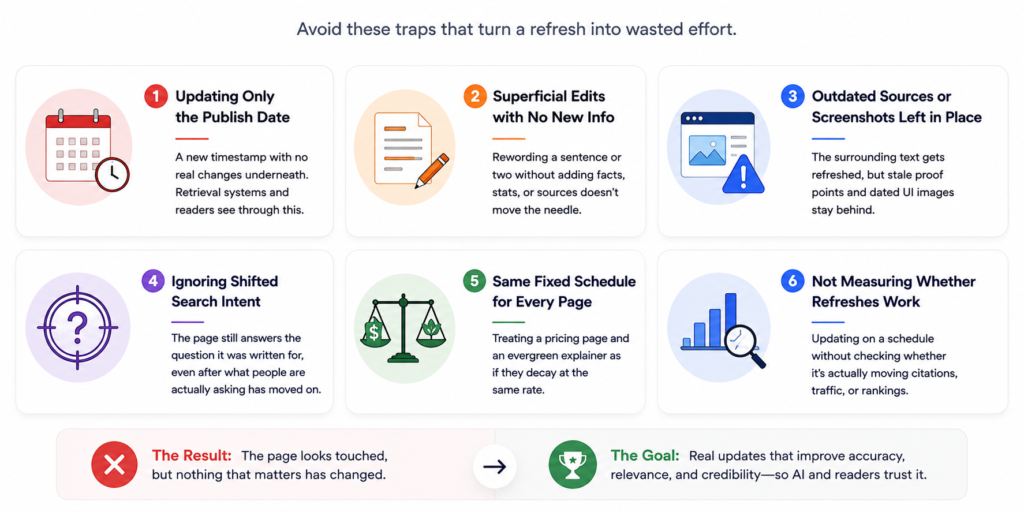
Each of these turns a would-be refresh into wasted effort. The page looks touched, but nothing that actually matters to an AI system or a reader has changed.
FAQs
Does refreshing content improve AI citation potential?
Yes. Ahrefs’ analysis of 17 million AI citations found cited URLs average 1,064 days old vs. 1,432 days for organic results, 25.7% fresher. SE Ranking found refreshed pages (last 3 months) earn 67% more AI citations than older ones. Freshness doesn’t guarantee a citation, but it measurably affects retrieval frequency.
How often should evergreen content be updated?
Every 6–12 months. Core facts stay stable, but examples, links, and screenshots still go stale in that window at a slower cadence than fast-moving categories like SaaS pages, which need monthly updates.
What updates have the biggest impact on AI visibility?
Facts, statistics, and research. A KDD 2024 study (Princeton, Georgia Tech, Allen AI, IIT Delhi) found adding current stats and citations was the strongest visibility lever tested, with a +30–40% lift alone. Product accuracy and updated visuals help too, but none move the needle as much.
