AI-powered search is changing how people discover information online. Instead of showing only a list of links, platforms like Google AI Overviews, ChatGPT, Perplexity, Gemini, and Copilot generate answers by understanding and combining information from multiple trusted sources.
Schema Markup for AEO helps search engines and AI systems better understand your content by adding structured, machine-readable data. It explains important details such as the content type, author, organization, and relationships between different pieces of information. While schema markup for AEO does not guarantee AI citations, it helps AI interpret your content more accurately, making it easier to understand and use.
In this guide, you’ll learn which schema markup for AEO, which schema types are most useful for AEO, when to use them, how to implement them with JSON-LD, and how to test them. You’ll also discover common mistakes to avoid and why schema should always reflect the visible content on your page.
Key Takeaways :
Organization Schema: Strengthens brand identity and entity recognition.
Article Schema: Helps AI understand authorship, freshness, and content context.
Person Schema: Connects content with real experts and improves machine understanding.
WebPage & Breadcrumb Schema: Improves page context and site structure.
FAQPage & HowTo Schema: Useful for structured understanding, but not a reliable way to earn AI citations.
What Is Schema Markup and Why Does It Matter for AEO?
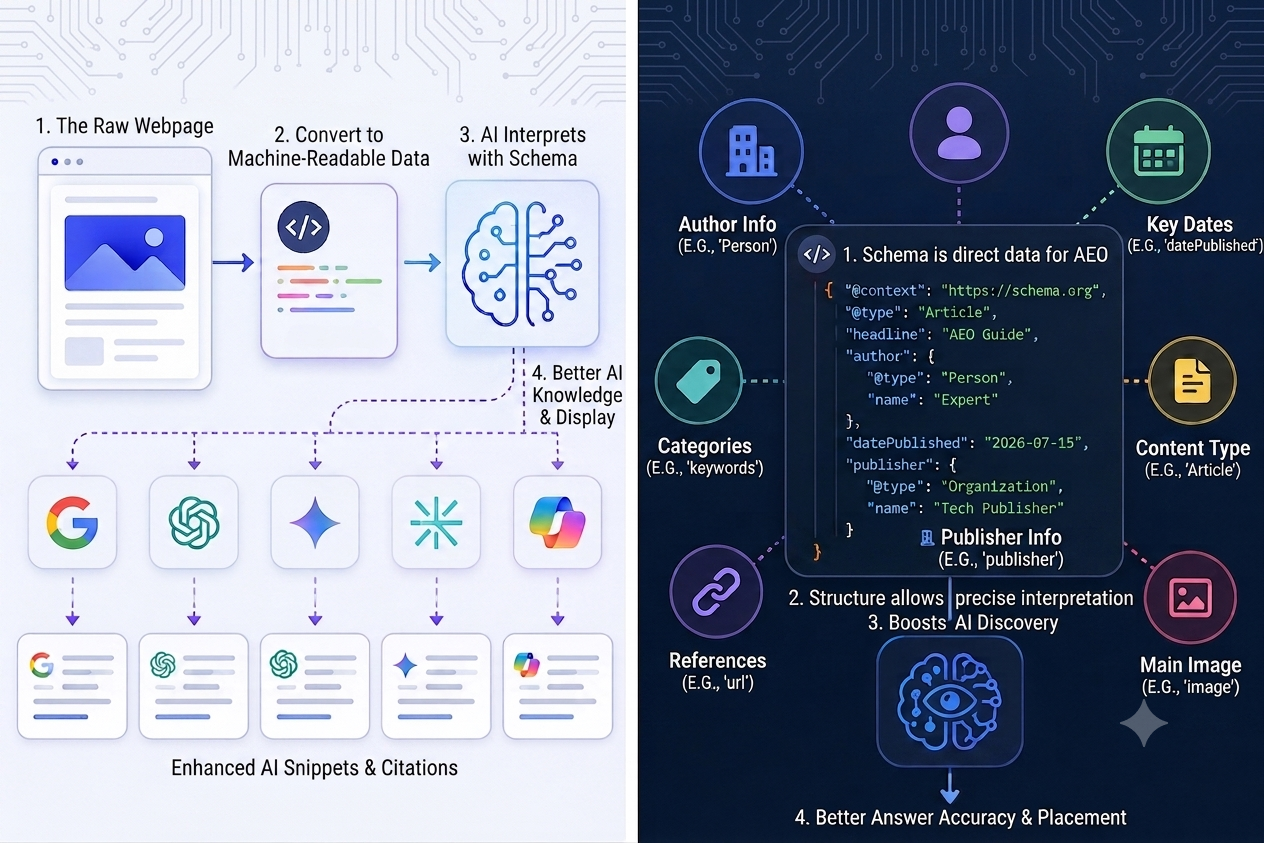
Schema Markup for AEO is structured data that helps search engines and AI systems understand your content. It adds context about elements like articles, authors, organizations, products, and FAQs, making your pages easier for machines to interpret.
In traditional SEO, schema markup was mainly used to enable rich results. With Answer Engine Optimization (AEO), Schema Markup for AEO also helps AI platforms better understand your content, entities, and page context. While schema can improve content understanding, it does not guarantee higher rankings or AI citations.
The most important rule when implementing Schema Markup for AEO is to keep it accurate and consistent with the visible content on the page. Misleading or outdated structured data can reduce trust and violate search engine guidelines.
What the Evidence Actually Shows
They tracked 1,885 pages that added JSON-LD between August 2025 and March 2026 and matched each treated page with three comparable control pages from different domains, resulting in roughly 4,000 control pages overall.
Citation performance was then compared for the 30 days before and after schema implementation. Importantly, every treated page already had 100 or more Google AI Overview citations before schema was added, meaning the study only tested whether schema increased citations for pages that AI systems were already considering.
The researchers also noted that this does not rule out schema helping with crawling, parsing, indexing, or entity understanding for pages that are not yet visible in AI search.
| AI Source | Effect on Citations | Verdict |
|---|---|---|
| Google AI Overviews | -4.6% | Small but statistically significant decline vs. controls |
| Google AI Mode | +2.4% | Statistically indistinguishable from zero |
| ChatGPT | +2.2% | Statistically indistinguishable from zero |
“53% of AI-cited pages run schema markup. Ahrefs analysed 6 million URLs to find that number then ran a second study to find out whether it meant anything.” – Ahrefs, “We Tracked 1,885 Pages Adding Schema,” May 2026
Schema Types That Matter Most for AEO
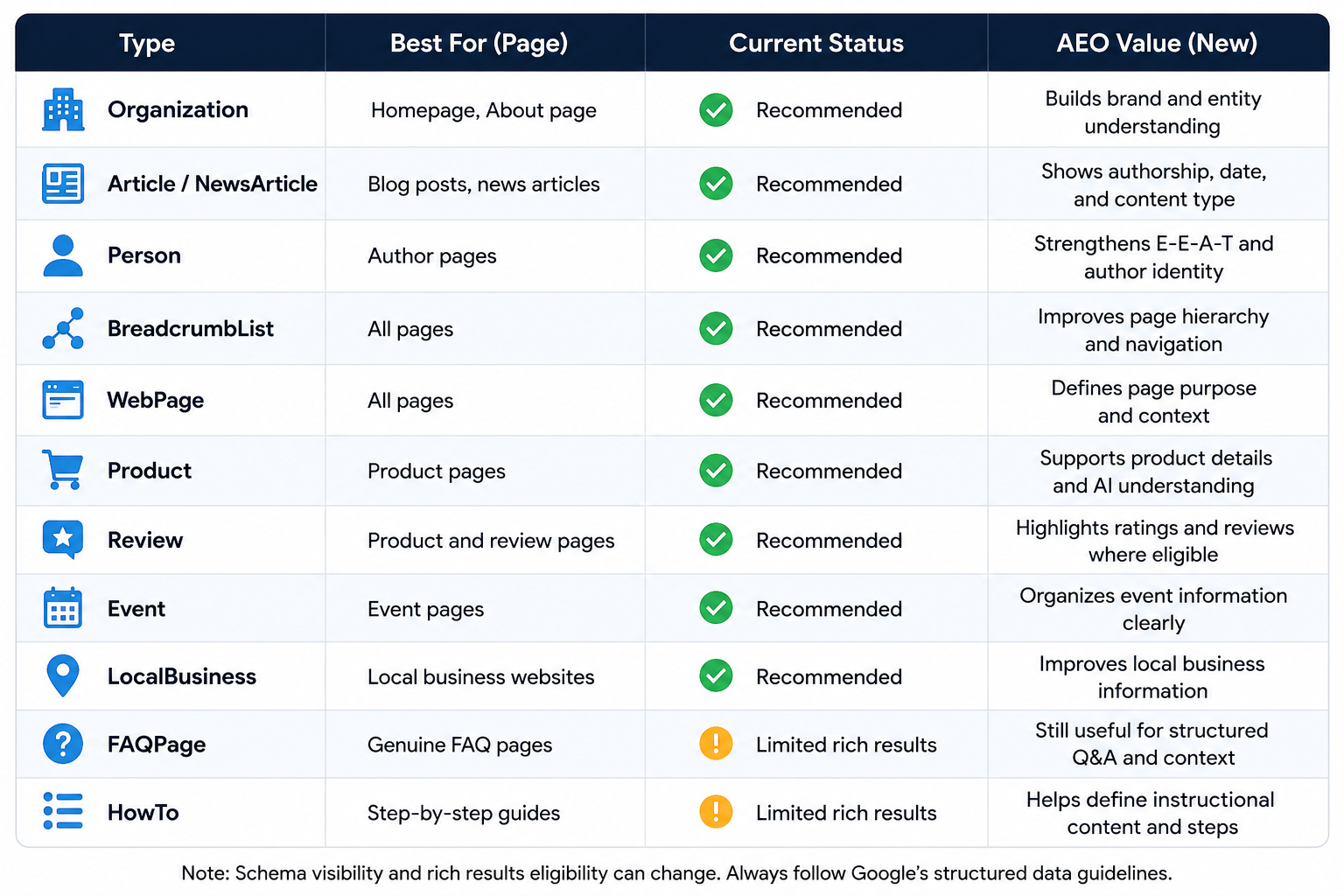
Not all schema types have the same impact on AI search. The table below highlights the most valuable schema markup for AEO.
Machine Understanding Value reflects how much each schema type helps search engines and AI systems interpret entities, page context, and structured information. These ratings are based on observed AI search behavior and practical SEO analysis, not official AI platform scores or direct citation impact.
Organization: Building Brand Understanding
Machine Understanding Value: High
Organization schema helps AI systems identify your business, website, logo, and official profiles. It strengthens your brand entity, making it easier for AI platforms to recognize and confidently attribute information to your organization.
While Organization schema does not directly increase AI citations, it strengthens brand identity and entity recognition, making it easier for AI systems to confidently understand and attribute your content.
{[
“@context”: “https://schema.org”,
“@type”: “Organization”,
“name”: “RankingBite”,
“url”: “https://www.example.com”,
“logo”: “https://www.example.com/logo.png”,
“sameAs”: [
“https://www.linkedin.com/company/example”,
“https://twitter.com/example]
}
Article and NewsArticle: Authorship, Freshness, Authority
Machine Understanding Value: High
Article and NewsArticle schema provide information such as the headline, publish date, update date, and author. These signals help AI systems identify current, well attributed content,which helps AI systems interpret authorship, freshness, and content context.
These signals support machine understanding but have not been shown to directly increase AI citations on already-visible pages.
{
“@context”: “https://schema.org”,
“@type”: “Article”,
“headline”: “Schema Markup for AEO”,
“author”: {
“@type”: “Person”,
“name”: “John Doe”
},
“datePublished”: “2026-07-15”,
“dateModified”: “2026-07-15”
}
Person and Author: E-E-A-T Signals Machines Can Parse
Machine Understanding Value: High
Person schema connects content to a real author and provides clear expertise signals.AI systems use author information alongside the content itself to understand expertise and connect content with real people
This improves entity understanding rather than directly increasing citations.
{
“@context”: “https://schema.org”,
“@type”: “Person”,
“name”: “John Doe”,
“jobTitle”: “SEO Specialist”,
“url”: “https://www.example.com/about”,
“sameAs”: [
“https://www.linkedin.com/in/johndoe”]
}
Connecting Schema with @id and sameAs: The Entity Graph
Machine Understanding Value: High
Using @id and sameAs helps AI systems recognize the same organization or person across multiple sources. Strong entity connections improve confidence in your brand identity, making your content easier to understand and attribute correctly.
{
“@context”: “https://schema.org”,
“@type”: “Organization”,
“@id”: “https://rankingbite.com/#organization”,
“name”: “RankingBite”,
“sameAs”: [
“https://www.linkedin.com/company/example”,
“https://www.wikidata.org/wiki/Q123456”]
}
BreadcrumbList and WebPage: Page Hierarchy and Context
Machine Understanding Value: Medium
BreadcrumbList and WebPage schema clarify where a page fits within your website and what it is about. They improve navigation and page context, helping AI systems interpret content more accurately.
Product, Review, Event, LocalBusiness: Where Rich Results Still Live
Machine Understanding Value: Medium to High (when relevant)
These schema types organize structured information for products, reviews, events, and local businesses. They remain valuable for eligible rich results and help AI systems extract accurate details for these specific content types.
FAQPage and HowTo: What the Deprecations Mean
Machine Understanding Value: Low to Medium
Although Google has reduced FAQPage and HowTo rich results for most websites, these schema types still provide structured context when they match visible content. They should be used to improve content understanding rather than to earn AI citations.
How to Implement Schema Markup That AI Systems Can Understand
Implementing schema markup for AEO is not just about adding code. It should accurately describe your page and stay consistent with the visible content. Follow these steps to add structured data correctly.
Step 1: Identify the Page Intent
Determine the purpose of your page. For example, use Article for blog posts, Product for product pages, Organization for your homepage, and FAQPage only for genuine FAQ sections.
Step 2: Choose the Appropriate Schema markup for AEO
Select the schema type that best matches your content. Avoid adding multiple or unrelated schema types just to increase visibility.
Step 3: Generate JSON-LD
Create your structured data using the JSON-LD format, which is Google’s recommended method. You can generate it manually or with tools such as Schema Markup Generator or your SEO plugin.
Step 4: Add Schema to the Page
Place the JSON-LD code in the page’s <head> section or inject it through your CMS or SEO plugin. Ensure it matches the visible content exactly.
Step 5: Validate with the Rich Results Test and Schema Validator
Before publishing, test your markup using Google’s Rich Results Test and the Schema Markup Validator. Fix any errors or warnings to ensure the structured data is valid.
Step 6: Keep Schema Updated
Review your schema whenever your content changes. Keep details such as authors, dates, products, prices, and business information accurate to help search engines and AI systems trust your content.
How to Measure Whether Your Schema Is Working
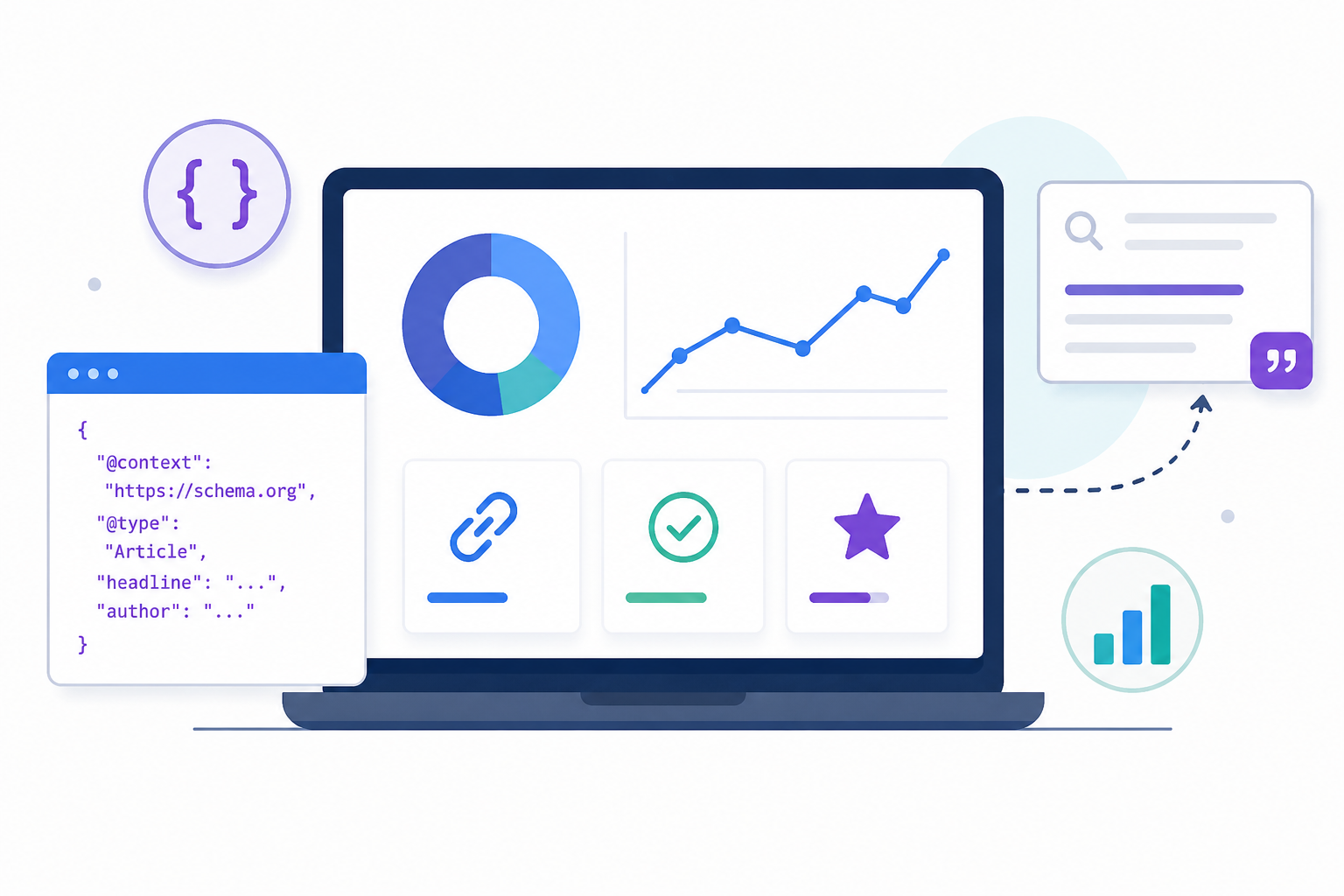
Adding schema markup for AEO is only the first step. Regularly monitor its performance to ensure search engines and AI systems are interpreting your content correctly.
Because current evidence shows little or no direct citation lift from adding schema alone, success should be measured through entity recognition, valid structured data, and rich result eligibility, rather than expecting immediate increases in AI citations.
Monitor Rich Results in Google Search Console
Use Google Search Console to check whether your pages are eligible for rich results. Review the Enhancements and Rich Results reports to identify valid markup, warnings, or errors that need attention.
Track AI Search Mentions
Search for your target topics in AI platforms like Google AI Overviews, ChatGPT Search, Gemini, Perplexity, and Copilot. Check whether your brand or content is being referenced in AI generated answers.
Check AI Visibility with AEO Monitoring Tools
Use AEO monitoring tools such as Peec AI, Profound, Scrunch AI, Semrush AI Toolkit, or Ahrefs Brand Radar to track AI citations, brand mentions, and overall visibility across AI search platforms.
Common Schema Markup Mistakes That Hurt AEO
Avoid these common mistakes when implementing schema markup:
- Adding schema without visible content: Only mark up information that appears on the page.
- Using the wrong schema type: Choose the schema that accurately matches your content.
- Overloading pages with unnecessary schema: Add only relevant structured data instead of multiple unrelated schema types.
- Using outdated or inaccurate structured data: Keep details like authors, dates, prices, and business information up to date.
- Treating schema as a shortcut to AI citations: Schema improves content understanding but does not guarantee AI citations. Content quality, relevance,and authority still matter most.
Frequently Asked Questions
-
Do ChatGPT and Perplexity actually read schema markup?
Yes. Schema markup helps AI systems better understand your content and entities, but it is only one of many signals they use when generating answers.
-
Should I remove FAQ schema now that rich results are gone?
No. Keep FAQPage schema if it accurately reflects visible FAQ content. It can still help search engines and AI systems understand your page.
-
FAQPage or QAPage, which one should I use?
Use FAQPage when you provide the questions and answers. Use QAPage only for community driven pages where users ask and answer questions.
-
Will AI crawlers see schema injected by Google Tag Manager?
Some AI crawlers may not fully process JavaScript injected schema. Adding JSON-LD directly to the page source is generally more reliable.
-
Can schema markup hurt my site?
Yes, if it is misleading, inaccurate, or does not match the visible content. Always use valid and truthful structured data.
Final Thoughts
Schema markup for AEO helps search engines and AI systems understand your content, but it is not a shortcut to AI citations. Use the right schema types, keep them accurate, and ensure they match your visible content.
Combined with high quality content, strong technical SEO, and clear entity signals, schema markup for AEO can improve your visibility in both traditional search and AI powered search.

Shanya
Hi, I'm Shanya, an SEO and content writer at RankingBite. I specialize in creating SEO-focused content around search, AI, cybersecurity, and digital marketing. I enjoy turning complex topics into clear, useful content that helps brands build visibility, connect with their audience, and grow their digital presence.