AI search is changing how customers discover brands. Instead of clicking through a traditional list of blue links, users increasingly ask platforms such as ChatGPT, Google AI Overviews, Gemini, Perplexity, and Claude for recommendations, comparisons, and solutions.
This creates a new challenge for businesses: how do you consistently monitor and improve your brand’s visibility across AI-generated answers?
Companies generally have three options for AI visibility: manage it entirely in-house, hire an AI visibility agency, or use an AI visibility tracking tool. A fourth approach combines the strengths of the last two, the hybrid model, where an agency (such as RankingBite) supplies strategy and execution support while an in-house tool supplies continuous monitoring data.
Framework: Tool = Measurement · Agency = Strategy · In-House Team = Execution
What Is the Hybrid AI Visibility Model?
The hybrid model combines external AI visibility expertise with internal monitoring and execution capabilities.
The agency handles strategic and specialized work, such as:
- AI search strategy
- Generative Engine Optimization (GEO)
- Answer Engine Optimization (AEO)
- Prompt and query research
- Competitor analysis
- Citation optimization
- Content strategy
- Entity and brand authority
- Technical and off-page recommendations
- Strategic reporting
Meanwhile, the in-house team uses an AI visibility tool to monitor performance continuously, tracking:
- Brand mentions
- AI citations and citation sources
- Share of voice
- Competitor visibility
- Sentiment
- Prompt-level performance
- Changes across AI search platforms
The basic workflow:
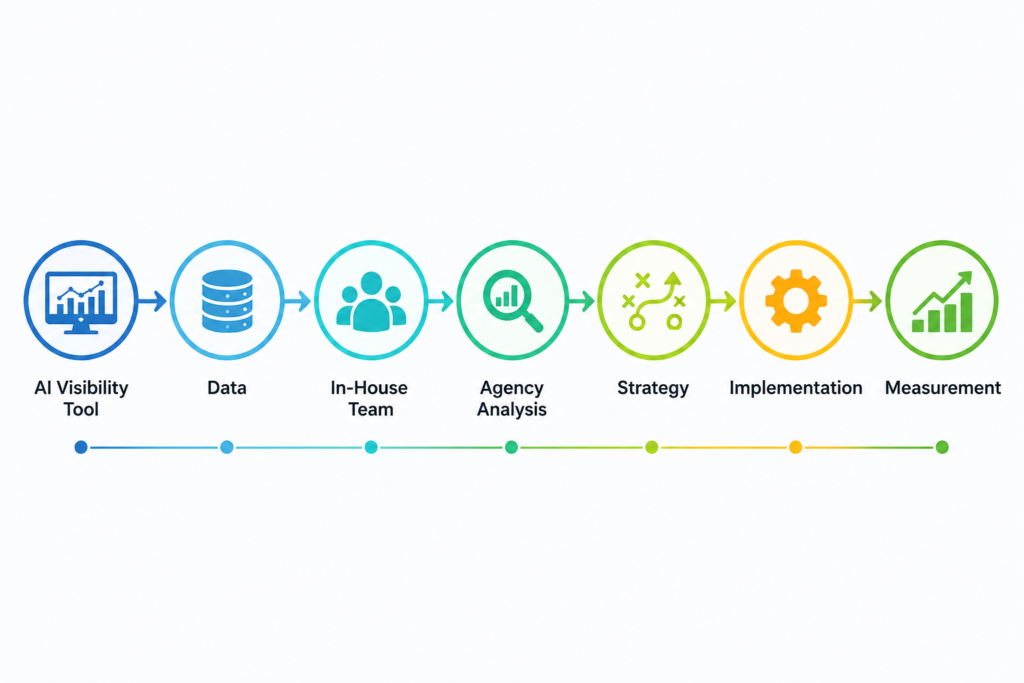
Instead of choosing between an agency and a tool, businesses use both as complementary parts of the same system.
Why Businesses Are Moving Toward a Hybrid Approach
AI visibility is not a one-time SEO project. AI platforms continuously change how they retrieve, interpret, summarize, and cite information; a strategy that works today may produce different results a few months later. This makes continuous measurement essential.
At the same time, simply having visibility data does not guarantee a company knows what to do with it.
For example, an AI visibility tool might show that a SaaS company is mentioned in only 8% of relevant prompts while a competitor appears in 31%. The data identifies the problem but the company still needs to answer:
- Why is the competitor mentioned more frequently?
- Which sources are AI systems using?
- What content gaps exist?
- Which third-party websites influence the answers?
- Does the brand have an entity recognition problem?
- Are competitors cited because of stronger topical authority?
- Which pages should be improved first?
The tool provides ongoing intelligence. The agency turns that intelligence into strategy.
How the Hybrid Model Works: A 6-Stage Process
1. Establish an AI Visibility Baseline
The agency conducts an initial audit while the in-house team begins collecting visibility data through the chosen monitoring platform. The baseline typically includes:
| Metric | What It Measures |
|---|---|
| Mention Rate | How frequently the brand appears in AI answers |
| Citation Rate | How often the brand’s website or content is cited |
| Share of Voice | Brand visibility compared with competitors |
| Citation Position | Where the brand appears among cited sources |
| Sentiment | How AI systems describe the brand |
| Competitor Mentions | How often competitors appear in relevant answers |
“`
This baseline becomes the benchmark for future improvements.
2. Build a Relevant Prompt Library
Traditional SEO focuses heavily on keywords. AI visibility requires looking beyond keywords toward real questions and conversational prompts.
For example, instead of tracking only “CRM software,” a B2B SaaS company might track prompts such as:
- “What are the best CRM platforms for a growing SaaS company?”
- “What CRM should a startup use for managing enterprise leads?”
- “Salesforce alternatives for B2B SaaS companies”
- “Compare the best CRM tools for sales teams.”
The agency develops the initial prompt framework; the in-house team continuously expands and monitors it. Prompts are typically grouped into categories: informational, commercial, comparison, problem-solution, category, and branded.
3. Monitor AI Platforms Continuously
The in-house tool becomes the company’s ongoing monitoring layer across environments such as ChatGPT, Google AI Overviews, Gemini, Perplexity, Claude, and other emerging AI search experiences. The goal is to identify changes over time, for example:
| Month | Share of Voice |
|---|---|
| January | 12% |
| February | 16% |
| March | 21% |
| April | 18% |
“`
A decline like the one in April would trigger an investigation into whether it resulted from competitor content improvements, new sources entering the AI ecosystem, changes in AI retrieval behavior, lost citations, outdated content, repositioning, or new competitors.
4. Let the Agency Analyze the Data
A monitoring tool can tell you what changed. An experienced agency helps determine why it changed and what should happen next.
For example, if your tool reports that your brand is mentioned in only 18% of comparison prompts, an agency may discover that competitors are consistently cited from industry publications, review websites, expert roundups, comparison pages, research reports, and other high-authority third-party sources. The resulting recommendation might be to launch a digital PR campaign, strengthen comparison content, and pursue relevant third-party mentions. The data becomes the foundation for strategic decision-making.
5. Execute the Optimization Strategy
Once the agency identifies opportunities, the internal team implements recommendations or the agency handles execution. Optimization areas typically include:
- Content optimization– sharpen existing pages so they answer AI-retrieved questions clearly and authoritatively
- Content expansion – build supporting pages around key topics, questions, comparisons, and use cases
- Entity optimization – clarify the relationship between the brand, products, people, categories, and industry
- Citation optimization – increase presence across sources AI systems already trust
- Digital PR – build third-party mentions that influence AI-generated answers
- Technical SEO – ensure content is easily discovered, crawled, indexed, and understood
6. Measure the Impact
After implementation, the in-house tool continues monitoring the same prompt set, creating a feedback loop:
Monitor → Analyze → Optimize → Measure → Learn → Repeat
| Stage | Share of Voice |
|---|---|
| Initial baseline | 11% |
| After content optimization | 15% |
| After authority campaign | 22% |
| After comparison-content expansion | 27% |
Results vary by company and industry, but the key is that the organization can measure whether its AI visibility strategy is actually improving.
Agency vs. Tool vs. Hybrid: Comparison Table
| Factor | Agency Only | Tool Only | Hybrid |
|---|---|---|---|
| AI visibility monitoring | High | High | High |
| Strategic expertise | High | Low | High |
| Internal control | Medium | High | High |
| Continuous data access | Medium | High | High |
| Implementation support | High | Low | High |
| Initial complexity | Medium | Low | Higher |
| Scalability | High | High | Very high |
| Internal learning | Medium | High | High |
| Cost efficiency at scale | Medium | High | High |
| Best for | Companies needing expertise | Experienced teams | Growing teams with serious AI visibility goals |
“`
The hybrid approach requires more coordination, but it provides a stronger long-term operating model.
What an AI Visibility Agency Should Handle
Not every task needs external support an agency should focus on areas where specialized expertise creates the most value, owning:
- AI visibility strategy
- GEO strategy
- Prompt research
- Competitor intelligence
- Citation analysis
- Content gap analysis
- Entity strategy
- Third-party authority strategy
- Digital PR recommendations
- Quarterly strategic reviews
An agency should ideally work as an extension of the internal marketing team rather than as a fully separate vendor. RankingBite, for instance, positions itself as a GEO-focused agency that combines programmatic SEO, AI-powered content optimization, and link-building to help brands get cited across ChatGPT, Perplexity, and other AI platforms the kind of specialized partner that fits naturally into the “agency” layer of this hybrid model.
What the In-House Team Should Handle
The internal team owns day-to-day monitoring and operational knowledge, typically including:
- Running regular visibility reports
- Monitoring priority prompts
- Tracking competitors
- Identifying visibility changes
- Updating content and publishing new pages
- Maintaining prompt libraries
- Sharing product and customer insights
- Reporting changes to leadership
This division keeps the company from becoming fully dependent on an external agency.
Where an AI Visibility Tool Fits
An AI visibility platform serves as the measurement layer of the hybrid system. A tool such as RadarKit can be positioned as part of the internal monitoring workflow, helping teams understand how their brand appears across AI search experiences.
The important distinction: the tool should not be treated as the entire AI visibility strategy.
Framework:
- Tool = Measurement
- Agency = Strategy
- In-House Team = Execution
When these three components work together, AI visibility becomes an ongoing business process rather than an occasional SEO project.
When the Hybrid Model Makes the Most Sense
- B2B SaaS Companies – Buyers frequently research products through comparisons, recommendations, and problem-based questions, so AI visibility influences discovery throughout the buying journey.
- Enterprise Brands – Large organizations with multiple products and markets benefit from centralized monitoring data paired with agency strategy across complex markets.
- Companies With Existing SEO Teams – If SEO, content, and marketing specialists already exist in-house, an agency can supply specialized AI search expertise while the internal team owns execution no need to hire an agency solely for routine monitoring.
- Companies Entering Competitive AI Search Markets – If competitors are already being frequently recommended by AI platforms, the hybrid model provides both expert analysis and continuous monitoring to close the gap.
When the Hybrid Model May Be Overkill
The hybrid approach isn’t automatically the right choice for every business. A small company with limited AI search demand may not need an agency and a dedicated monitoring platform simultaneously starting with a tool and building internal capability may be more practical. Companies that lack the internal resources to implement recommendations may instead benefit from a full-service agency arrangement.
The right model depends on:
- Company size
- AI search importance
- Internal expertise
- Content capacity
- Competitive intensity
- Budget
- Number of markets
- Number of prompts and products being monitored
How Much Does the Hybrid Model Cost?
Cost depends heavily on the scope of the agency engagement and the AI visibility platform chosen:
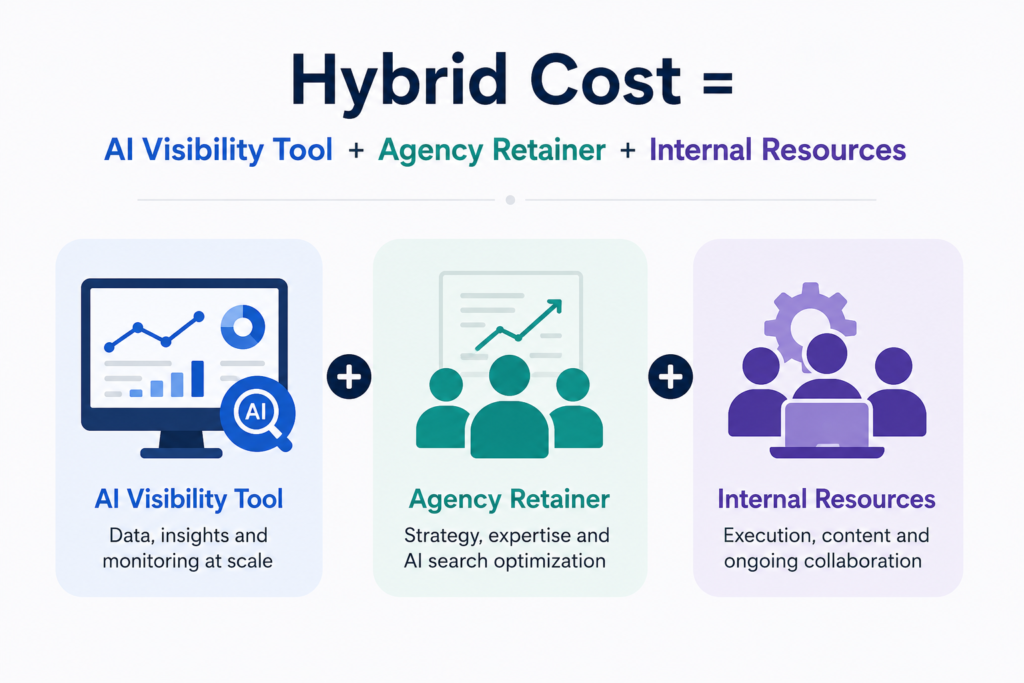
A company might pay for: an AI visibility monitoring platform, monthly agency strategy and consulting, internal content/SEO resources, and additional PR or content production as needed.
Although the hybrid model may cost more than a tool alone, the objective isn’t minimizing software spend, it’s improving AI-driven discoverability and business outcomes. Evaluate the investment against:
- Increase in AI mentions and citations
- Growth in share of voice
- Increase in qualified referral traffic
- Pipeline influenced by AI discovery
- Improvement in branded search demand
- Competitive visibility gains
How to Build a Hybrid AI Visibility Workflow
- Select your monitoring platform -choose a tool that covers the AI platforms, prompts, competitors, and metrics that matter to your business.
- Create your baseline – measure current visibility before changing your content or authority strategy.
- Bring in specialized expertise – use an AI visibility agency (e.g., RankingBite) to audit the data and identify the biggest opportunities.
- Prioritize opportunities – don’t optimize everything at once; prioritize by business value × visibility gap × achievable impact.
- Execute internally – your SEO, content, PR, and marketing teams implement the recommendations.
- Review and repeat – use the monitoring platform to measure changes and feed the data back to the agency for the next optimization cycle.
Create a Shared Data Loop
One of the biggest mistakes companies make is separating the agency’s work from internal reporting the agency delivers a monthly report while the internal team tracks entirely different KPIs. The hybrid model works best when everyone uses the same visibility data.
A shared dashboard should answer:
- Where are we being mentioned?
- Where are competitors winning?
- Which prompts matter most?
- Which sources are influencing AI answers?
- Which pages generate citations?
- Where has visibility declined?
- What actions are currently underway, and did they work?
This creates accountability across both the agency and the internal team.
Frequently Asked Questions
What is the hybrid AI visibility model?
It’s an approach that pairs an external AI visibility agency (for strategy, research, and execution support) with an in-house monitoring tool (for continuous, real-time data) so the same visibility data drives both reporting and action.
Is a hybrid model better than using a tool alone?
For companies with meaningful AI search demand, yes a tool shows what changed, but an agency helps explain why and what to do next. Smaller companies with limited AI search exposure may be fine starting with a tool alone.
What should an in-house team own versus an agency?
The in-house team should own day-to-day monitoring, reporting, and publishing. The agency should own strategy, prompt research, competitor intelligence, and specialized execution like digital PR and entity optimization.
How is AI visibility different from traditional SEO?
Traditional SEO optimizes for keyword rankings; AI visibility optimizes for how often and how favorably a brand is mentioned, cited, and recommended inside AI-generated answers across platforms like ChatGPT, Gemini, Perplexity, and Google AI Overviews.
