The Two-Track Model: Combining Authority Links and Entity-Rich Content
The two-track model is the framework behind who gets cited in AI search results today. AI-powered platforms like ChatGPT and Perplexity don’t rank pages…
The two-track model is the framework behind who gets cited in AI search results today. AI-powered platforms like ChatGPT and Perplexity don’t rank pages the way Google does; they synthesize answers from sources they trust and understand, which has quietly changed what earns visibility online.
The common assumption is that backlinks alone still carry over. They don’t, not fully. Ranking well on Google no longer guarantees AI cites you because authority and machine-readable understanding are now two separate signals, not one.
That’s the core of the two-track model: Track 1 is right-sized authority link building, earning trusted, relevant mentions rather than maximizing volume. Track 2 is entity-rich content structuring your brand so AI can understand and retrieve it accurately. Together, they answer the real question behind AI visibility: does AI trust you, and does it understand what you actually are?
Why the Two-Track Model Requires Both Authority and Entities
Traditional SEO rewards accumulated authority: the more relevant links you earn, the higher you rank. AI search behaves differently. It doesn’t just weigh accumulated trust; it evaluates entity recognition, contextual consistency, topical depth, and source reliability together, often drawing on an entirely different set of sources than those ranking on page one.
The gap is significant: only 8% of ChatGPT’s citations overlap with Google’s top organic results for the same query, based on a 15,000-prompt analysis by Ahrefs Brand Radar. Perplexity’s overlap is higher at 28%, but that still means nearly three-quarters of its cited sources differ from standard organic results.
This is why the two-track model exists. Ranking on Google builds authority, but authority alone doesn’t guarantee AI recognizes or retrieves you accurately. AI needs both signals working together.
Links establish trust. Entities create understanding. AI relies on both.
Track 1: Build Authority Through Trusted Mentions
What Right-Sized Authority Link Building Looks Like
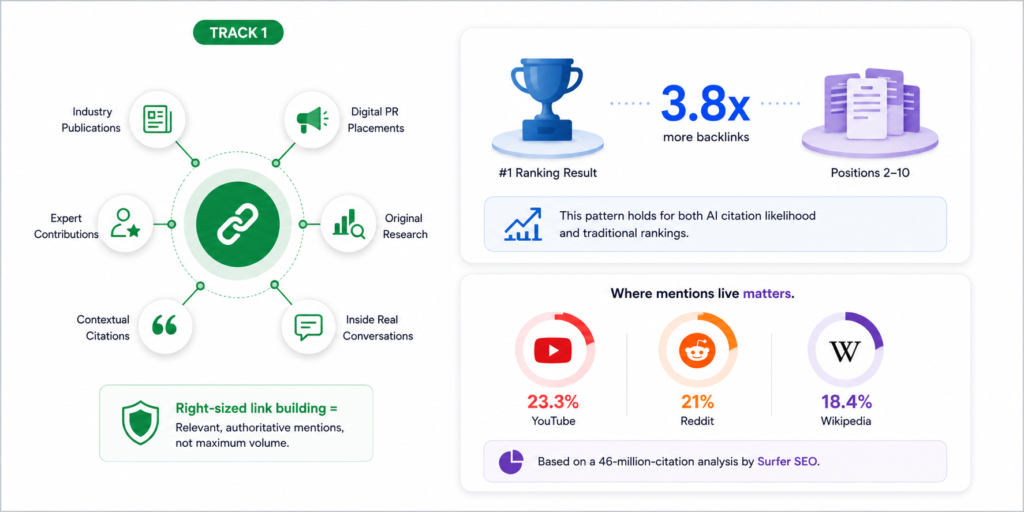
Right-sized link building means earning relevant, authoritative mentions, not maximizing volume for its own sake. This includes editorial mentions in industry publications, digital PR placements, expert contributions, original research, and contextual citations that place your brand inside a real conversation, not just a directory listing.
Volume still correlates with authority to a point: the number one ranking result on Google has 3.8 times more backlinks than pages in positions 2 through 10, and this pattern holds for AI citation likelihood as well as traditional rankings.
But where those mentions live matters just as much as how many you have. YouTube accounts for 23.3% of AI Overview citations, Reddit for 21%, and Wikipedia for 18.4%, based on a 46-million-citation analysis by Surfer SEO. A single well-placed mention on a trusted platform can outweigh several generic ones elsewhere.
Why Authority Links Still Matter
Authority links strengthen brand credibility, publisher trust, topical authority, and retrieval confidence, but they aren’t a one-time achievement. Content updated within the last 90 days receives a 3.2x citation multiplier compared to older content, according to a ConvertMate study spanning 80 million citations across 10,000+ domains. Authority requires maintenance, not a single campaign.
Still, authority only tells AI who to trust. It doesn’t tell AI what your brand actually represents; that’s where entity-rich content comes in.
Track 2: Build an Entity-Rich Citation Layer
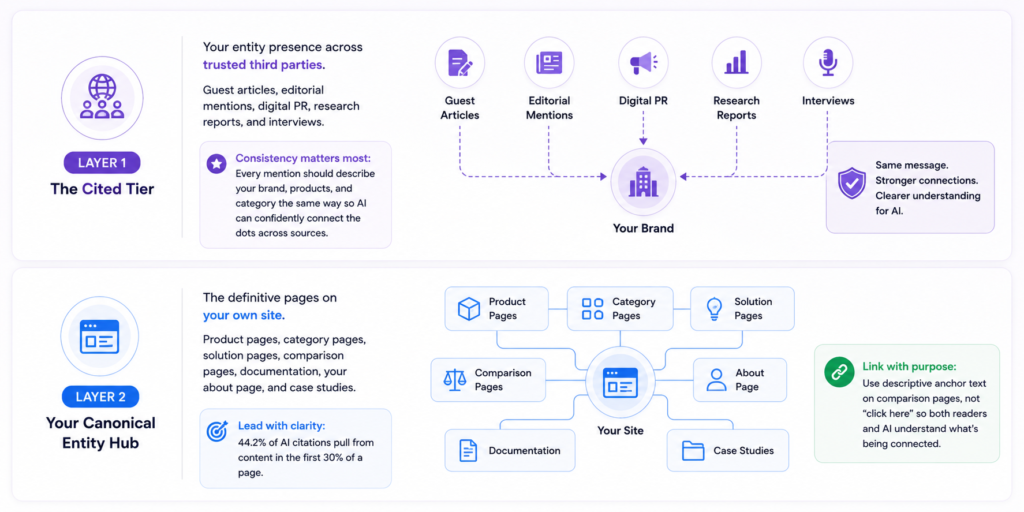
AI builds entity understanding by connecting external sources with your own site. Entity optimization means structuring content around recognized, disambiguated entities, brands, people, products, and concepts so AI systems can pull specific passages into generated answers. This layer has two parts: what others say about you, and what your own pages say about yourself.
Layer 1: The Cited Tier
This is your entity presence across trusted third parties, guest articles, editorial mentions, digital PR, research reports, and interviews. Consistency matters most here: every mention should describe your brand, products, and category the same way, so AI can confidently connect the dots across sources.
Layer 2: Your Canonical Entity Hub
These are the definitive pages on your own site: product pages, category pages, solution pages, comparison pages, documentation, your about page, and case studies. Nearly half of all AI citations (44.2%) pull from content in the first 30% of a page, so these pages should lead with clear entity definitions rather than narrative introductions. Link between them using descriptive anchor text on comparison pages, not click here, so both readers and AI understand what’s being connected.
Characteristics of AI-Friendly Entity Content
| Trait Concrete | Action |
|---|---|
| Clear Entity Definitions | State what it is in the first sentence. |
| Consistent Terminology | Use one product or brand name consistently across all content. |
| Structured Headings | Write descriptive headings instead of clever or vague ones. |
| Internal Linking | Connect related entity pages with clear internal links. |
| Named Entities | Reference specific brands, tools, people, or concepts by name. |
| Original Insights | Include at least one unique claim, observation, or framework. |
| Supporting Citations | Back important claims with credible sources. |
| Schema Markup | Implement Organization, Product, FAQPage, and Article schema where appropriate. |
| Topical Completeness | Answer the user’s question thoroughly from start to finish. |
Two patterns explain why this works.
ChatGPT favors content using definite rather than vague language, containing a question mark, high in entity density, balanced between fact and opinion, and written in simple sentence structures.
Format matters too: comparison pages with three tables earn 25.7% more citations, and pages with roughly eight list sections earn up to 26.9% more citations.
Why the Two Tracks Compound
Track 1 builds trust. Track 2 builds structure. Neither compensates for the other’s gap: trust tells AI who to cite, while structure tells AI what to say.
| Track 1 Only | Track 2 Only | Both | |
|---|---|---|---|
| What AI Has | Trust, no structure | Structure, no trust | Trust + structure |
| Result | Cites the brand name, but stays vague on specifics. | Has clean data, but no signal to surface it. | Confident, specific citations. |
Consider two hypothetical brands.
Brand A has heavy PR and editorial coverage, but thin product pages. AI recognizes and cites the name, but can’t retrieve specifics, so answers stay vague or default to competitors with better-structured pages.
Brand B has strong documentation and category pages but no external mentions. AI has clean entity data to work with, but no trust signal telling it to surface that brand over more established competitors.
Only when both tracks are in place does AI have both the confidence to cite a brand and the structure to say something specific about it.
The Flywheel
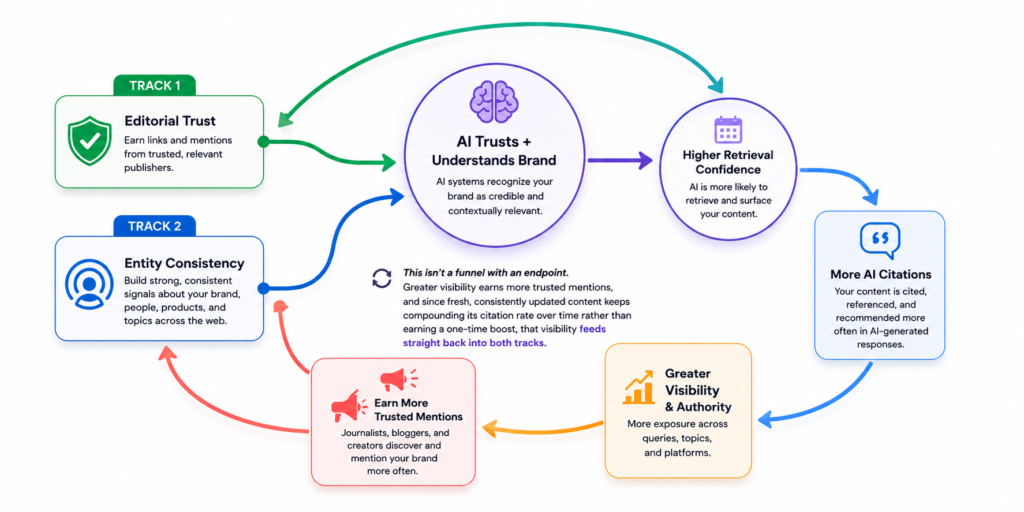
This isn’t a funnel with an endpoint; it’s a loop. Greater visibility earns more trusted mentions, and since fresh, consistently updated content keeps compounding its citation rate over time rather than earning a one-time boost, that visibility feeds straight back into both tracks.
H2: Implementing the Two-Track Model
Building the two-track model starts with five concrete steps.
- Define core entities: Pin down your brand, products, services, categories, and audience so every mention describes the same thing.
- Build your canonical entity hub: Create product, category, solution, and comparison pages that lead with clear definitions.
- Expand your cited tier: Pursue editorial mentions, digital PR, original research, and expert contributions.
- Maintain entity consistency: Keep terminology identical across owned and earned content.
- Measure what matters: Track AI citations, brand mentions, retrieval frequency, branded search growth, and AI referral traffic.
Content introducing a new category with 5–7 supporting statistics earns roughly 20% higher citation likelihood, worth building into step 2 as you write hub pages, not just checking after publishing.
Common Mistakes to Avoid
Even with a clear plan, these are the mistakes that undercut the model.
- Prioritizing link quantity over authority
- Building authority without entity consistency
- Using inconsistent brand or product terminology
- Publishing weak product or category pages
- Treating AI optimization as separate from SEO
Conclusion
Sustainable AI visibility comes from external authority and entity clarity, not one or the other. Right-sized, not maximized, link building matters because relevance and consistency outperform volume: a smaller footprint of well-placed, entity-consistent mentions beats a large footprint of generic ones. Pair that with content AI can actually parse and cite, and the two-track model becomes a compounding cycle of trust, recognition, and visibility that keeps reinforcing itself
