AI search is changing how brands earn visibility. Instead of simply ranking pages, AI systems select a small number of brands to mention in their answers. This makes brand inclusion the key goal. A strong search ranking does not automatically mean an AI system will mention your brand.
So the question is no longer just “How do we rank higher?” It is “What makes AI systems mention our brand, and how quickly can that happen?”
This article breaks down the key factors that influence AI visibility, using research, data, and expert analysis to explain what can accelerate or slow down brand appearances in AI-generated answers.
What Appearing in AI Answers Actually Means
Before looking at what drives inclusion, it’s worth being precise about what we’re measuring. This is often called Share of Model: how often a brand gets mentioned by an LLM relative to competitors on a category- or problem-based question. It’s the modern descendant of share of search.
The mechanics differ, though. Traditional search ranks pages, so even a brand on page three technically existed in the results. LLMs generate one synthesised answer instead. A brand either gets pulled in or it doesn’t. No partial credit for being indexed somewhere.
Researchers now study this under the label Generative Engine Optimisation (GEO). Aggarwal et al. (2024) were among the first to test how adding statistics, citations, and expert quotes affects whether an LLM includes content in its answer. Their benchmark found visibility gains of up to 40%, though the best-performing method varied by domain. Statistics worked best for legal and opinion content, quotations for historical and social topics.
A separate study by Ma et al. (2025), sampling roughly ten thousand websites across conventional and generative search results, found these systems use a different selection logic entirely. Content more predictable to the underlying model was significantly more likely to be cited. A one-standard-deviation drop in perplexity (making content more predictable) raised citation odds from 47% to 56%, while that same effect was completely absent in conventional Google rankings.
That’s the real shift: not where you rank, but whether the model names you at all.
Retrievability: The Gate Before Everything Else
Before content strategy, backlinks, or brand narrative matter, there’s a more basic question: can the AI even find you?
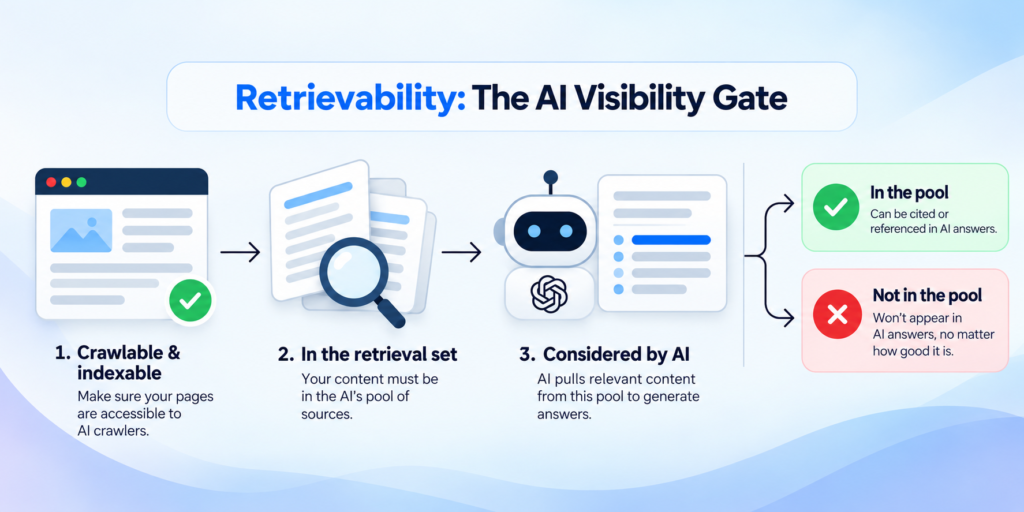
- Retrieval comes first. LLMs generate answers from a retrieval set, the pool of sources the system considers. If your page isn’t in that pool, it can’t be cited or referenced, no matter how good it is.
- Optimisation only works after retrieval. Academic GEO research treats this as a baseline assumption: most techniques for improving visibility only help once a source is already inside the retrieval set.
- The fundamentals still apply. Your site needs to be crawlable, indexable, and technically accessible: no robots.txt blocks on key pages, no content trapped behind JavaScript rendering, no orphaned pages with no path in.
- It’s size-agnostic. A ten-person startup with a clear, easily extractable answer has the same shot at retrieval as an enterprise brand. What matters is how plainly the content is structured, not the marketing budget behind it.
- It’s a pass/fail gate, not a ranking. Retrievability doesn’t care about domain authority. You’re either in the pool, or you’re not.
Solution-Oriented Content Beats Brand Narrative
Once a page clears the retrievability gate, the next question is what kind of content actually gets pulled into the answer. The pattern here is simple: pages built to solve a specific problem outperform pages built to tell a brand story.
The Data Point
A large-scale study by Seer Interactive ran 10,000 real-world questions through GPT-4o and tracked which brands got mentioned. After filtering out noise like forums, social media, and aggregators, the correlation got stronger for one type of content in particular: solution-oriented pages that directly addressed the question being asked.
What “Solution-Oriented” Means in Practice
Content written to answer a specific question head-on, like “best CRM for small teams” or “how to fix X problem,” outperforms generic brand pages that talk about who the company is rather than what it solves.
The Takeaway
Broad “about us” pages, mission statements, and brand-voice content rarely get pulled into AI answers, because they don’t map cleanly onto the problem a user is actually asking about. Direct, problem-first framing does.
What This Means for Content Strategy
Every page competing for AI visibility should be able to answer: what specific question is this built to solve, and does it answer that question in the first few lines? If the answer requires scrolling past brand positioning to get to the substance, it’s less likely to be extracted.
Structured, Extractable Formatting
Content quality alone isn’t enough anymore. How that content is packaged determines whether an AI system can actually pull it out and use it.
| Aspect | Traditional SEO | AI Search / GEO | Best Practice |
|---|---|---|---|
| Signal Shift | Backlinks & keywords | Extractability & structure | Make content easy to extract |
| Extractability | Human-focused content | Fact-focused retrieval | Use clear headings, lists & schema |
| The Risk | Complex pages can still rank | Buried answers may be ignored | Put answers upfront |
| In Practice | Optimise keywords & authority | Optimize for retrieval | Use structured, scannable content |
Cross-Source Consensus & Authoritative Association
A brand’s own website is only one input. What gets said about it elsewhere carries just as much weight.
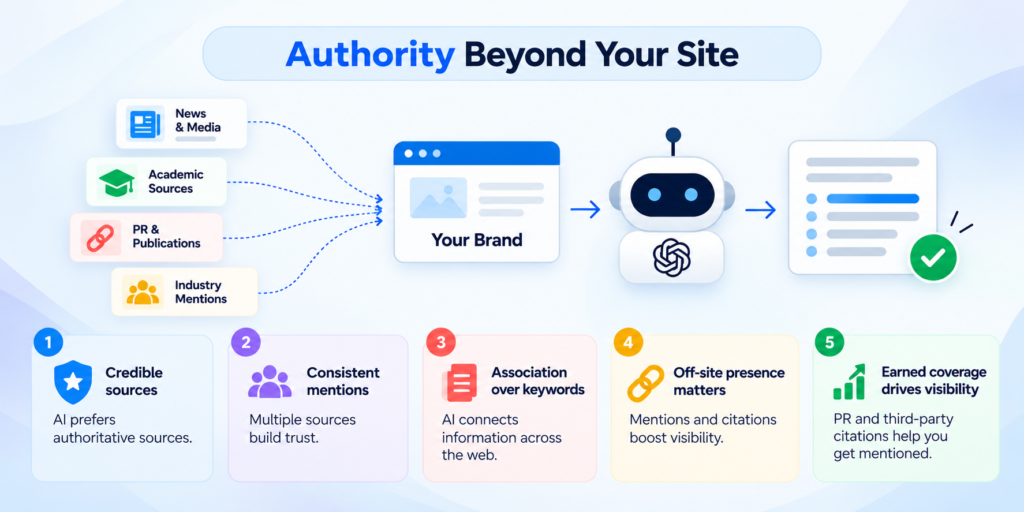
- Credibility matters. AI systems favour sources that appear credible and authoritative, not just technically accessible.
- Consensus builds trust. When multiple independent sources describe the same fact in similar terms, AI treats it as more reliable and more likely to surface.
- It’s association, not just keywords. LLMs synthesise patterns across news, PR, academic sources, and industry publications, not just a brand’s own pages.
- Off-site presence directly feeds on-site visibility. Brand mentions, citations, and partnerships across other credible sites act as reinforcement signals, making a brand more likely to be recognised and referenced as an authority on its category.
- Practical implication. Visibility can’t stop at owned content. Earned coverage, PR, and third-party citations are now direct inputs into whether an LLM trusts and surfaces a brand.
Traditional SEO as One Input, Not the Whole Strategy
Search rankings haven’t lost relevance; they’ve lost their monopoly on visibility.
SEO Isn’t Dead, It’s Demoted
Search rankings still play a role in whether a brand gets mentioned by an LLM, but they’re no longer the deciding factor on their own.
The Evidence
In the large-scale study that pulled over 300,000 keywords and tested 10,000 real-world questions through GPT-4o, search rankings showed some correlation with brand mentions, but a much weaker one than factors like solution-oriented content and source credibility.
What This Means
Ranking well in Google can still feed AI visibility indirectly, since better rankings often mean better retrievability and more citations. But treating SEO as the whole strategy leaves the bigger levers, like structure, consensus, and off-site authority, unaddressed.
The Reframe
SEO becomes table stakes rather than the finish line. It’s one input feeding a larger system, not the system itself.
Why Smaller, Newer Brands Often Win on Speed
Size and history used to be reliable SEO advantages. In AI search, they’re turning into liabilities.
The Pattern
Focused brands with conversational, specific, cleanly structured content are getting picked up faster than legacy brands relying on broad, organic-traffic strategies. Research from LightSite AI and theCUBE Research found that in AI search, the playing field is flatter than most assume, with newer, more agile vendors already outpacing larger, more established competitors in AI-driven discovery.
What Gets Rewarded
Vendors that speak plainly about specific use cases, back claims with measurable outcomes, and maintain a consistent voice across channels get referenced more often and tend to use their own names consistently in citations, transcripts, and podcast appearances.
What Gets Penalised
Legacy brands often spread their story across disconnected campaigns or lean on generic positioning statements, producing a weaker, muddier signal that’s harder for AI systems to extract and trust.
The Takeaway
Being small or new is no longer a disadvantage in search. Being vague and inconsistent is.
The Compounding / Early-Mover Effect
- AI reinforces existing patterns. Brands that consistently appear as authoritative sources get reinforced further, making future visibility more likely.
- Visibility begets visibility. Once a brand becomes a go-to reference in its category, each new mention adds to a signal that’s already trusted.
- The gap widens over time. Early movers build a position that gets harder for competitors to displace, not because the door closes, but because the leader’s signal keeps strengthening.
- Waiting has a real cost. Brands that delay risk finding competitors already entrenched as the default answer, requiring far more effort to break in later.
- The framing that matters. This is a compounding asset, like domain authority in the SEO era, where early investment pays off disproportionately compared to catching up.
Measuring It — Share of Answer / Share of Voice
Optimisation without measurement is just guesswork. Before making changes, teams need a clear read on where they currently stand.
The KPI, Defined
Share of Voice (or Share of Answer) measures how often your brand appears relative to competitors when users ask category-level or problem-based questions, reflecting how visible a brand is within AI-generated answer sets where inclusion is inherently limited.
Why It Replaces Old Metrics
Rank tracking and keyword position reports don’t capture this. A brand can rank well in Google and still be absent from AI-generated answers, so this requires a distinct measurement approach.
The Blind Spot
Teams that have invested heavily in SEO often lack visibility into how their brand appears across AI search engines, and in many cases simply don’t know whether their content is being cited, summarised, or ignored by AI systems altogether.
Why This Blind Spot Matters
You can’t improve what you can’t see. Without visibility into current share of voice across models, any optimisation effort is a guess rather than a strategy.
What to Track
Frequency of brand mentions by query and category, which competitors are showing up instead, which sources AI systems are citing, and how this shifts over time and across different models and platforms.
Practical Takeaways / Checklist
Pulling everything together, here’s what to actually act on:
- Confirm crawlability and retrievability first. No robots.txt blocks, no content trapped behind rendering issues, no orphaned pages. This is the gate everything else depends on.
- Write direct, solution-first answers, not brand narrative. Lead with the specific question you’re answering, not who you are as a company.
- Add schema and structured data, and avoid burying answers in long-form. Front-load the answer. Use headers, lists, and clean formatting that make extraction easy.
- Build cross-source consensus via PR, guest content, and partnerships. Your own site is one input among many. Earned coverage and third-party citations reinforce credibility.
- Treat SEO as one input, not the whole strategy. Rankings still matter, but they’re no longer sufficient on their own.
- Keep brand narrative specific and consistent across channels. Vague, generic positioning produces a weak signal. Plain, consistent claims about use cases and outcomes get picked up.
- Track share of answer or share of voice over time, by model. Measure before optimising. Without visibility into current standing, any change is a guess.
Conclusion
Speed of AI-answer inclusion was never going to come down to one lever. It’s retrievability, solution-first content, extractable structure, and cross-source consensus, all compounding over time. That’s why brands that start now have an edge over those that wait.
The brands winning this shift aren’t the biggest or best-funded. They’re the ones treating AI visibility as a measurable, buildable asset, not an afterthought.
Before changing anything, measure where you stand. Optimising without knowing your current share of voice is optimising blind.
