Most companies land on one of three paths: hire an AI visibility agency to manage the work, buy an AI visibility tool and run it themselves, or build an in-house team of specialists. This guide focuses on the comparison most teams actually face first: agency vs. tool, since a full internal hiring build-out is usually a later-stage decision (we cover where a team fits in below).
Neither an agency nor a tool is automatically better. The right choice depends on your team’s expertise, available time, budget, and how much control you want to keep. This guide gives you a decision framework, real cost math, and a self-scoring worksheet so you can make the call with evidence instead of guesswork.
Agency, Tool, or Team? Know What You’re Actually Comparing
Before going further, it’s worth separating three options that get blended together in most comparisons:
| Option | What you’re buying | Who does the work |
|---|---|---|
| AI visibility agency | An outcome – strategy, diagnosis, and execution | An external team, on your behalf |
| AI visibility tool | Data – monitoring, tracking, and dashboards | Your existing team, using the software |
| In-house team | Capability – dedicated specialists you hire | New employees you recruit, train, and manage |
A tool answers “where do we stand right now.” An agency answers “why, and what should we do about it.” A full in-house team is essentially building an internal agency it can offer the most control, but it also carries hiring costs, ramp time, and ongoing headcount that most companies don’t need before they’ve even validated whether AI visibility matters for their category. Most of this guide compares agency vs. tool, since that’s the decision most teams are actually weighing. Where a dedicated internal team makes sense on its own, we call it out explicitly.
AI Visibility Agency vs In-House Tool: What Is the Difference?
The biggest difference is who owns the work.
An AI visibility agency provides both the technology and the expertise required to improve your presence in AI search. The agency typically handles research, prompt tracking, competitor analysis, content recommendations, optimization, reporting, and ongoing strategy. Agencies like RankingBite, for example, are built around this managed model combining monitoring technology with hands-on strategy and execution so the team doesn’t have to interpret the data themselves.
An in-house AI visibility tool gives your team the technology to monitor and analyze AI search results. Your internal SEO, content, or marketing team is responsible for interpreting the data and deciding what actions to take. Platforms such as RadarKit fall into this category they give you the tracking and dashboards, while your own team stays in the driver’s seat on strategy.
| Factor | AI Visibility Agency | In-House Tool |
|---|---|---|
| Strategy | Managed by experts | Managed internally |
| Technology | Usually included | Provided through software |
| Implementation | Agency handles or supports it | Internal team handles it |
| Expertise required | External specialists | Requires internal expertise |
| Control | Lower | Higher |
| Flexibility | Depends on agency capacity | High |
| Internal workload | Lower | Higher |
| Time to first useful decision | Faster (diagnosis included) | Slower (someone has to interpret the data) |
| Time to first dashboard | Slower (onboarding, approvals) | Faster (self-serve signup) |
| Scalability | Agency-supported, scales with cost | Depends on internal resources |
| Best for | Teams seeking managed execution | Teams with strong SEO/content resources |
The important nuance: a tool is fast to get data, but slower to get a decision, because someone still has to read the dashboard, diagnose the gap, and act. An agency is slower to onboard, but often faster to a usable decision, because diagnosis is part of what you’re paying for.
When Should You Choose an AI Visibility Agency?
An AI visibility agency is usually the better option when your company knows AI search matters but doesn’t have the internal resources or expertise to manage it effectively.
You Need Diagnosis, Not Just Data
AI visibility involves more than tracking whether ChatGPT or Gemini mentions your company. You need to understand:
- Which prompts actually matter to your buyers
- How often your brand appears, and where
- Which competitors are being recommended instead, and why
- Which sources AI systems cite most for your category
- How your brand is described when it does appear
- What content gaps are limiting visibility
- Which pages and external sources can influence your presence
A tool can surface many of these signals. It generally won’t tell you why the gap exists or what to do first; that interpretation step is where teams stall out on a tool-only approach. This is the gap a managed agency like RankingBite is designed to close, turning the raw signals into a prioritized action plan.
Your Team Does Not Have Time for Ongoing Optimization
AI visibility isn’t a one-time project. AI platforms and their retrieval systems keep evolving, and competitors keep changing their content and positioning. An agency can continuously monitor those shifts and turn the data into an ongoing program useful for small marketing teams already stretched across multiple channels.
You Need Strategy and Execution, Not Just a Number
Suppose your tracking shows your brand appears in only 12% of relevant AI answers, while a competitor appears in 35%. The data tells you what is happening. It doesn’t tell you what to do next. An experienced agency investigates the gap and builds a plan around content, authority signals, citations, brand mentions, technical SEO, and third-party sources.
You Are Entering AI Search for the First Time
Companies starting from zero face a steep learning curve which prompts matter, which platforms to prioritize, what “good” even looks like. An agency brings an established methodology instead of requiring your team to experiment blind.
When Should You Choose an In-House AI Visibility Tool?
An in-house tool is usually the better choice when your company already has a capable SEO, content, or marketing team and wants direct control over the process.
You Already Have SEO and Content Expertise
If your internal team already understands search optimization, content strategy, competitive research, and analytics, adding a monitoring platform may be enough. Your team can use a tool like RadarKit to:
- Create and prioritize relevant prompts
- Track AI-generated answers over time
- Monitor brand and competitor mentions
- Measure citation rates by source
- Identify content gaps
- Develop optimization priorities
- Measure changes after each content or technical fix
In this situation, paying an agency to manage the entire process adds cost without adding much you can’t already do yourselves.
You Want More Control
An in-house approach keeps control over prompt selection, reporting, data interpretation, content priorities, timelines, internal workflows, and testing strategies particularly valuable for larger organizations with established marketing operations that don’t want an outside team setting the roadmap.
You Want to Build Internal AI Search Expertise
AI visibility is becoming part of the broader search discipline. Building the capability internally lets your team develop knowledge that carries over into SEO, content marketing, brand strategy, and digital PR, a repeatable internal process instead of a dependency on an outside partner.
You Need Continuous Monitoring Across Multiple Brands
Companies managing multiple products, sites, or markets often benefit from a centralized platform. An internal team can build different prompt sets for different products, customer segments, geographies, and use cases, with a tool like RadarKit acting as a single measurement layer across the whole portfolio.
The Real Cost: Total Cost of Ownership, Not Just the Invoice
Comparing an agency’s monthly fee to a software subscription’s monthly fee is the most common mistake teams make in this decision. The number that actually matters is total cost of ownership – what it costs to get a usable result, not what it costs to get access.
For an agency, your cost typically includes:
- Monthly or project-based retainer
- Strategy and consulting fees
- Implementation support
- Content or digital PR execution
- Additional campaigns or one-off fixes
For an in-house tool, the real cost includes:
- Software subscription
- Employee time spent on setup and prompt research
- Ongoing data analysis
- Content and technical optimization work
- Reporting time
- Training and ramp-up
The Hidden Line Item: Internal Labor Hours
A subscription that costs a few hundred dollars a month can look inexpensive next to a five-figure retainer until you count the internal hours it takes to turn a dashboard into action. A reasonable planning estimate is 10–20 hours a month of a marketer’s or SEO manager’s time to define prompts, review data, and brief or execute fixes once the program is running. At a fully loaded cost of roughly $60–$120/hour for a mid-to-senior marketer, that’s $600–$2,400 a month in labor most teams never add to the “tool” line of the budget.
A simple formula for comparing the two:
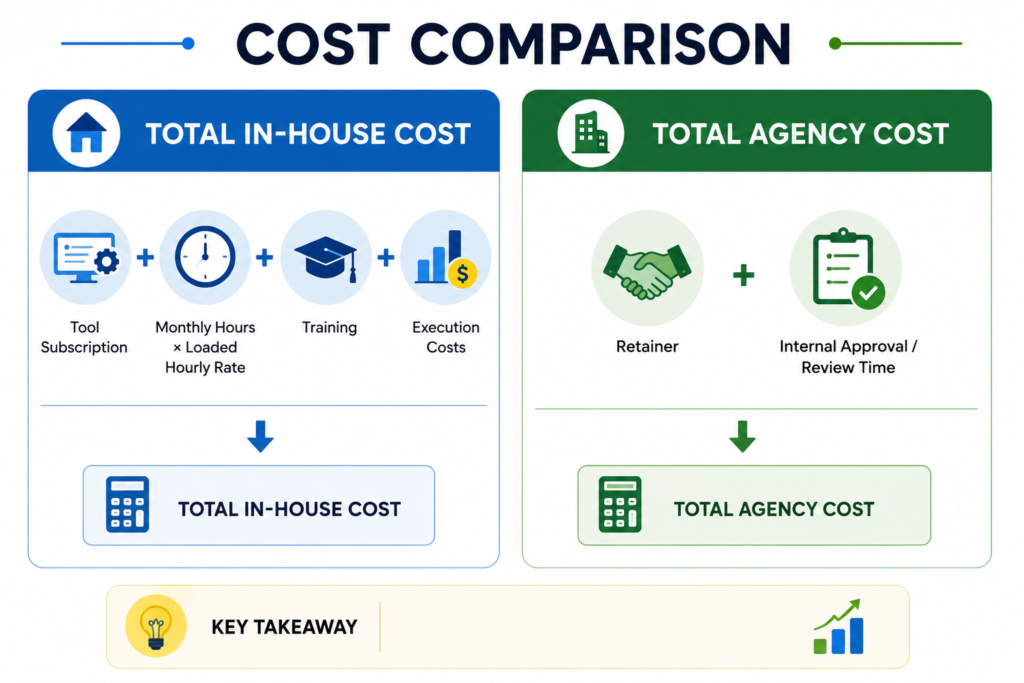
Run both formulas with your own numbers before deciding. The cheapest line item on the invoice is not necessarily the cheapest way to get results and an agency retainer that looks expensive can be cheaper in practice if the alternative is a senior marketer’s week disappearing into a dashboard every month.
Decision Scorecard: Score Your Team Before You Choose
Score your organization from 1 (strongly “tool”) to 5 (strongly “agency”) across each row, then total the columns.
| Criterion | Lean Tool (1–2) | Lean Agency (4–5) |
|---|---|---|
| In-house SEO/content expertise | Strong, experienced team in place | Little to no dedicated expertise |
| Available time | Someone can dedicate 10+ hrs/month | Team is already at capacity |
| Need | Mostly measurement “where do we stand” | Measurement plus fixes – “what do we do” |
| Timeline | Can wait 2–3 months to see traction | Need movement in weeks |
| Budget shape | Limited cash, has internal hours to spend | Has budget, limited internal hours |
| Control preference | Wants full ownership of process | Comfortable delegating execution |
| Program complexity | Single brand, single market | Multiple brands, markets, or regulated industry |
| Data sensitivity | Comfortable with third-party data handling | Needs strict internal data control |
“`
A total skewed toward the low end points to an in-house tool. A total skewed toward the high end points to an agency. A roughly even split is usually a sign the hybrid model (below) is your best fit.
Where Each Option Fits by Company Profile
Startups
Startups typically have limited marketing resources and small teams. An agency is usually the better fit if the internal team lacks specialized AI-search expertise. A startup with an experienced in-house SEO or growth hire may prefer a tool to keep costs and control internal.
Small Marketing Teams
Small teams often understand SEO but don’t have spare hours to manage another complex channel. A tool works if someone can genuinely dedicate the time each month; an agency is more attractive when the team needs execution support on top of an already full plate.
Mid-Market SaaS Companies
Either approach can work here. A strong internal SEO team can operate a tool effectively; an agency can accelerate strategy and execution when speed matters more than cost control.
Enterprise Companies
Enterprises often have sophisticated SEO, content, and analytics functions already. An in-house tool is attractive for measurement and centralized control across brands and markets, while agencies add value for specialized strategy, execution capacity, or regulated-industry expertise. A hybrid model is especially common at this scale.
Regulated Industries (Finance, Healthcare, Legal)
Data handling matters more here than almost any other factor. If your industry requires strict control over where competitive and brand data lives, weigh that heavily before handing monitoring to a third party to check any agency’s data handling practices (SOC 2, access controls, retention policy) as carefully as you’d check a software vendor’s.
What About Using Both?
You don’t have to choose one. A hybrid AI visibility strategy combines an in-house monitoring tool with external expertise, and it’s often the most practical setup for teams with real complexity.
Internal team → AI visibility tool (source of truth) → Agency support for diagnosis and execution → Optimization → Measurement
The internal team owns the data and business context; the agency provides specialized strategy or execution capacity when needed for a launch, a rebrand, a reputation gap, or a period when the internal team is stretched thin.
This works particularly well for multi-brand teams, regulated industries, and companies entering AI search for the first time who need someone to diagnose the gap before the tool’s data means much on its own. In practice, this often looks like running a tool such as RadarKit as the day-to-day source of truth, with an agency like RankingBite brought in for periodic strategy and execution support.
A Five-Step Decision Framework
Step 1 – Assess your expertise. Do you already have people who understand SEO, content, analytics, and AI search? Yes → lean tool. No → lean agency.
Step 2 – Assess your available time. Can your team consistently dedicate hours to tracking, analysis, and execution? Yes → a tool can work. No → an agency is more efficient.
Step 3 – Define your goal. Do you mainly need measurement? Choose a tool. Do you need measurement plus strategy and execution? Choose an agency.
Step 4 – Consider your budget shape. Limited cash but real internal hours → a tool is more practical. Real budget but limited internal hours → an agency is more complete.
Step 5 – Decide how much control you want. Want to own the entire process? Choose a tool. Prefer to delegate strategy and execution? Choose an agency.
Quick Decision: Agency, Tool, or Hybrid?
Choose an AI visibility agency (such as RankingBite) if:
- You don’t have AI search expertise in-house
- Your team is already overloaded
- You need strategy and execution, not just data
- You need results faster than your team can self-teach the discipline
- You need help understanding why competitors outperform you
Choose an in-house tool (such as RadarKit) if:
- You already have a strong SEO/content team
- You want complete control over the process
- You primarily need tracking and analytics
- Your team has real time to analyze and act on the data
- You want to build internal AI-visibility expertise
Choose a hybrid model if:
- You have an experienced internal team but occasional strategic gaps
- You want ownership of your data and workflows
- You’re in a regulated industry or manage multiple brands
- You want to combine internal knowledge with external execution capacity
Frequently Asked Questions
Is an AI visibility tool cheaper than an agency?
Not always. A tool’s subscription price is usually lower, but once you add the internal hours needed to interpret data and execute fixes, the total cost can approach or exceed a mid-sized agency retainer. Compare total cost of ownership, not sticker price.
Can a tool fully replace an agency?
Only if your team already has the expertise and spare time to turn monitoring data into action. A tool surfaces the gap; it doesn’t diagnose the root cause or execute the fix. If no one owns that process internally, the tool becomes an unused subscription.
How long does it take to see results?
Regardless of approach, meaningful movement in AI visibility typically takes a few months, since it depends on content and authority changes that AI platforms need time to pick up on. Tools can show you data within days; results take longer either way.
What size company should consider an in-house team instead of a tool or agency?
Full internal teams generally make sense only for larger organizations where AI visibility is a core, ongoing priority across multiple brands or markets otherwise the hiring and ramp-up cost outweighs the benefit compared to a tool or agency.
Is AI visibility monitoring necessary for every business?
It matters most for businesses whose buyers research options online before purchasing B2B SaaS, ecommerce, and considered-purchase categories in particular. Businesses with little discovery-driven search behavior will see less impact from either approach.
Can we start with a tool and add an agency later, or vice versa?
Yes, and it’s a common path. Many teams start with a tool like RadarKit to establish a baseline, then bring in an agency such as RankingBite once they identify a specific gap the internal team doesn’t have time or expertise to close or start with an agency diagnostic and move monitoring in-house once the program stabilizes.
