


Removing AI footprints means editing AI-generated content to make it sound natural, clear, and more like something a person would write. It involves fixing repetitive wording, varying sentence structures, removing generic phrases, and adding relevant details or insights that make the content more meaningful.
AI tools can save time when creating a first draft, but the result doesn’t always sound natural. You may notice the same phrases appearing repeatedly, sentences following similar patterns, or paragraphs that explain a lot without saying anything specific. These small things can make an article feel robotic, even when the writing is grammatically correct.
In this article, we’ll look at the common signs of AI-generated writing, practical ways of removing AI footprints, and simple checks to make your content sound more natural and engaging.
Why AI-Written Content Often Feels Artificial
Most AI-generated content is grammatically correct, but that doesn’t always mean it sounds natural. AI tools generate text by predicting words and phrases based on patterns in their training data. This often leads to similar sentence structures, repeated expressions, and wording that feels too predictable. Removing AI footprints involves spotting these patterns and rewriting them in a way that feels more natural and reflects the writer’s own thinking.
A 2026 study published in Nature Human Behaviour examined more than 880,000 texts across seven datasets and three studies. Researchers found that using large language models to polish or rewrite text was associated with a 21% to 50% reduction in writing-complexity variation across different datasets and models. The findings suggest that AI-assisted writing can make different pieces of content sound more alike, even when their original meaning remains largely unchanged. This helps explain why AI-generated drafts can lack the individual style and variation found in human writing.
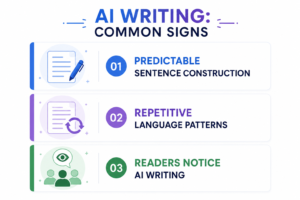
Predictable Sentence Construction
AI frequently builds sentences using the same structure, making paragraphs sound repetitive.
- AI-style
The platform improves productivity by helping teams collaborate more effectively.
- More natural
Teams use the platform to organize projects, share updates, and keep work moving without switching between multiple tools.
Repetitive Language Patterns
AI often repeats similar transitions, sentence openings, and phrasing throughout a draft. Even when the wording changes slightly, the overall rhythm stays the same, making the content feel less engaging.
- Less natural:
This feature helps teams stay organized. This feature also saves time. This feature improves accuracy. - More natural:
This feature keeps tasks organized in one place. Teams spend less time switching tools, and fewer details slip through the cracks.
The first version repeats “this feature” as a crutch. The second drops the subject once it’s established and lets each sentence do different work instead of restating the same one.
Why Readers Notice AI Writing Even Without AI Detectors
Most readers don’t need software to sense when writing feels artificial. Repeated sentence patterns, predictable phrasing, and generic language create a style that lacks the variety people naturally expect. Breaking these patterns is one of the simplest and most effective steps in removing AI footprints.
The Most Common AI Writing Tells
Many AI drafts share the same writing habits. Individually, these patterns may seem harmless, but when several appear together, the content starts to feel repetitive and mechanical. Removing AI footprints begins with recognizing these common tells and replacing them with more natural alternatives.
| AI Writing Tell | Why It Stands Out | Better Approach |
|---|---|---|
| Overused transition words | Frequent use of words like however, moreover, furthermore, and therefore creates an unnatural flow. | Use transitions only when they improve clarity or remove them entirely. |
| “It’s not X, it’s Y” pattern | This sentence structure appears repeatedly in AI-generated writing and becomes predictable. | State the point directly instead of using a contrast formula. |
| Excessive em dashes (—) | Overusing em dashes interrupts the reading flow and creates a recognizable AI style. | Split the idea into two sentences or use commas where appropriate. |
| Triple-list writing | AI often groups ideas into sets of three, making paragraphs feel formulaic. | Vary sentence structures and list lengths naturally. |
| Generic filler phrases | Phrases like it’s important to note, in today’s world, or when it comes to add words without adding value. | Remove the filler and begin with the main idea. |
| Repeated sentence openings | Starting several sentences the same way makes the writing sound repetitive. | Alternate sentence openings to create a more natural rhythm. |
| Overused intensifiers | Words like very, highly, extremely, and truly weaken the writing instead of strengthening it. | Replace them with more precise words or remove them entirely. |
Generic language can make an article sound polished without giving readers much useful information. Phrases that make broad claims but lack examples, facts, or specific details often leave readers wondering what the writer actually means. Removing AI footprints means replacing these vague expressions with clear, specific wording that explains what something does, how it works, or why it matters.
Research in psycholinguistics and reading comprehension suggests that concrete language helps readers understand and remember information more easily than abstract wording. Specific examples and details give readers a clearer picture of the subject, reduce confusion, and make the writing more meaningful and relatable.
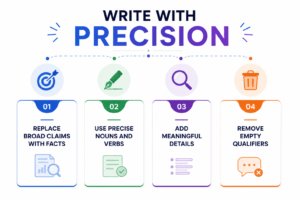
Replace Broad Claims with Facts
Instead of describing something as powerful, innovative, or effective, explain what makes it so using verifiable information.
Use Precise Nouns and Verbs
Strong nouns and verbs communicate ideas more clearly than vague adjectives and adverbs. They make sentences shorter while increasing clarity.
Add Meaningful Details
Include information that helps readers understand the topic without adding unnecessary words. Relevant facts, features, actions, or measurable details create stronger and more informative writing. Adding specific details also means checking whether the facts and examples in your content are accurate. Verify important claims against reliable sources and provide clear citations so readers can confirm the information.
Remove Empty Qualifiers
Words such as very, really, quite, somewhat, and extremely rarely add value. Replacing them with more precise language makes the writing sound more confident and natural.
Edit Sentences for a Natural Rhythm
Natural writing doesn’t follow the same pattern from one sentence to the next. Some ideas are best expressed in a short sentence, while others need more explanation. AI-generated drafts often repeat similar sentence lengths and structures, creating a steady rhythm that feels mechanical. Removing AI footprints means introducing variation without making the writing difficult to read.
Mix Short and Long Sentences
Using sentences of different lengths creates a more natural flow.
- Less natural
The software is easy to use. It has many features. It helps teams collaborate. It improves productivity.
- More natural
The software is easy to use, even for first-time users. It combines collaboration tools, task management, and reporting in one place, helping teams stay organized without adding unnecessary complexity.
Change Repetitive Sentence Openings
Starting several sentences the same way makes a paragraph predictable.
- Less natural
The platform offers reporting tools. The platform includes automation features. The platform supports team collaboration.
- More natural
The platform offers reporting tools. Built-in automation reduces repetitive tasks, while collaboration features help teams work more efficiently.
Remove Unnecessary Repetition
Repeating the same words or ideas weakens the writing.
- Less natural
The application is fast. The application is reliable. The application is simple to use.
- More natural
The application combines speed, reliability, and an intuitive interface.
Clear, self-contained sentences also make important information easier to understand and extract. This is useful when preparing content for AI Overviews and answer engines, where individual passages need to communicate their meaning without depending heavily on surrounding text.
Read the Content Aloud
Reading your draft aloud helps identify awkward wording, repetitive patterns, and sentences that sound unnatural. If a sentence feels uncomfortable to say, it usually needs editing before publishing.
Build a Human Vocabulary
The words you choose influence how natural your writing feels. AI-generated drafts often rely on the same phrases and formal expressions, making different articles sound alike. Removing AI footprints involves replacing predictable wording with language that is clear, direct, and appropriate for your audience.
- Replace overused phrases
- Leverage → Use
- Utilize → Use
- Facilitate → Help
- Avoid empty intensifiers
- Very useful → Useful
- Highly effective → Effective
- Choose precise words
- Good results → Higher conversions
- Many features → Task automation, reporting, and collaboration
- Write the way people naturally speak
- Less natural: It is important to note that this tool offers several benefits.
- More natural: This tool offers several useful features.
Before-and-After Editing Examples
A full rewrite isn’t usually necessary. Most of the work is finding the handful of patterns that make a draft feel automated, then swapping them for choices that sound specific and considered.
The examples below show how small changes can make AI-assisted drafts feel more like human-written content.
Product Description
- Before:
Experience the ultimate solution for all your skincare needs. Our innovative product is designed to provide exceptional results and deliver a seamless experience for users looking for healthier and glowing skin.
- After:
This lightweight moisturizer helps keep skin hydrated without leaving a sticky finish. Its formula absorbs quickly and works well for daily use, especially when your skin feels dry after cleansing.
What changed:
- Removed exaggerated phrases like “ultimate solution” and “exceptional results.”
- Added clear product details.
- Focused on what the user actually experiences.
LinkedIn Post
- Before:
Success is not just about working harder; it’s about working smarter. In today’s fast-paced world, professionals need to adapt, innovate, and embrace new opportunities to achieve growth.
- After:
A few months ago, I started learning digital marketing alongside my regular studies. The biggest lesson has been that progress comes from practicing small skills consistently, not from trying to master everything at once.
What changed:
- Removed common motivational patterns.
- Added personal experience.
- Replaced generic advice with a specific situation.
Quick Checklist to Remove AI Footprints
Before publishing AI-assisted content, review it using this checklist to make sure it sounds natural, useful, and written for real readers.
- Replace generic phrases with specific details
Avoid vague statements like “improves efficiency” or “provides great results.” Add examples, numbers, situations, or clear explanations. - Remove repeated sentence patterns
AI writing often follows similar structures. Mix short and long sentences to create a more natural flow. - Cut unnecessary filler transitions
Words like “furthermore,” “moreover,” and “in today’s digital world” can make content feel predictable. Use them only when they add meaning. - Avoid overused AI phrases
Replace common expressions like “not just X, but Y” or “plays a crucial role” with direct explanations. - Break triple-listing habits
Instead of forcing three points into every sentence, include only the details that support the idea. - Add human perspective
Include examples, observations, opinions, or experiences where appropriate. - Check sentence tone
Make sure the writing sounds like a person explaining something, not a machine summarizing information. - Review facts and claims
Remove exaggerated statements and make sure every claim is accurate and supported.
A final read-through from the perspective of a real reader can reveal sentences that feel too polished, predictable, or disconnected. The goal is not to hide AI assistance but to create content that feels clear, useful, and genuinely written.
Frequently Asked Questions
Can AI-generated content be made to sound human?
Yes, Editing the structure, adding specific details, removing repetitive patterns, and including human perspectives can make AI-assisted content feel more natural.
Does removing AI footprints mean rewriting everything?
No, Small edits like improving wording, adding examples, and changing sentence patterns can often make a major difference.
Are AI writing patterns easy to identify?
Yes, Common signs include generic wording, repeated sentence structures, excessive transitions, and predictable phrases.
Should I avoid using AI for content creation?
No, AI can help with research and drafting, but human editing is needed to add accuracy, experience, and originality.
Can AI detectors identify all AI-written content?
No, AI detection tools are not always accurate and can produce incorrect results. Quality, usefulness, and authenticity matter more than trying to pass a detector.
Conclusion
AI-generated drafts can save time, but they still need a writer’s input to become useful and engaging. Editing is where you add the context, perspective, and small details that make the content feel complete rather than leaving it as a basic first draft.
This can be as simple as replacing a vague phrase with a clearer one, changing sentences that follow the same pattern, or adding examples based on real situations instead of made-up scenarios. These changes also help with removing AI footprints without making the writing sound forced.
The aim isn’t to hide the use of AI or make every sentence sound different. It’s to bring in your own knowledge, judgment, and experience so the final content offers something meaningful to readers.