


Answer engine optimization (AEO) is the practice of structuring content so AI answer engines, such as Google AI Overviews, ChatGPT, Gemini, and Perplexity, can find, understand, and cite it in their answers. It works by giving direct, clearly worded answers to the questions buyers ask, backed by credible sources, so AI systems can lift and attribute them with confidence.
Your brand can rank #1 on Google and still be invisible. When a buyer asks ChatGPT or an AI Overview for a recommendation, they get one answer, a few named brands, and no reason to scroll further. More buying journeys now start this way.
The stakes are real. Google AI Overviews now reach more than 2.5 billion monthly users, and when an AI Overview appears, the top-ranking page gets 58% fewer clicks. If your brand is missing from the AI answer, the buyer may never know you were an option.
This guide explains how answer engines choose their sources, how SEO and AEO differ, six steps to optimize your content, how to measure results, and how to build a revenue-focused AEO strategy.
What Is Answer Engine Optimization (AEO)?
Answer engine optimization (AEO) is the practice of optimizing website content so AI answer engines select, quote, and cite it in their responses. These engines include ChatGPT, Google AI Overviews, Perplexity, and voice assistants like Siri and Alexa. AEO aims to make your brand the direct answer rather than one link in a list.
AEO Meaning in Simple Terms
AEO means creating content that AI tools can quote directly. SEO helps a whole web page rank. AEO helps a specific passage on that page get selected, summarized, and credited inside an AI-generated answer.
SEO consultant Jason Barnard, founder of Kalicube, is credited with coining the term “answer engine optimization” around 2017–2018. At the time, Google’s featured snippets had started answering questions directly on the results page.
Where Do Answer Engines Appear?
Answer engines are AI-powered tools that respond to a question with a single synthesized answer instead of a list of links. They appear in three main places:
- AI chatbots: ChatGPT, Gemini, and Claude answer questions inside a conversation and often cite web sources.
- AI search: Google AI Overviews, Google AI Mode, Perplexity, and Microsoft Copilot place AI summaries above traditional results or in place of them.
- Voice assistants: Siri, Alexa, and Google Assistant read out one spoken answer, usually without showing a source.

Why Does AEO Matter in Modern Search?
Answer engine optimization matters because AI tools now answer questions for audiences as large as traditional search.
When an AI answer settles a question, many users stop there. Brands cited in that answer gain visibility, and brands left out lose it.
Google reports that AI Mode has passed 1 billion monthly active users and that the Gemini app has 950 million (Google, Q2 2026). ChatGPT reached more than 900 million weekly active users in February 2026
How Is User Behavior Changing?
User behavior is changing in three connected ways: how people search, what they see first, and whether they click.
- People search in full questions. A search that once looked like “CRM software” might now read “What is the best CRM for a 10-person real estate team under $50 a month?”
- AI answers appear before links. Google AI Overviews, ChatGPT, and Perplexity show a summarized answer first, so content that is clear and easy to summarize is more likely to be selected.
- Most Google searches end without a click. In early 2026, 68.01% of US Google searches ended without a click, up from 60.45% in 2024 (SparkToro, data from Similarweb).
How Does AEO Help Businesses Stay Visible?
AEO helps businesses stay visible as search moves from links to answers.
- Visibility without a click: When an AI tool cites a brand, users see that brand as a trusted source, even if they never visit its website.
- Content that AI can quote: Many AI engines use retrieval-augmented generation (RAG) to pull live web content into answers. Clear headings and direct answers make pages easier to find and quote.
- More value from existing SEO: AI answers draw heavily from pages that already rank well in Google, so strong rankings and quotable content work together.
- Higher-intent visitors: Users who click through from an AI citation have often already compared their options, so they tend to arrive closer to a buying decision.
How Does Answer Engine Optimization Work?
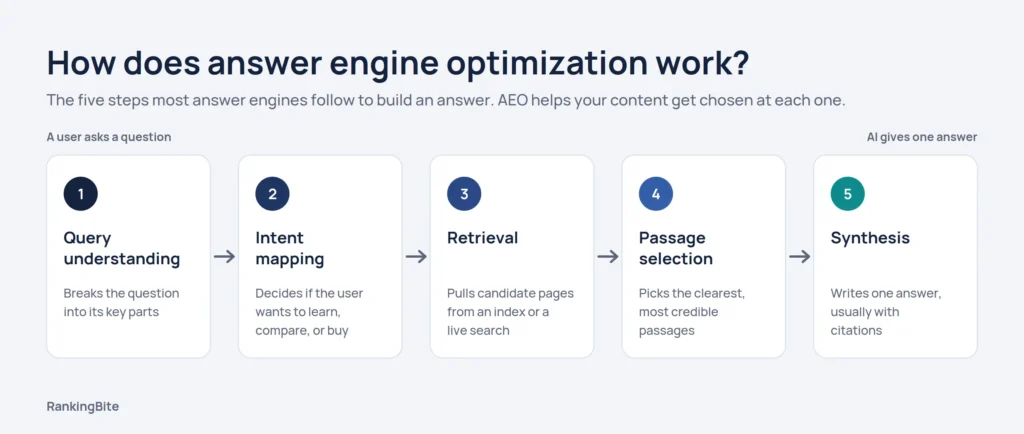
Answer engine optimization works by shaping content to fit the process AI tools use to build an answer. Most answer engines follow five steps: understand the question, identify intent, retrieve sources, select the best passages, and write a final answer. AEO improves a page’s chances of being chosen at each step.
-
Query understanding:
The answer engine uses natural language processing (NLP) to break a conversational question into its topic, conditions, and constraints. It also reads context, such as earlier questions in the same chat.
Content that covers a topic’s specific details and related sub-questions is easier to match.
-
Intent mapping:
The engine decides whether the user wants to learn, compare, or buy, and that decision shapes which sources it looks for. Informational questions favor clear definitions, while commercial questions favor comparisons, reviews, and pricing details.
Pages built around one clear intent are more likely to be used.
-
Retrieval:
The engine pulls candidate pages from its search index or runs a live web search. Pages that are not crawlable, not indexed, or blocked to AI crawlers are excluded at this stage. Accurate sitemaps and crawler access in robots.txt keep a page eligible.
-
Passage selection:
The engine picks the passages that answer the question most clearly and credibly. Self-contained answers under question-based headings are easier to extract than points buried in long paragraphs. Named authors, cited sources, and recent updates make a passage more likely to be selected.
-
Synthesis:
The engine combines passages from several sources into one conversational answer. Most AI search tools cite their sources with links, which gives cited brands visibility even without a click.
Voice assistants usually read the answer aloud without naming a source.
Retrieval vs. Training Data: What Is the Difference?
AI tools do not answer only from what they learned during training. Training data is a fixed snapshot of text that a model learned from before its release, so it can be months or years out of date.
Retrieval happens live, each time a question is asked, which lets answer engines cite pages published or updated recently. That makes AEO an ongoing practice rather than a one-time effort.
SEO vs AEO: What Is the Difference?
The main difference between SEO and AEO is where visibility happens. Search engine optimization (SEO) focuses on moving users from a results page to your website. Answer engine optimization (AEO) focuses on making your content the answer that AI tools show and cite, whether in Google AI Overviews, ChatGPT, or a voice assistant.
| Difference | SEO | AEO |
|---|---|---|
| Goal | Drive organic traffic and clicks to a website | Earn citations and brand mentions inside AI-generated answers |
| Query type | Short keyword phrases | Long, conversational, multi-part questions |
| Content format | Comprehensive articles and landing pages | Structured pages with direct answers and extractable passages |
| User behavior | Browsing several sites to piece together an answer | Reading one synthesized answer within the AI interface |
| Success metrics | Impressions, keyword rankings, and click-through rate (CTR) | Citation share, brand mentions, and AI referral traffic |
| Key signals | Backlinks, keyword relevance, and page experience | Clear answers, structured data, entity consistency, and source authority |
What Is AEO in SEO?
AEO in SEO is an advanced layer built on top of a technical SEO foundation, not a replacement for it. If a website has poor technical health, AI crawlers struggle to access it, and its content cannot be retrieved or cited.
Pages still need to be crawlable, indexed, fast, secure, and authoritative. Traditional SEO makes a page discoverable, while AEO makes that page easy for AI engines to understand and quote.
AEO vs GEO: Are They the Same?
AEO and GEO overlap heavily, but they emphasize different goals. AEO focuses on structuring content so it can serve as a direct answer, while generative engine optimization (GEO) focuses on increasing a brand’s visibility in responses from generative AI tools.
In practice, most tactics serve both, so many marketers treat the two terms as close partners rather than separate strategies.
How to Optimize Content for Answer Engines
Answer engine optimization works best when every page is easy for AI tools to find, understand, trust, and quote.
The six steps below form a practical AEO strategy that improves a brand’s chances of being cited in AI-generated answers.
1. Lead With a Direct Answer
Answer engines pull short passages from a page, so the lines directly under each heading carry the most weight. Open every section with a clear 40–60 word answer that makes sense even when quoted on its own.
Once the core answer is in place, add context, evidence, and nuance in the paragraphs that follow. Readers get a quick answer, and those who want more can keep reading.
2. Write Headings as Real Questions
Question-based headings help answer engines match content to the questions users actually ask. Each H2 or H3 should focus on a single question with one clear intent.
To find the right questions, check People Also Ask boxes, Google Search Console queries, customer support conversations, and community forums.
Phrase headings naturally rather than forcing exact-match keywords, and keep a clear hierarchy of one H1 with nested H2s and H3s so AI systems can see how topics connect.
3. Structure Content for Easy Extraction
AI tools cite content more accurately when it is broken into clear, self-contained pieces. Match the format to the information:
- Numbered lists for steps and processes
- Bullet points for features and key points
- Tables for comparisons
Keep paragraphs short, with one idea each, and name the subject in every sentence instead of relying on “it” or “this.” Specific numbers, dates, and named sources also make passages easier for answer engines to trust than vague claims.
4. Add Relevant Schema Markup
Schema markup is structured data that tells search engines what a page contains and who published it. Use Organization schema to define your brand, Article schema for blog posts and authors, and Product or Review schema for commercial pages.
FAQPage markup can still help machines read question-and-answer content, even though Google stopped showing FAQ rich results for all websites in May 2026 (Google Search Central).
Schema does not guarantee citations, but it removes ambiguity about your content and brand. Validate every implementation with the Schema Markup Validator, or use Google’s Rich Results Test for supported types such as Article, Product, and Review.
5. Build Entity Authority and E-E-A-T
Answer engines favor sources they can recognize as credible and consistent. Strengthen your E-E-A-T (experience, expertise, authoritativeness, and trustworthiness) by adding author bios with real credentials, linking to primary sources, and sharing original data, case studies, or expert input.
Consistency matters just as much. Keep your brand name, description, and key facts identical across your website, social profiles, and business listings so AI systems connect every mention to the same entity.
Update important pages regularly and show the last-updated date.
6. Earn Brand Mentions Beyond Your Website
Answer engines draw from the wider web, so what other sites say about a brand shapes what AI tools say about it. Third-party sources such as Reddit, Quora, LinkedIn, YouTube, review platforms, and industry publications often appear in AI-generated answers.
Share genuinely helpful answers in communities where your audience asks questions, encourage customer reviews, and pursue mentions in industry roundups and comparison articles.
Even unlinked mentions build recognition. The more credible places a brand appears, the more likely AI tools are to include it in their answers.

How Do You Measure AEO Success?
AEO success is measured by how often and how well AI tools present your brand, not only by rankings and organic traffic. Four metrics give the clearest picture.
AI Share of Voice
AI share of voice measures how often your brand is cited or mentioned in AI answers compared with competitors.
How to track it: Build a fixed list of target prompts, test them monthly in ChatGPT, Perplexity, Gemini, and Google AI Overviews, and record which brands appear. Note placement too, since a citation in the main answer carries more weight than one in a secondary source list.
Brand Sentiment and Context
Brand sentiment tracks how AI tools describe your brand when they mention it.
How to track it: Record the attributes, strengths, and weaknesses that AI answers associate with your products. Correct inaccurate claims by updating your own content and third-party profiles.
AI Referral Traffic and Conversions
AI referral traffic shows how many visitors click through from AI citations, and conversions show whether those visitors take action.
How to track it: In Google Analytics 4, group sources such as chatgpt.com and perplexity.ai into a custom AI channel, then track form fills, sign-ups, and sales. Some AI visits appear as direct traffic, so treat this number as a minimum.
Branded Search Growth
Branded search growth captures the influence of AI answers that never send a click.
How to track it: Track branded query impressions and clicks in Google Search Console over time.

How to Build a Revenue-Focused Answer Engine Optimization Strategy
A revenue-focused AEO strategy starts with understanding why AI tools overlook a brand, then fixing the causes in the right order. Rankings remain important, but they do not show whether AI understands, trusts, or recommends your brand.
The pages closest to a buying decision deserve attention first: comparison and alternatives pages, pricing pages, product and service pages, and case studies. Clear, extractable answers on these pages give AI tools accurate facts to cite when buyers ask for options.
Is AEO Just SEO With New Labels?
Partly, and it’s worth being honest about that. AEO shares the same foundation as SEO: crawlable pages, helpful content, and real authority. Three requirements are genuinely new:
- Entity resolution: AI tools must clearly identify your brand before they can mention it.
- Extractability: Content must be structured so AI tools can quote specific passages accurately.
- Recommendation share: Success includes how often AI answers recommend you, not only where you rank.
These requirements explain why a site can rank well and still be missing from AI answers.
What Does AI Need to Recommend a Brand?
RankingBite is an AI visibility and SEO agency that looks at AI visibility through five layers. Each layer answers a different question about why AI understands, recognizes, or recommends one brand over another.
- Identity (be understood): AI needs to distinguish your brand from others and know what you offer, who you serve, and where you fit in the market.
- Language (be reinforced): Customers, reviewers, and publishers should describe your brand the way your website does, because consistent messaging strengthens how AI understands you.
- Distribution (be present): Your brand needs a presence beyond its own website, on relevant publishers, reference sources, and industry communities. Different AI systems use different sources, so visibility varies across platforms.
- Data (be retrievable): Pricing, features, integrations, and product details should be clear, consistent, and structured so AI systems can extract them accurately.
- Integrity (be credible): Credible evidence, verifiable expertise, reliable sources, and consistent claims make your information worth citing.

The layers build on each other. AI first needs to understand who you are. Then your positioning needs reinforcement, your information needs reach and structure, and your claims need credibility.
How Does RankingBite Apply the Five Layers?
RankingBite’s approach is simple: understand what’s broken before deciding what to fix. Every answer engine optimization engagement follows a five-phase methodology that covers both SEO and AI visibility:
- Audit: A fixed set of buyer-intent prompts is tested across Google AI Overviews and AI Mode, ChatGPT and Gemini, plus Perplexity, Copilot or Claude where your buyers use them alongside technical SEO health, content, and links.
- Diagnose: The five layers pinpoint where visibility breaks down, whether through unclear identity, inconsistent messaging, limited presence, hard-to-retrieve information, or gaps in credibility.
- Architect: Findings become a 90-day roadmap prioritized by impact.
- Execute: A senior strategist owns delivery, with work shipped weekly.
- Monitor: Traditional search and AI visibility are tracked separately, with mentions, citations, and recommendations measured as distinct signals.
Case study: Matrack. Over a 14-month programme (October 2024 to November 2025), RankingBite combined SEO strategy, technical fixes, comparison and buyer-intent content, link building, and AI visibility work for this GPS fleet-tracking and ELD brand.
By the end of the engagement, organic traffic reached 16,957 visits a month, Matrack’s presence in SERP features including AI Overviews had grown, and the brand held 89.1% of entity-level organic traffic against adjacent organisations (figures from Ahrefs). Read the Matrack case study.
Frequently Asked Questions
Does AEO apply to local businesses?
Yes. AI tools often answer location-based questions, so AEO is relevant for local businesses. Accurate Google Business Profile details, consistent contact information across directories, and genuine customer reviews help AI tools identify a local business and include it in relevant answers.
Why should my business invest in AEO services right now?
AI answers are now part of how buyers research purchases, and Google reports that AI Mode has surpassed 1 billion monthly active users. Starting early gives you more time to shape how AI tools describe your brand.
How long does AEO take to show results?
Timelines vary by industry, competition, and site authority. Technical and formatting fixes can affect AI answers soon after pages are recrawled, while entity recognition and third-party mentions usually take months to build.
Do ChatGPT and Google AI Overviews need different content?
No. The same well-structured content serves every answer engine. Results vary because each platform uses different sources, so a consistent presence on trusted third-party sites matters too.
Conclusion: Make Your Brand the Answer
Answer engines favor content that is clear, trustworthy, and well structured, and brands that build these foundations early have more time to shape how AI tools describe them.
Answer engine optimization extends SEO rather than replacing it. Strong rankings keep your pages discoverable, while answer-first content, consistent entity data, and credible third-party mentions make those pages easier for AI tools to understand, quote, and recommend. As more searches end inside AI answers, tracking citations and recommendations matters as much as tracking clicks.