
ChatGPT Ads: How They Work, Cost and Organic Impact

ChatGPT Ads let businesses pay for a sponsored placement directly below ChatGPT’s answers, starting at $25 a day. The ads launched on February 9, 2026, and appear only for users on the Free and Go plans.
ChatGPT matches ads to the meaning of a conversation instead of keywords, charges per click or per 1,000 views with a recommended bid of $3 to $5 per click, and keeps every ad below the answer, so brands named inside the answer still earn that spot organically.
Bidding runs on a relevance-weighted auction, a click costs about the same as on Google Ads, and campaigns need their own setup and tracking. Paid placements also let a competitor appear directly below an answer that recommends another brand, which makes the answer itself the most valuable spot.
What exactly is a ChatGPT ad?
A ChatGPT ad is a sponsored recommendation that appears after ChatGPT finishes answering, clearly labelled and kept apart from the response. It shows a brand name, a short message, an image and a link, and it’s chosen to match what the user is asking about.
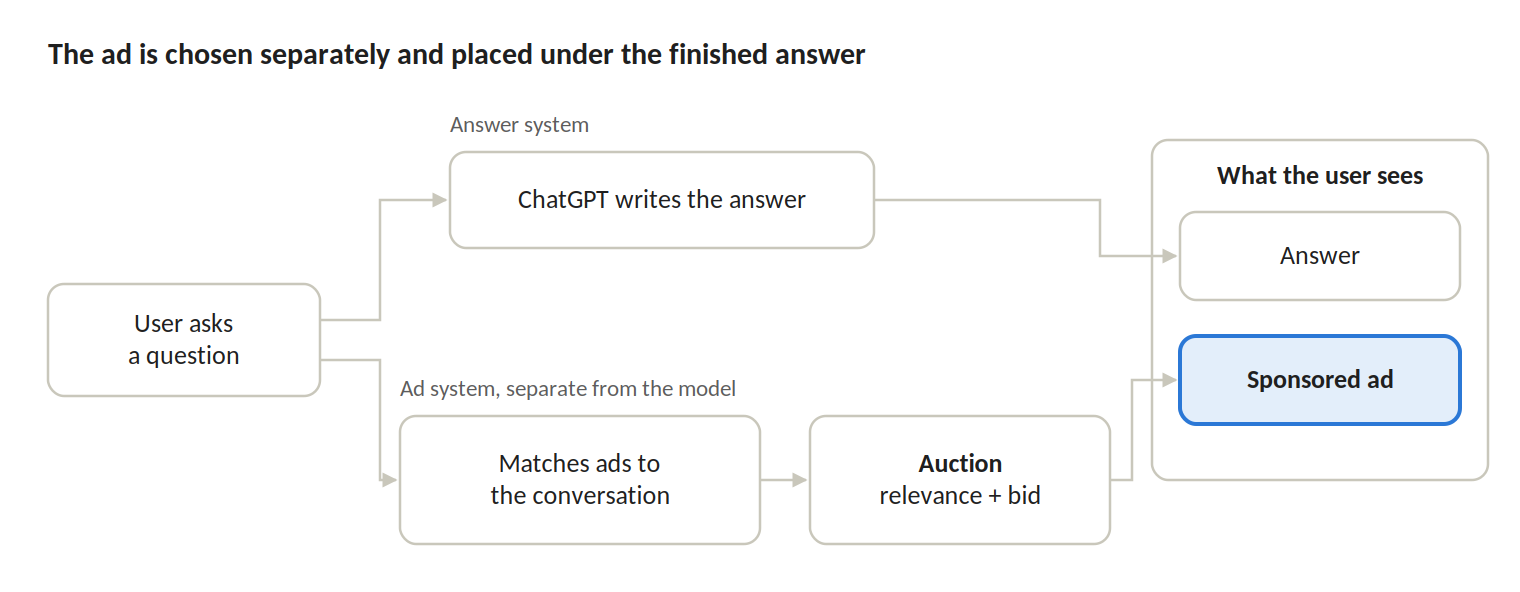
Think of it as the opposite of a Google search ad. On Google, ads sit above the results and are triggered by keywords. In ChatGPT, the ad waits until the answer is done, there are no keywords to bid on, and only one ad appears per response. Paying for the ad doesn’t change a word of the answer above it.
Why are ChatGPT ads such a big deal?
Because for the first time, businesses can pay to appear next to ChatGPT’s answers, a space that only organic mentions could reach before.
OpenAI’s stated reason is to fund free and low-cost access to ChatGPT. It also set two ground rules: ads don’t influence answers, and advertisers never see anyone’s chats.
Advertisers jumped in fast. ChatGPT Ads hit a $1 billion annualized revenue run rate in under 200 days, and more than 100,000 advertisers had run campaigns by October 21, 2026.
How does ChatGPT decide which ad to show?
ChatGPT reads the meaning of the conversation, finds ads that fit, and ranks them in a relevance-weighted, second-price auction. Advertisers describe where their product belongs; OpenAI makes the final call.
The four signals behind every placement
ChatGPT uses four signals to decide which ad fits a conversation. The first three apply to every user, while the fourth only counts when ad personalization is switched on:
- What the user is talking about right now
- The ad’s title, copy and landing page
- The advertiser’s context hints
- Past chats and memory, but only when the user has ad personalization turned on
Advertisers can also narrow delivery by country, region, platform and custom audience. Personalized ads aren’t available in the European Economic Area (EEA) or Switzerland.
Context hints: why there are no keywords
Instead of keywords, advertisers write context hints: plain-language descriptions of the situations where their product helps. OpenAI’s own example shows the difference. “Running shoes” is a weak hint. “Cushioned everyday running shoes for beginners training for their first 5K” is a strong one.
Hints guide matching, but they aren’t rules. There’s no exact match, and no guarantee your ad shows in any specific conversation.
Why a bigger budget doesn’t always win
OpenAI doesn’t just pick the highest bid. It also checks how well each ad fits the conversation, so a smaller bid with a better match can win the spot. The winner doesn’t pay its full bid. It pays based on the next highest bid in line.
What advertisers can (and can’t) see
Advertisers get aggregated numbers only: impressions, clicks and conversions. They never see chats, memory, names or the prompt that triggered their ad. That means there’s no search-terms report and no Quality Score to optimize against.
How much do ChatGPT ads cost?
You pay whatever you bid, with OpenAI recommending a starting bid of $3 to $5 per click and a $25 minimum daily budget. There’s no rate card and no official benchmark data yet, so treat every number here as a floor, not a forecast.
Three ways to pay
Your campaign objective decides how you’re billed:
| Objective | Billing | Best For |
|---|---|---|
| Views | Per 1,000 impressions (CPM, cost per mille) | Awareness |
| Clicks | Per valid click (CPC, cost per click) | Website traffic |
| Conversions | Per click or impression, optimized to a conversion event | Sales and leads, once the pixel is set up |
You never pay per conversion, even on a Conversions campaign. Once a campaign is created, its objective is locked.
The $25 minimum and how daily budgets really work
The floor is $25 per campaign per day, with no account-level commitment. The daily figure is a pacing target, not a hard cap: one day can spend up to 2× the daily budget, but a week won’t go past 7×.
What the official and independent numbers show
OpenAI publishes no average cost per click. The only official price signal is its recommended starting bid of $3 to $5 per click, and independent research so far measures click-through rates rather than costs.
Early pricing was far higher. ChatGPT ads launched in February 2026 at a $60 CPM with a $200,000 minimum spend, but that pricing ended when self-serve buying opened. Today’s real benchmark is the click-through rate: ChatGPT ads in the US earn clicks on 0.73% of ad views, and the rate changes sharply by country.
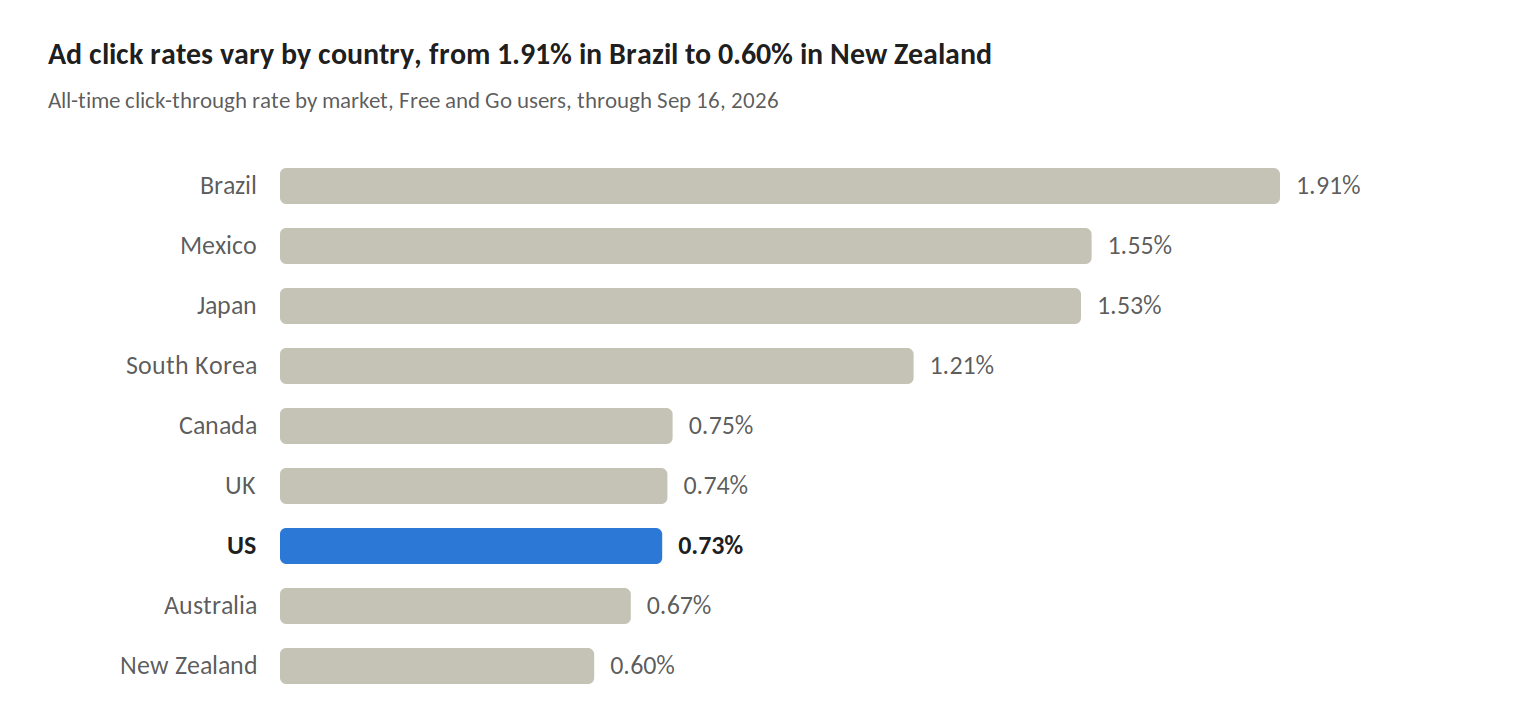
English-speaking markets all sit below 0.8%, while Brazil, Mexico, Japan and South Korea all clear 1.2%.
Is it cheaper than Google Ads?
A click on ChatGPT costs about the same as a click on Google, but far fewer people click.
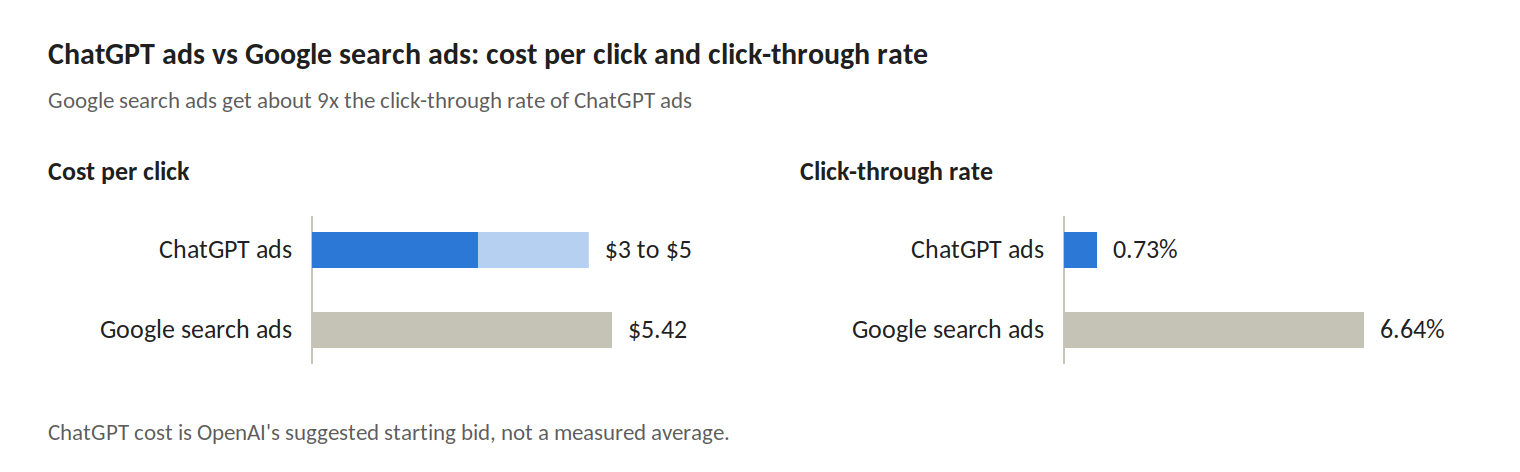
The Google figures come from a 2026 benchmark of more than 13,000 search campaigns. The ChatGPT data counts clicks per ad-bearing exchange rather than per impression, so the two click-through rates aren’t a perfect match. You pay a similar price for each visitor, but you need many more impressions to get the same traffic. That makes ChatGPT ads an extra channel to test, not a replacement for Google Ads.
Size your test around the results you need, not the minimum. At a 1% conversion rate, 10 conversions take roughly 1,000 clicks, which is $3,000 to $5,000 at recommended bids.
How do you launch your first ChatGPT ad campaign?
Everything runs through OpenAI’s self-serve Ads Manager at ads.openai.com. Expect about an hour of setup, plus time for account review.
- Check you’re eligible. Make sure your country is on the Ads Manager availability list and your category is allowed. Gambling, alcohol, dating and political ads are banned; health, finance and legal services go through stricter review.
- Create and verify your account. Add billing details and business documents.
- Set up tracking before anything else. Install the OpenAI Pixel and Conversions API, and add your own UTM tags.
- Create the campaign. Pick the objective, daily budget, dates and countries.
- Give each customer need its own ad group. Write specific context hints for each one.
- Write a few ad variations. Send each one to the most relevant page, not your homepage.
- Let OpenAI’s crawlers in. Ads fail review when a landing page blocks OAI-AdsBot (OpenAI’s ad-review crawler) or OAI-SearchBot.
- Bid within the guidance, then wait two weeks. Judge the test on revenue, not first-day click-through rate.
What do ChatGPT ads mean for your organic visibility?
Ads don’t replace organic visibility, but they change the game around it. The answer is still earned, not bought. What’s new is who can show up next to it.
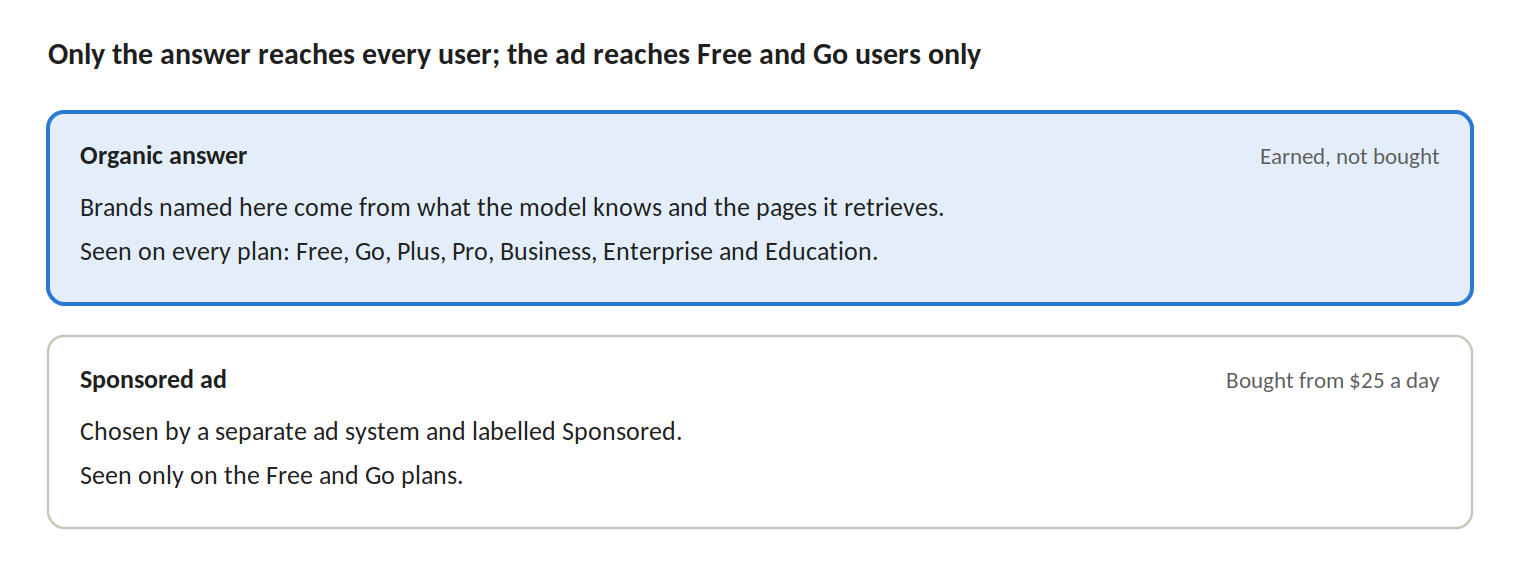
What a ChatGPT response looks like · answer on top, ad below
Can you buy your way into the answer?
No. OpenAI runs ads on systems separate from the model that writes answers, and the data backs that up. An independent study of 50,006 commercial prompts found the advertiser’s domain was cited in the answer above its own ad in only 3.63% of placements. The exact advertised URL showed up just 0.09% of the time.
Why the answer itself is now prime real estate
People read the whole answer before they ever see an ad. The brands named in that answer get the first and strongest impression, and they’re chosen from what the model knows and the pages it pulls in, not from ad budgets.
Your competitors can sit right under your citation
The same study found ads on 25.94% of commercial prompts. A competitor can appear directly below an answer that recommends you, for as little as $25 a day.
Your best buyers may never see an ad
Ads only run on the Free and Go plans. People on Plus, Pro, Business, Enterprise and Education never see them. For B2B and premium brands, those are often the most valuable buyers, and an organic mention is the only way to reach them inside ChatGPT.
Don’t let paid and organic traffic blur together
ChatGPT already adds utm_source=chatgpt.com to many organic links, so untagged ad clicks can end up in the same report as organic visits. UTM tags, the URL parameters that label traffic sources, fix this. Tag ads with utm_source=chatgpt_ads and utm_medium=cpc.
Should you run ChatGPT ads or invest in organic first?
For most brands, organic comes first, and ads fill the gaps you can’t win organically. Organic mentions reach every ChatGPT plan and keep working after you stop spending; ads reach only Free and Go users. The organic side of this work is often called GEO (generative engine optimization): making your content easy for AI systems to find and cite.
| Factor | ChatGPT Ads | Organic (GEO) |
|---|---|---|
| Position | Sponsored card below the answer | Inside the answer |
| Audience | Free and Go users only | Every plan |
| Speed | Live after ad review | Weeks to months |
| Cost | Per click or impression, from $25/day | Content, PR and technical work |
| Durability | Stops when spend stops | Persists, but varies between runs |
Ads make the most sense for new brands the model doesn’t know yet, time-limited offers, ecommerce catalogues and challengers in categories where the leader isn’t advertising. Organic matters more for enterprise B2B, premium audiences and brands already showing up in answers.
A simple place to start: run your 20 most valuable commercial prompts in ChatGPT a few times, note who gets recommended, and only buy ads for the prompts you’re losing.
Frequently asked questions
Can I target keywords with ChatGPT ads?
No. ChatGPT ads use context hints, plain-language descriptions of the conversations you want to appear in. They guide matching but don’t guarantee delivery.
Do ChatGPT ads help SEO?
Not directly. Ads don’t influence organic answers or citations; advertisers were cited above their own ad in only 3.63% of placements.
Are ChatGPT ads worth it?
They’re worth a capped test for ecommerce brands, challengers and new products. With a US click-through rate of 0.73% and no official benchmarks yet, a two-week test on a fixed budget is safer than a big commitment.
How long should a ChatGPT ads test run?
At least two weeks. Spend can take 7 to 8 hours to show up in reports, and attributed conversions take 24 to 48 hours.