

SEO technology refers to the tools, software, and technologies used to improve a website’s visibility and performance in search engine results. It helps website owners optimize their sites so search engines can crawl, understand, and rank their content more effectively.
It simplifies key SEO tasks such as keyword research, content optimization, technical audits, rank tracking, competitor analysis, and performance monitoring. These tools are commonly known as SEO tools or SEO software, and the terms are often used interchangeably.
By improving site structure, page speed, content quality, and technical health, SEO technology helps websites strengthen their organic search performance and attract more qualified visitors without relying solely on paid advertising.
SEO Technology at a Glance
| Feature | Overview |
|---|---|
| Purpose | Improves website visibility and search rankings. |
| Key Components | Keywords, content, technical SEO, backlinks, and analytics. |
| Main Types | On-page, Off-page, Technical, Local, and AI-powered SEO. |
| Popular Tools | Google Search Console, GA4, Ahrefs, Semrush, Moz, Yoast, Surfer SEO, Screaming Frog. |
| Benefits | Higher rankings, more organic traffic, better user experience. |
| Best Practices | Regular audits, quality content, performance monitoring, and UX optimization. |
How SEO Technology Works
SEO technology works by collecting and analyzing website data to help search engines understand your content and rank it more effectively. SEO tools automatically scan your website, identify issues, and suggest improvements to boost search visibility. They also track performance over time, helping you make informed decisions and continuously improve your SEO strategy. Google states that websites should aim for these Core Web Vitals thresholds to provide a good user experience:
- Largest Contentful Paint (LCP): 2.5 seconds or less
- Interaction to Next Paint (INP): Less than 200 milliseconds
- Cumulative Layout Shift (CLS): Less than 0.1
The process typically involves the following steps:
Crawling: SEO technology checks whether search engine bots can discover and access your website’s pages. It identifies problems such as broken links, blocked pages, and crawl errors that may prevent search engines from finding your content.
Indexing: Once pages are crawled, SEO tools verify whether they can be indexed by search engines. They highlight issues like duplicate content, incorrect robots directives, or missing canonical tags that could affect a page’s visibility.
Keyword Analysis: SEO technologies analyze the words and phrases people search for online. They measure search volume, keyword difficulty, and user intent, helping you target keywords that are relevant to your audience and more likely to drive qualified traffic.
Technical Checks: SEO tools perform detailed website audits to evaluate factors such as page speed, mobile usability, HTTPS security, structured data, internal linking, XML sitemaps, and Core Web Vitals. These technical elements play an important role in helping search engines crawl and rank a website effectively. Learn more in our guide to technical SEO.
Performance Monitoring: SEO technology continuously tracks important metrics, including keyword rankings, organic traffic, click-through rate (CTR), impressions, backlinks, and user engagement. By monitoring these metrics, businesses can identify what is working, detect issues early, and refine their SEO strategy based on real performance data. They can also understand changes in impressions, clicks, and CTR to identify why search visibility may increase without generating more website traffic.
Types of SEO Technologies
Different SEO technologies are designed to improve specific areas of a website. Some focus on optimizing content, while others help improve technical performance, analyze backlinks, or increase visibility in local search results. Together, these technologies create a complete SEO strategy.
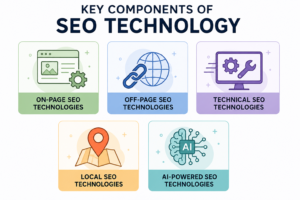
On-Page SEO Technologies
These technologies help optimize the elements that appear directly on a webpage. They improve title tags, meta descriptions, headings, internal links, image alt text, keyword placement, and content structure to make pages more relevant to both users and search engines.
Example: Changing your page title from “Home” to “Beginner’s SEO Guide” and adding descriptive image alt text to make the page easier for search engines to understand.
Off-Page SEO Technologies
Off-page SEO technology focuses on activities outside your website that influence search rankings. It helps monitor backlinks, analyze referring domains, track brand mentions, and identify link-building opportunities to strengthen a website’s authority.
Technical SEO Technologies
Technical SEO technology analyzes the health and performance of a website. It identifies issues related to crawling, indexing, page speed, mobile usability, HTTPS security, structured data, XML sitemaps, and Core Web Vitals, helping search engines access and understand the website more effectively.
The importance of technical performance is also reflected in the 2026 Web Almanac by HTTP Archive. Its analysis found that 48% of mobile websites achieved good Core Web Vitals, compared with 56% of desktop websites. It also reported that only 62% of mobile pages achieved a good Largest Contentful Paint (LCP) score. These findings highlight why SEO technology should include regular performance monitoring across mobile and desktop devices.
Example: Fixing a slow-loading page and submitting an updated XML sitemap so search engines can crawl your website more easily.
Local SEO Technologies
Local SEO technology helps businesses improve their visibility in location-based searches. It assists with managing business listings, tracking local keyword rankings, monitoring customer reviews, and optimizing profiles for platforms like Google Business Profile.
Example: A bakery in Lucknow updates its Google Business Profile with its address, opening hours, and customer reviews to appear in local searches.
AI-Powered SEO Technologies
AI-powered SEO technologies use artificial intelligence and machine learning to automate SEO tasks and provide data-driven recommendations. They can generate content ideas, identify keyword opportunities, analyze competitors, predict ranking trends, optimize content, and streamline reporting making SEO more efficient and scalable.
This is also an important area of SEO development. As AI models increasingly support tasks such as content analysis, technical audits, rank tracking, and reporting, businesses need to understand which traditional SEO practices still matter in AI search.
Popular SEO Technologies and Tools
SEO technology includes a wide range of tools that simplify keyword research, technical audits, performance tracking, content optimization, and competitor analysis. Each tool is designed for a specific purpose, and many businesses use a combination of them to build an effective SEO strategy.
- Google Search Console
- Google Analytics 4 (GA4)
- Ahrefs
- Semrush
- Screaming Frog SEO Spider
- Moz Pro
- Yoast SEO
- Surfer SEO
Common Challenges of Using SEO Technology
While SEO technology makes optimization easier, it also comes with a few challenges. Understanding these limitations helps businesses use SEO tools more effectively and make better decisions.
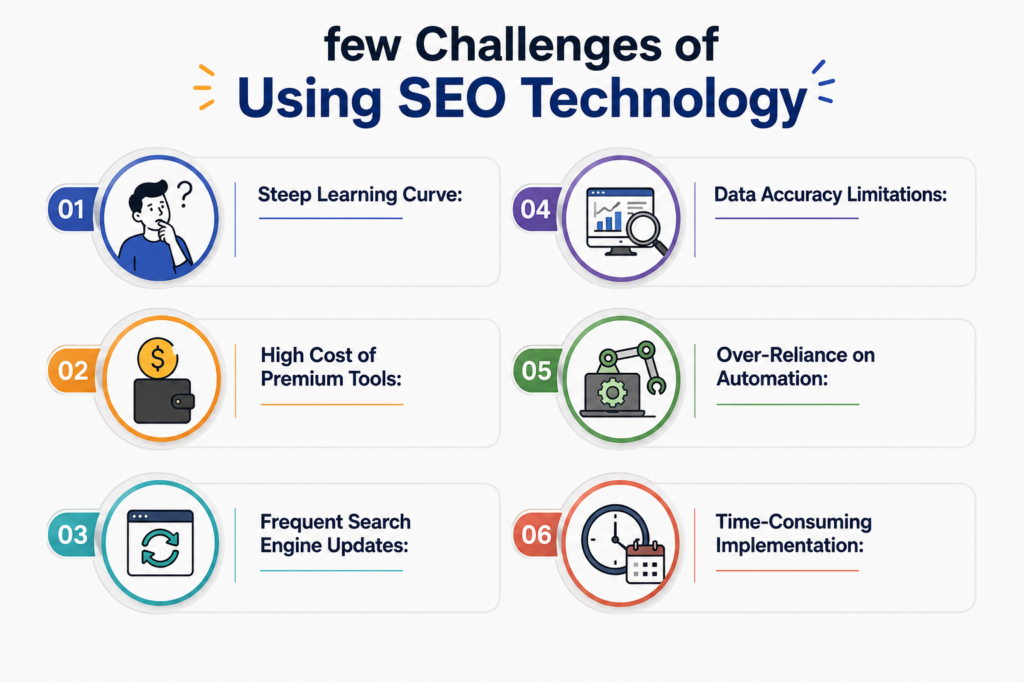
- Steep Learning Curve: Many SEO tools offer advanced features that can be difficult for beginners to understand and use effectively.
- High Cost of Premium Tools: Professional SEO platforms often require paid subscriptions, which may not fit the budget of small businesses or startups.
- Frequent Search Engine Updates: Search engines regularly update their algorithms, so SEO tools and strategies need constant adjustments to stay effective.
- Data Accuracy Limitations: Different tools may report slightly different data for metrics like search volume, backlinks, and keyword rankings.
- Over-Reliance on Automation: Automated recommendations are helpful, but they cannot replace human expertise, content quality, and strategic planning.
- Time-Consuming Implementation: While tools identify issues quickly, fixing technical problems and optimizing content still requires time and effort.
Benefits and Best Practices of SEO Technology
SEO technology helps businesses improve their online visibility by making SEO faster, more accurate, and data-driven. To get the best results, it’s important to combine SEO tools with regular monitoring, quality content, and a strong user experience.
- Improve Search Rankings with Regular Audits: Perform website audits to identify crawl errors, broken links, duplicate content, and indexing issues. Fixing these problems improves search visibility and website health.
- Create High-Quality, User-Focused Content: Use keyword and content optimization tools to create original, relevant, and well-structured content that matches user search intent and attracts organic traffic.
- Monitor Performance and Make Data-Driven Decisions: Track keyword rankings, organic traffic, click-through rate (CTR), and user engagement to measure SEO performance and identify areas for improvement.
- Optimize for User Experience: Improve page speed, mobile responsiveness, website structure, and usability to keep visitors engaged and support higher search rankings.
- Save Time with Automation: Use SEO tools to automate routine tasks such as site audits, keyword tracking, and performance reporting, allowing you to focus on strategy.
- Gain Competitive Insights for Long-Term Growth: Analyze competitor strategies, discover new opportunities, and continuously refine your SEO efforts to build sustainable organic traffic and long-term business growth.
Future of SEO Technology
SEO is changing faster than ever. Search engines are becoming smarter, and people are searching in different ways than they did a few years ago. Instead of focusing only on keywords, modern SEO is moving towards understanding user intent and delivering the best possible experience.
Here are two important trends that are shaping the future of SEO technology:
Voice and Visual Search Optimization
More people now use voice assistants like Google Assistant, Siri, and Alexa to search for information. At the same time, visual search tools allow users to search using images instead of typing text. Because of this, businesses need to create content that answers natural, conversational questions and uses well-optimized images with descriptive file names and alt text. As these search methods continue to grow, optimizing for both voice and visual search will become an important part of every SEO strategy.
User Experience Will Matter Even More
A good user experience is no longer just a bonus it’s an essential part of SEO. Google already considers factors like page speed, mobile friendliness, and Core Web Vitals when evaluating websites. While high-quality and relevant content remains the most important ranking factor, websites that load quickly, are easy to navigate, and provide a smooth browsing experience are more likely to perform well in search results. As search engines continue to improve, creating websites that users enjoy using will become even more important for long-term SEO success.
SEO technology has become an essential part of modern digital marketing, helping businesses improve their visibility in search engines through data-driven insights and automation. From keyword research and technical audits to performance tracking and content optimization, these technologies make it easier to identify opportunities, solve website issues, and build a stronger online presence.
As search engines and AI answer engines continue to evolve, using the right SEO technologies and following proven best practices can help you stay competitive and achieve sustainable growth. Whether you’re managing a personal blog, an e-commerce store, or a business website, investing in the right SEO tools and strategies, including GEO and AEO, can lead to better rankings, increased organic and AI-driven traffic, and long-term success.