

GEO in SEO refers to optimizing website content so AI-powered search platforms can understand, select, and cite it in AI-generated answers. It extends traditional SEO by focusing on brand visibility in responses from platforms like ChatGPT, Google AI Overviews, and Perplexity, rather than only rankings in search engine results.
not like traditional SEO, which primarily focuses on improving a website’s rankings in search engine results, GEO focuses on making content relevant, understandable, and useful enough for AI systems to reference in their responses. This helps businesses maintain visibility as more users rely on AI-powered platforms to find information.
What is GEO (Generative Engine Optimization)?
Generative Engine Optimization (GEO) is the process of optimizing content so AI-powered search engines and assistants can understand, trust, and reference it when generating answers.
The term comes from the academic paper that introduced GEO (Aggarwal, Murahari, Rajpurohit, Kalyan, Narasimhan, and Deshpande, presented at ACM SIGKDD 2024). The researchers found that generative engines synthesize information from multiple sources using large language models, creating a distinct optimization challenge from traditional search. Their experiments showed that specific content interventions could boost a source’s visibility in generative-engine responses by up to 40%.
While SEO is designed to drive clicks from a results page, GEO focuses on making your content a trusted source that an AI system chooses to cite when it generates an answer. As AI-powered search grows, GEO helps businesses stay visible across both traditional and AI-driven search experiences.
Instead of showing a list of links, AI search engines analyze information from trusted sources, interpret user intent, and generate a direct answer. Content that is accurate, well-structured, and up to date is more likely to be referenced in these responses.
How AI-Powered Search Works
AI search follows a step-by-step process to understand a user’s query and generate a relevant answer instead of simply displaying a list of web pages.
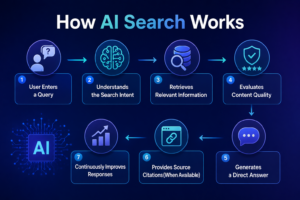
User Enters a Query
The process begins when a user asks a question or searches for information using natural language.
Understands the Search Intent
AI analyzes the meaning behind the query to understand what the user is actually looking for, rather than relying only on exact keywords.
Example: Instead of only looking for the words “improve SEO,” the AI understands that the user wants practical ways to increase their website’s search rankings.
Retrieves Relevant Information
It gathers information from indexed web pages, trusted sources, knowledge bases, and other available content related to the query.
A 2026 study published by researchers from Washington University in St. Louis and other institutions analyzed 55,393 Google searches and found that AI Overviews appeared in 64.7% of question-based queries, compared with 13.7% of searches overall. The study also found that 29.8% of cited domains were absent from Google’s first-page organic results. This suggests that AI-powered search can select sources through a process that differs from traditional search rankings.
Evaluates Content Quality
The AI assesses the information based on factors such as accuracy, relevance, credibility, authority, and freshness before selecting the most reliable sources.
Example: If two websites give different advice, the AI is more likely to use information from a trusted and up-to-date source than from an outdated or low-quality blog.
Generates a Direct Answer
Using Large Language Models (LLMs), the AI combines the collected information and creates a clear, conversational response tailored to the user’s question.
Provides Source Citations (When Available)
Many AI search platforms include links or citations to the original sources, allowing users to verify the information or explore the topic in more detail.
Continuously Improves Responses
AI systems learn from updated information, user interactions, and improved language models to deliver more accurate and relevant answers over time.
GEO vs SEO: What’s the Difference?
GEO and SEO both aim to improve online visibility, but they’re built for different search experiences. SEO is optimized for ranking web pages in a results list; GEO is optimized for being referenced inside an AI-generated answer. In practice, the two overlap more than they compete — GEO still depends on the technical crawlability and indexing that SEO handles, and modern SEO already rewards the same quality and authority signals GEO prioritizes. Think of it as a difference in emphasis, not a difference in fundamentals.
| SEO (Search Engine Optimization) | GEO (Generative Engine Optimization) |
|---|---|
| Focuses on ranking web pages higher in search engine results. | Focuses on getting your content referenced in AI-generated responses. |
| Relies on keyword optimization, backlinks, and technical SEO. | Relies on clear, trustworthy, well-structured, and citable content. |
| The main goal is to increase website clicks and organic traffic. | The main goal is to increase AI citations, mentions, and recommendations. |
| Optimized for traditional search engines like Google and Bing. | Optimized for AI-powered search platforms such as ChatGPT, Google AI Overviews, Gemini, and Perplexity. |
| Success is measured by rankings, impressions, CTR, and traffic. | Success is measured by AI visibility, citations, brand mentions, and recommendation frequency. |
| Users visit your website by clicking on search results. | Users often receive answers directly from AI, with your brand cited as a source. |
| Content is written mainly to match search intent and ranking factors. | Content is written to be easy for AI models to understand, summarize, and reference accurately. |
The best approach is to combine GEO and SEO, ensuring your content performs well in both traditional search engines and AI-driven search experiences. Unlike traditional search engines that rank web pages, generative search systems synthesize information from multiple sources into a single response. This changes the goal from simply achieving higher rankings to becoming a trustworthy source that AI systems choose to reference.
Why GEO Will Shape Search in 2026 and Beyond
As AI continues to reshape how people search for information, GEO is becoming an essential part of digital marketing. With more users relying on AI-generated answers instead of browsing multiple websites, optimizing content for AI search helps businesses improve their visibility, increase their chances of being referenced by AI platforms, and reach the right audience.
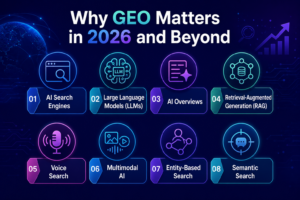
- AI Search Engines: Platforms are increasingly providing direct answers, reducing reliance on traditional search results.
- Large Language Models (LLMs): Advanced AI models understand context and generate human-like responses using trusted sources. Large Language Models are capable of understanding context, summarizing information, and generating natural language responses by predicting the most likely sequence of words based on their training and retrieved information.
- AI Overviews: AI-generated summaries are appearing directly in search results, changing how users discover information.
- Retrieval-Augmented Generation (RAG): AI combines language models with real-time information retrieval to deliver more accurate and up-to-date answers.
- Voice Search: The growing use of voice assistants is increasing demand for conversational, question-based content.
- Multimodal AI: AI can now process text, images, audio, and videos together, making diverse content formats more valuable.
- Entity-Based Search: Search engines are focusing more on understanding people, places, brands, and concepts instead of just matching keywords.
- Semantic Search: AI interprets the meaning and intent behind queries, making high-quality, context-rich content more important than keyword repetition.
How to Optimize Your Website for GEO
Optimizing for GEO means creating content that’s easy for AI systems to understand, trust, and cite. The Aggarwal et al. research is useful here beyond its headline 40% figure the paper’s most actionable finding is that adding citations, quotations from credible sources, and statistics to your content produced the largest visibility gains of any tactic tested. That’s a concrete, GEO-specific lever, not just general content advice. Here’s how to put it into practice.
Add citations, quotations, and statistics
Per the research above, this combination is the single highest-leverage GEO tactic. Back up claims with data and quote credible sources rather than writing purely from opinion.
Write self-contained, quotable answers
Structure key sentences so they make sense on their own, out of context that’s what a generative engine lifts into its response. A sentence that only makes sense after three paragraphs of setup is hard for an AI to extract cleanly.
Cover topics in depth, in one place
Instead of several thin pages, publish comprehensive content that explains a topic from multiple angles in a single guide. For example, a piece on email marketing that covers what it is, its benefits, best practices, common mistakes, and useful tools is more useful to a generative engine than five separate short posts.
Use clear, structured formatting
Descriptive headings, short paragraphs, bullet points, and tables are easier for both readers and AI systems to parse and extract.
Demonstrate real experience and expertise
Original insights, first-hand examples, and credible references make your content more trustworthy — and more likely to be selected as a source.
Optimize for search intent
Lead with a direct answer to the likely question, then add supporting detail. AI systems favor content that answers the query quickly.
Keep content current
Review and refresh regularly, especially for fast-moving topics. If a platform releases a major feature update, update your existing guide rather than letting it go stale.
Use structured data
Schema markup helps both traditional and AI-powered search systems interpret your content correctly.
Earn mentions on third
Party sources AI engines already trust-Generative engines draw on a range of sources beyond your own site. Being mentioned or cited on outlets the AI already treats as authoritative industry publications, established reference sites, credible news outlets feeds back into your own visibility.
Strengthen overall site authority
High-quality backlinks, consistent publishing, secure browsing (HTTPS), and strong user experience all support the trust signals generative engines weigh.
Best GEO Strategies for Different Industries
Every industry has unique content needs, so your GEO strategy should match what your audience is searching for. Creating clear, trustworthy, and relevant content improves your chances of being referenced in AI-generated answers.
| Industry | GEO Strategy |
|---|---|
| Healthcare | Share accurate, expert-reviewed content backed by trusted sources. |
| E-commerce | Write detailed product pages, buying guides, and FAQs. |
| Education | Create easy-to-follow learning resources and how-to guides. |
| Local Businesses | Optimize business details, reviews, and location-based content. |
| Travel & Hospitality | Publish travel guides, tips, and frequently asked questions. |
Common GEO Mistakes to Avoid and How to Measure GEO Success
Avoiding common mistakes and tracking the right metrics can help improve your content’s visibility in AI-powered search.
Common GEO Mistakes to Avoid
- Publishing low-quality or incomplete content.
- Focusing only on keywords instead of user intent.
- Not updating outdated content.
- Using poor content structure and unclear headings.
- Ignoring source credibility and fact-checking.
- Neglecting technical SEO and website performance.
Measure GEO Success
- Track AI citations and brand mentions.
- Monitor organic traffic and user engagement.
- Measure keyword visibility.
- Track conversions and leads from organic search.
FAQs
Is GEO replacing traditional SEO?
No, GEO complements traditional SEO rather than replacing it. Using both together helps improve visibility across search engines and AI-powered platforms.
Does GEO in SEO help improve website visibility?
Yes, optimizing for GEO in SEO can increase the chances of your content being cited or referenced in AI-generated responses.
Can small businesses benefit from GEO in SEO?
Yes, businesses of all sizes can improve their online presence by creating high-quality, trustworthy, and well-structured content.
Is structured data important for GEO?
Yes, structured data helps search engines better understand your content, which can support visibility in AI-powered search experiences.