Most brands start seeing early GEO signals, like brand mentions, basic AI citations, and improved factual accuracy in AI answers, within 2 to 8 weeks of publishing optimised content. Comprehensive visibility, where you’re consistently cited across AI platforms for non-branded, high-intent queries, typically takes 3 to 6 months.
The timeline depends on three main factors:
- Industry competitiveness: SaaS and ecommerce take longer due to crowded competition
- Existing authority: brands with established domain authority see faster early wins
- Content quality and structure: clear, well-structured content (headings, schema, FAQs) gets cited faster, even on newer sites
GEO doesn’t need months of authority-building to show initial movement, but it isn’t instant either. Early signals show up fast; durable, competitive visibility still takes time to compound.
Why GEO Timelines Differ From Traditional SEO
Traditional SEO rewards accumulated authority over time, taking months to show meaningful movement.
GEO can move faster. The Princeton GEO study tested nine content tactics across 10,000 queries and found that adding citations, quotations, and statistics improved visibility by up to 40%, with the top three tactics producing a 30–40% lift. A real-world Perplexity.ai test showed up to 37% improvement using the same tactics.
Not every tactic works. C-SEO Bench found most “conversational SEO” tricks don’t help and some hurt visibility, while plain source relevance keeps winning.
Speed isn’t accuracy. A FAccT 2025 study found 50 to 90% of AI citations don’t fully support their claims, and a Nature Communications study found even RAG-enabled GPT-4o leaves about 30% of statements unsupported.
GEO still depends on indexing, like SEO. Structural changes can produce a faster visibility lift, but gains aren’t guaranteed and say nothing about accuracy. A specific figure like “6.81 days” remains unverified and circulates without a real source.
GEO Results Timeline: Phase by Phase
GEO doesn’t move in one smooth line; it unfolds in distinct stages, each with its own signals and its own way of measuring progress. Knowing what to expect at each stage helps you judge whether things are on track or actually stalled.
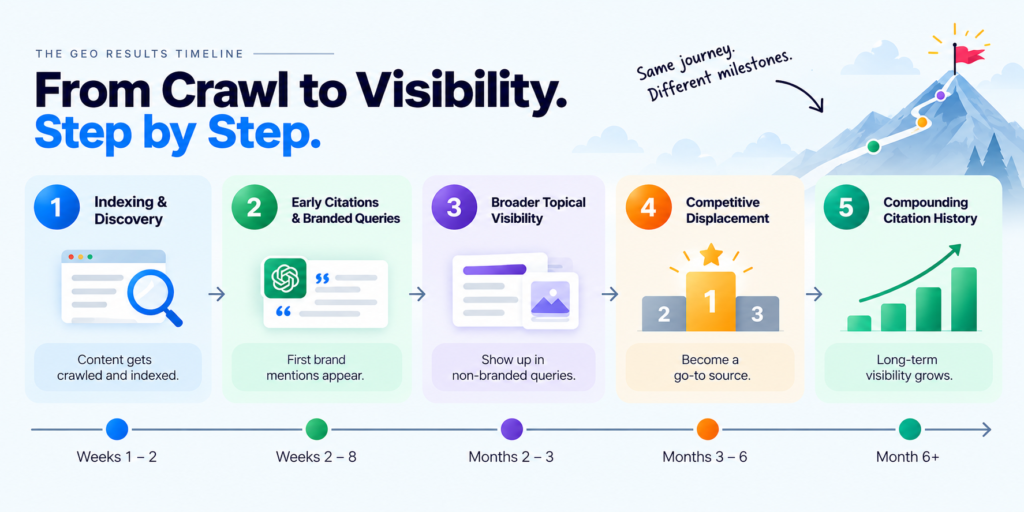
Phase 1 (Weeks 1–2): Indexing and Crawl Discovery
Content gets crawled and indexed, but citations are rarely visible yet. Confirm AI crawlers (GPTBot, ClaudeBot, PerplexityBot, Google-Extended) aren’t blocked in robots.txt, the most common cause of zero citations later.
Phase 2 (Weeks 2–8): Early Citations and Branded Queries
Brand mentions and branded-query citations start appearing, with improved factual accuracy in AI answers. Well-structured content (headings, FAQ schema, direct answers) starts paying off here.
Phase 3 (Months 2–3): Broader Topical and Comparison Visibility
Content begins appearing in non-branded “best of” and comparison queries alongside competitors, with more consistent citation frequency across topics.
Phase 4 (Months 3–6): Competitive Displacement and Category Authority
Your brand becomes a go-to source for high-intent queries and starts displacing competitors in AI shortlists. Since answers typically cite only 2 to 5 sources, gaining a slot here means someone else lost theirs.
Phase 5 (Month 6+): Compounding Citation History
Citation frequency compounds across platforms, and multi-platform consistency sets in. Early optimisers hold a lasting edge, as AI engines favour sources with established citation history.
GEO Results Timeline by AI Platform
Citation speed isn’t uniform across AI engines:
- Perplexity updates fastest, running real-time web searches, so fresh or updated content can become citation-eligible within hours. The flip side: untouched content loses citation probability quickly as newer sources get swapped in.
It also cites more sources per response than most other platforms, giving content more openings to appear.
- Google AI Overviews refreshes regularly but less instantly, pulling from the organic index. SparkToro and Gumshoe.ai tested 2,961 identical prompts in January 2026 and found AI Overviews returned the same brand list less than 1% of the time, so visibility here is volatile and closely tied to how you already rank in traditional search.
- ChatGPT shifts slowest. In plain chat, it often answers from training data, not live search, so citations only surface when its search tool is invoked, and even then, updates lag behind Perplexity’s live model.
- Gemini tracks similarly to AI Overviews, tied to Google’s knowledge graph and rewarding the same structured data and entity consistency signals.
Takeaway: GEO isn’t one clock. A page can get cited on Perplexity within days while taking months to show up consistently on ChatGPT. Track citation performance per platform rather than assuming one win means broad visibility.
What Speeds Up or Slows Down Your GEO Timeline
Not every brand moves through GEO at the same pace. Five factors explain most of the difference between weeks and months.
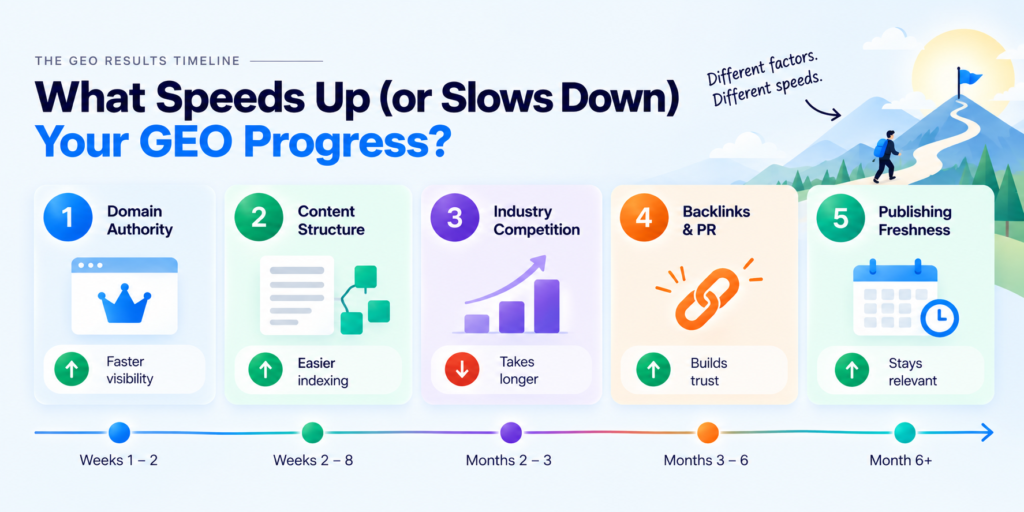
Domain Authority and Entity Presence
High-traffic, established sites earn roughly 3x more AI citations than low-traffic ones, shortening the ramp-up period.
Content Structure
The single fastest lever you control. Direct answers up front, clean H2/H3 hierarchy, and tables over dense prose get pulled into AI answers far more often. FAQ schema alone makes pages ~3.2x more likely to appear in AI Overviews.
Industry Competitiveness
Crowded verticals like SaaS and ecommerce take longer to break into, since AI answers typically surface just 2 to 5 sources per query, leaving less room to compete for citation slots.
Backlinks and Digital PR
Around 89% of LLM citations trace back to earned sources like press coverage and journalism, not owned websites, making third-party placements a key trust signal.
Publishing Cadence and Freshness
Recency compounds. Content updated within the last 30 days performs better on freshness-sensitive platforms like Perplexity, while stale pages steadily lose citation share.
How to Measure GEO Results at Each Stage
Citation gains don’t show up in the metrics you’re used to. Before checking dashboards, it helps to know which numbers actually reflect GEO progress and which ones will just confuse the picture.
Key Metrics to Track
Citation frequency: the share of target queries where your brand appears in an AI answer (citations ÷ total queries tracked × 100%). This is your core visibility metric, equivalent to rankings in SEO.
Share of voice: how often you’re cited relative to competitors on the same queries. High citation frequency means little if a competitor is cited twice as often.
AI-referral traffic: sessions from AI platforms, tracked separately from organic. Volume is typically lower than organic but often converts better.
Conversion quality: AI-referred visitors tend to arrive further along the buying journey. Track conversion rate and deal quality separately from organic traffic.
Tools for Monitoring AI Visibility
- Profound: tracks brand mentions and citation frequency across ChatGPT, Perplexity, and other major platforms
- Daydream: monitors AI search visibility and flags content gaps against competitors
- HubSpot AI Search Grader: quick audit of current AI visibility and structural readiness
- Am I Cited: checks specific citation status and tracks ROI milestones over time
None of these map directly to traditional SEO dashboards, so run them alongside Google Search Console and existing analytics rather than replacing them.
GEO vs. Traditional SEO: Timeline Comparison
| Dimension GEO Traditional | GEO | Traditional SEO |
|---|---|---|
| Time to first result | 3–14 days (median ~6.81 days) | 3–6 months |
| Time to meaningful results | 4–8 weeks, verifiable by 90 days | 6–12 months |
| Win condition | Cited inside an AI answer | Ranked in top 10 |
| Primary surfaces | ChatGPT, Perplexity, Gemini, AI Overviews | Google, Bing |
| Core ranking signal | Structure, clarity, citations | Backlinks, keywords, authority |
| Competitive slots | Only 2–5 sources per answer | 10 slots, plus long tail |
| Freshness sensitivity | High | Moderate |
| Conversion rate | Higher per visitor | Lower per visitor, higher volume |
| Decay risk if paused | High | Lower |
Key insight: GEO front-loads early wins; citations can appear within days. SEO front-loads long-term stability; rankings take months but hold longer once earned.
The two aren’t competing timelines; they’re sequential. SEO builds the authority foundation most AI-cited sources already have, while GEO layers faster, more volatile visibility on top. Judge each by its own clock, not the other’s.
It’s Been Weeks, and Nothing’s Happening — A Diagnostic Guide
Weeks 1–2: No citations yet is normal; content is still being crawled. A warning sign is the page not being indexed at all; check Search Console.
Weeks 2–8: Citations limited to branded queries are expected. Zero citations even for your own brand name is a red flag; check robots.txt for blocked AI crawlers (GPTBot, ClaudeBot, PerplexityBot).
Months 2–3: Citations still confined to a narrow set of topics is normal. No movement beyond branded queries by now usually points to a content depth or structure issue.
Months 3–6: Inconsistent presence across platforms is expected. Being consistently absent from comparison or “best of” queries where competitors show up signals weak topical authority.
Month 6+: Citation frequency should still be building steadily. A flat or declining trend signals stale content or being outpaced by competitor freshness.
Quick self-check before assuming something’s broken:
- Confirm indexing (Search Console, log files)
- Confirm AI crawlers aren’t blocked in robots.txt
- Audit content structure (headings, direct answers, schema)
- Compare freshness against competitors who are getting cited
If all four check out and there’s still no movement past the expected window for that phase, the issue is usually content depth or authority, not a timeline problem.
What Happens If You Pause GEO Efforts
- AI visibility isn’t “set and forget.” GEO citations are more volatile than SEO gains and depend on continuous freshness signals.
- Decay starts fast: on real-time platforms like Perplexity, citation sets can shift within weeks. Pages untouched for 30+ days start losing ground.
- Competitors fill the gap: answers cite only 2 to 5 sources, so lost slots go straight to competitors; there’s no stable “page two.”
- Regaining a lost slot takes as much effort as earning it the first time.
- Momentum reverses: consistently active brands build trusted citation history; pausing lets competitors overtake that lead.
- Takeaway: treat GEO as ongoing maintenance. Light, regular updates (refreshed stats, new FAQs, updated examples) protect citations better than a fresh push after a long gap.
Case Study: A 6-Month GEO Timeline in Practice
The research: The ACES study 2025 audited how AI shopping agents choose products. It found agents show “choice homogeneity,” concentrating demand on a few “modal” products while ignoring near-identical alternatives. These preferences are unstable too: one product’s share swung from 45% to 77% between Claude versions, while another dropped from 62.6% to 5% between GPT versions.
Why it matters for GEO: Being eligible for citation isn’t enough. AI systems tend to converge on one or two “winners,” so a competitor’s small content tweak can flip which brand gets picked, even without your visibility dropping.
Takeaway: A single citation win doesn’t guarantee lasting visibility. This is why Phase 4 and 5 (competitive displacement and compounding citation history) matter as much as early wins, and why periodic re-testing matters, since preferences shift across model updates.
Frequently Asked Questions
Can GEO show results faster than SEO?
Yes. Initial GEO citations can appear within days to weeks, while SEO typically takes 3–6 months for early traction.
Does GEO visibility decay if you stop?
Yes. Citations are volatile and can be replaced by competitors within weeks, especially on real-time platforms like Perplexity.
How is GEO measured differently from SEO?
SEO tracks keyword rankings, organic traffic, and click-through rate. GEO tracks citation frequency, share of voice, and AI-referral conversions.
Do all AI platforms update at the same speed?
No. Perplexity updates near real-time, Google AI Overviews and Gemini refresh regularly, and ChatGPT is the slowest since it often relies on training data unless its search tool is active.
