Organic traffic reports no longer tell the complete story. AI search has changed how people discover and evaluate brands, and a large share of that discovery now happens without a single click. Marketers are seeing fewer sessions in Google Analytics 4 (GA4) while brand awareness, branded search, and revenue stay flat or grow. This is an attribution gap, not a demand drop.
The rest of this guide explains where that gap comes from, backs it with 2026 data, and shows which metrics close it.
Why Organic Traffic Metrics No Longer Reflect Reality
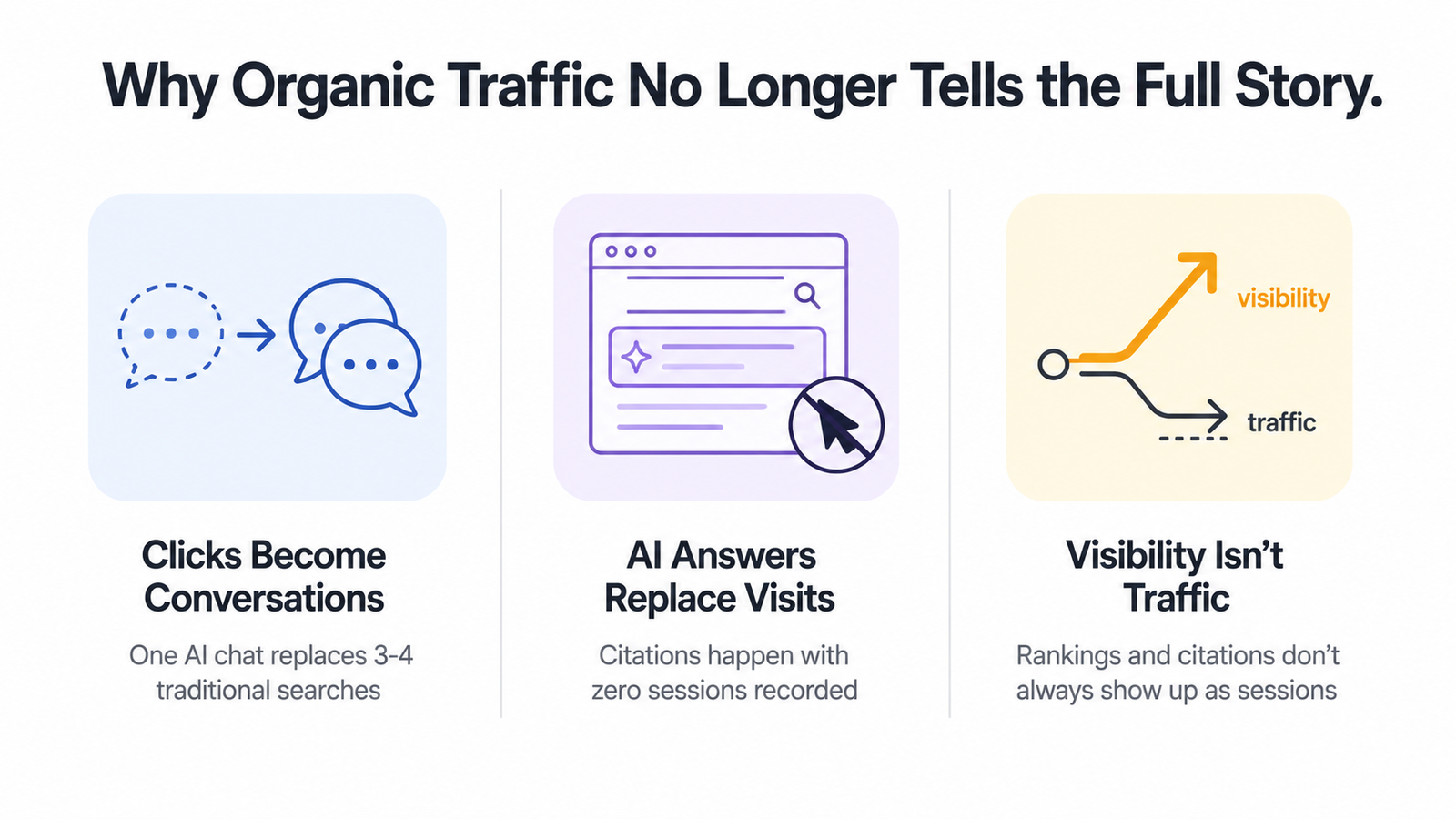
Organic traffic metrics undercount real search visibility because AI platforms answer queries directly, strip referrer data, and shift discovery into channels GA4 was not built to track. Three shifts explain most of the gap: search behavior itself, AI’s role as an answer engine, and the growing split between visibility and traffic.
Search behavior has shifted from clicks to conversations
Users increasingly ask AI assistants like ChatGPT, Gemini, and Perplexity a question and act on the answer directly. A single conversation can replace three or four traditional search queries. The click that used to follow a search results page often never happens.
AI answers often replace website visits
Google’s AI Overviews answer many queries inline, on the results page, without requiring a click. A brand can be cited in the answer and still record zero sessions in GA4. The citation delivers value. The traffic does not appear.
The data: According to SparkToro and Similarweb’s June 2026 clickstream study, 68.01% of US Google searches ended without any click in the first four months of 2026, up from 60.45% in 2024. That’s the steepest two-year jump SparkToro has recorded since it began tracking the metric, and it works out to only about 276 open-web clicks for every 1,000 searches.
Visibility and traffic are no longer the same metric
A page can rank well, get cited in AI answers, and influence a purchase decision while showing a declining session count. Visibility now includes AI citations, branded search lift, and assisted conversions, none of which a standard traffic report captures on its own.
The Rise of Zero-Click Search
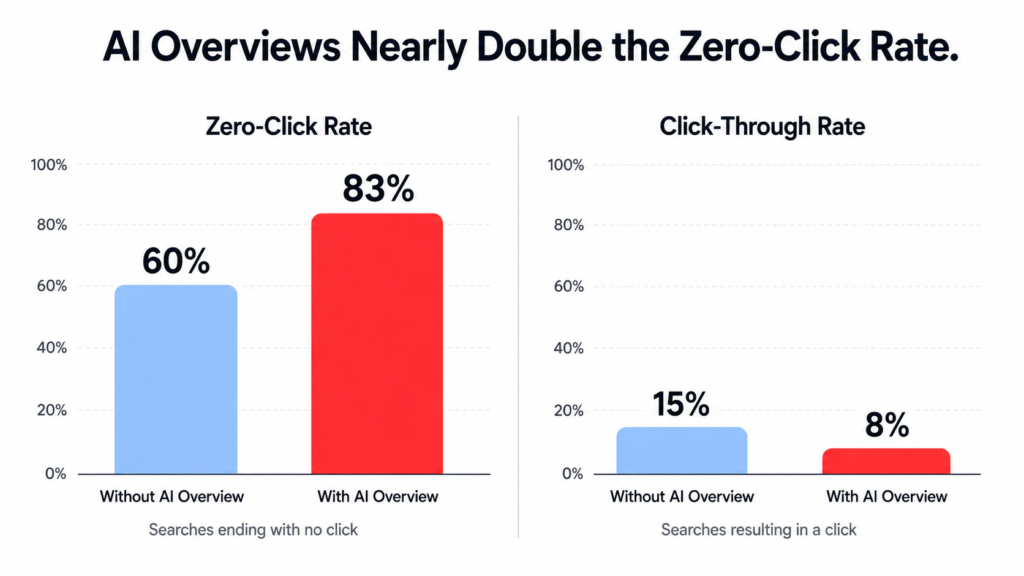
Zero-click search means the user gets a complete answer on the search results page and never visits a website. Zero-click queries now make up the majority of Google searches overall, and that share increases sharply when an AI overview appears on the page.
What zero-click search actually means
A zero-click search resolves the user’s question without a click-through. Weather, definitions, conversions, and increasingly complex informational queries all qualify. The search engine, or the AI layer sitting on top of it, becomes the destination instead of a referral point.
How AI Overviews expand the zero-click trend
AI Overviews summarize multiple sources into one answer block above traditional results. When the summary fully answers the query, the incentive to click any individual source drops. This applies even to pages that were the primary source for the answer.
The data: Searches that trigger an AI overview show an average zero-click rate of roughly 83%, compared to about 60% for queries without one. Pew Research found the click-through effect directly: users clicked through on just 8% of searches when an AI overview appeared versus 15% when it didn’t, a near-halving of click probability on queries that now account for more than 20% of all Google searches.
Why users often never reach your website
The user’s need is satisfied before they reach your domain. Awareness and trust can still form at this stage. The behavioral signal, the click, simply does not exist for GA4 to record.
Where Traditional Attribution Breaks Down
Traditional attribution breaks down because GA4 depends on click-based signals and referrer headers, and AI-driven discovery frequently produces neither. Understanding the mechanics explains why the numbers look inconsistent across reports and why this is actually two separate problems, not one.
How GA4 attributes organic traffic today
GA4’s rule: a session counts as organic search if the referrer matches a known search engine and nothing else claims it first. Weird side effect: clicks from AI Overviews and AI Mode land in Organic Search, not Direct. They happen on google.com, so GA4 treats them like any other blue link. No analytics tool can tell the two apart. That’s the sneakier problem: this traffic isn’t misclassified; it’s hidden inside your organic numbers.
The direct-traffic mess is different, caused by external platforms like ChatGPT, Perplexity, Copilot, and Claude, where the click leaves google.com. On May 13, 2026, Google added a native “AI Assistant” channel to catch these. But it only works if the referrer survives, Perplexity isn’t recognized yet, and it won’t reclassify past sessions.
The limits of last-click attribution
Last-click models credit the final touchpoint before conversion, at the session level. User-level acquisition reports, by contrast, credit the first touch. The same customer journey can appear differently depending on which report you open, the attribution model applied, and the lookback window used, often 30 days by default.
Why AI-assisted customer journeys remain invisible
A journey that starts inside an AI conversation, continues with a branded Google search, and ends in a direct visit shows three disconnected touchpoints in GA4. None of them mention the AI platform that started the journey. The influence is real. The record of it is not.
Common Attribution Blind Spots Every Marketing Team Should Know
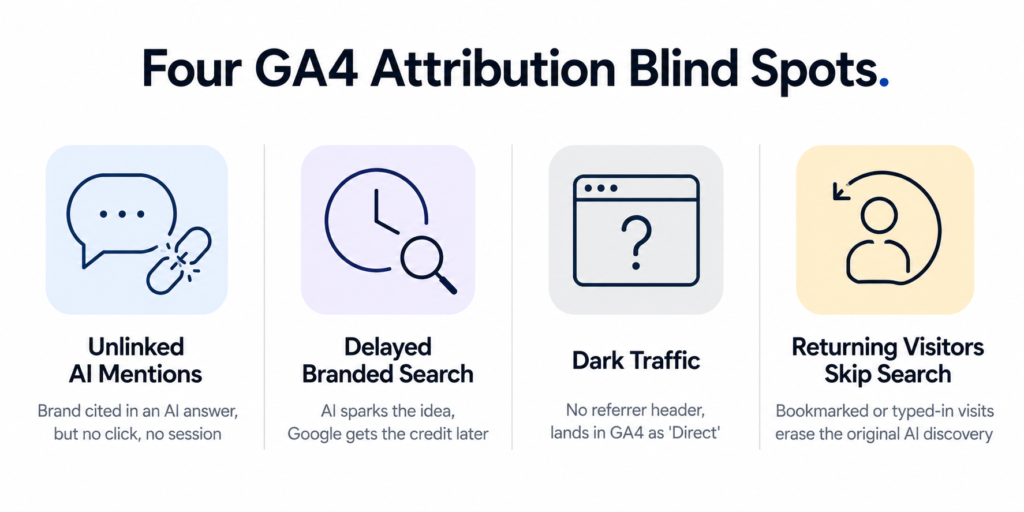 The four most common attribution blind spots are unlinked AI mentions, delayed branded searches, dark traffic, and returning visitors who skip search entirely. Each one hides real traffic inside a different GA4 bucket.
AI mentions that generate no referral traffic
When an AI assistant answers a question using your content but the user never clicks through, GA4 never fires a session. The exposure happened. No event exists to prove it.
Branded searches influenced by earlier AI conversations
A user asks an AI assistant for a recommendation, gets your brand name, then searches for you directly on Google minutes later. GA4 logs a visit as organic search, crediting Google for a discovery that actually happened inside the AI conversation.
Dark traffic and unattributed visits
Dark traffic refers to visits with no identifiable source, often from AI apps and in-app browsers that strip referrer headers before the click reaches your site. One 2026 dataset found that 70.6% of AI-driven traffic arrives with no referrer header at all, landing in GA4’s “Direct” bucket by default. This isn’t a fringe issue: ChatGPT alone accounts for roughly 87.4% of average AI referral traffic across industries, meaning the bulk of the dark-traffic problem traces back to a single, dominant platform whose visits your dashboard is systematically undercounting.
Returning visitors who skip organic search completely
A visitor who was introduced to your brand through an AI answer may bookmark your site or type your URL directly on later visits. GA4 records this as Direct traffic. The original AI-driven discovery disappears from the attribution chain entirely.
Why Organic Traffic Can Drop While Revenue Stays Stable
Organic sessions can decline while revenue holds steady because AI-referred visitors convert at a higher rate than average organic traffic, even in smaller volume. Multiple independent 2026 studies confirm this pattern, with AI-referred visitors converting at several times the rate of standard organic search traffic, showing lower bounce rates and longer session durations.
The proof, across five independent datasets
Every dataset below compares the same thing: how AI-referred visitors convert and engage versus regular organic traffic. Different industries, same direction — AI referrals consistently outperform.
- Opollo (312 B2B firms): 14.2% conversion rate for AI referral traffic vs 2.8% for Google organic.
- Seer Interactive (B2B case study): ChatGPT referrals converting at 15.9%, Perplexity at 10.5%, vs a 1.76% organic baseline.
- Adobe Digital Insights (retail, March 2026): AI referral traffic converts 42% better, with 37% more revenue per visit, and shoppers spent 48% more time on product pages.
- Microsoft Clarity (1,200+ publisher sites): LLM referral traffic signs up at 1.66% vs 0.15% for organic search.
- Visibility Labs (94 e-commerce brands) — the balance check: Only a 1.3x lift (1.81% vs 1.39% non-brand organic). Direction holds, but the size varies by sector treat any single multiplier as directional, not universal.
Fewer clicks don’t always mean lower demand
A lower session count paired with stable or growing revenue points to a quality shift, not a demand collapse. Fewer, more qualified visitors can produce the same, or better, business outcome than a higher volume of low-intent clicks.
AI is answering informational questions
Top-of-funnel, informational queries are exactly the type of query AI overviews and assistants answer directly. These queries rarely converted at a high rate even before AI search existed. Losing their clicks does not mean losing their revenue impact.
High-intent users arrive later in the buying journey
Users increasingly complete research inside an AI conversation before visiting any website. By the time they land on your page, they already understand your offer. This shortens the on-site journey and can inflate the conversion rate even as raw sessions decline.
The growth trajectory backs this up: Opollo’s data shows AI referral share for B2B tech firms grew from under 1% of traffic in January 2025 to an average of 6.4% by January 2026, a 975% year-over-year increase. Separately, the Visibility Labs study tracked ChatGPT sessions growing 1,079% across 94 e-commerce brands over the course of 2025. Even at roughly 1.08% of total website traffic today (per Conductor’s cross-industry benchmark), this is not a channel marketing teams can afford to keep bucketing under “Direct” or “Referral.”
The New Metrics That Matter Alongside Organic Traffic
Five metrics fill the gaps left by organic session counts: AI referral traffic, AI visibility across commercial prompts, coverage gaps, assisted conversions, and branded search growth.
AI referral traffic measures sessions from a clicked link inside an AI assistant’s answer. It’s small in volume today (around 1.08% of total traffic) but disproportionately high in conversion rate, 4x to 15x organic in most studies. AI visibility across commercial prompts measures how often your brand appears in AI answers to buying-intent queries. It’s a leading indicator that session data cannot show. Coverage gaps flag pages that rank organically but are never cited by AI engines, marking content that needs restructuring for AI extractability.
Assisted conversions capture conversions where AI exposure preceded a later direct or branded visit, recovering AI influence that last-click models discard. Branded search growth tracks rising branded query volume not explained by other campaigns, serving as a reliable proxy signal for AI-driven awareness.
Signs Your Attribution Model Needs an Update
Four signals reliably indicate that an attribution model is out of date: falling traffic with steady conversions, rising brand searches, sales teams naming AI as a discovery channel, and customers mentioning AI tools during sales calls.
Organic traffic declines but conversions remain steady
This is the clearest signal of a measurement gap rather than a demand gap. Next step: cross-reference Search Console impressions against GA4 sessions for the same queries to spot rising impressions with flat clicks.
Brand searches continue to increase
Growing branded search volume without a matching increase in paid or offline campaign activity often traces back to AI-driven exposure. Next step: segment branded query growth by time period and compare it against any known AI overview appearances for your brand terms.
Sales teams report AI as a discovery channel
When sales reps start hearing “I found you through ChatGPT” or “an AI tool recommended you” in early conversations, the qualitative signal has arrived before the quantitative one. Next step: add a discovery-source field to your CRM intake process.
Customers mention ChatGPT or Perplexity during demos
Direct customer mentions of AI platforms during sales calls or onboarding are the strongest available evidence of AI-influenced revenue. Next step: log these mentions systematically and review them alongside branded search and assisted-conversion data monthly.
How to Build a More Accurate Measurement Framework
Building an accurate measurement framework requires four steps: combining GA4 with dedicated AI referral tracking, monitoring AI visibility separately from traffic, measuring content coverage instead of clicks alone, and comparing assisted conversions against last-click conversions.
- Combine GA4 with AI referral tracking. Use GA4’s native AI Assistant channel alongside a custom regex-based channel group, since the native channel misses sessions with stripped referrer headers, doesn’t cover every AI platform, and won’t retroactively reclassify traffic recorded before its May 2026 launch.
- Track AI visibility separately from traffic. Monitor how often your brand and pages appear in AI answers to relevant prompts, independent of whether those appearances generate a click.
- Measure coverage, not just clicks. Identify which pages earn organic rankings but never get cited by AI engines. These pages are strong candidates for restructuring around clear, extractable answers.
- Compare assisted and last-click conversions. Review both models side by side monthly. A widening gap between them signals growing AI influence that last-click reporting alone will keep hiding.
Conclusion
Organic traffic reports still matter, but they no longer show the complete picture on their own. AI search removes the click while preserving the influence, which means declining sessions and stable or better revenue can both be true at once.
The data backs this up at scale: AI referral visitors convert at several times the rate of standard organic traffic across nearly every independent 2026 study, even though they still represent a small fraction of total sessions. Pair GA4 with AI referral tracking, visibility monitoring, and assisted-conversion comparisons to see the full picture your dashboard is currently missing.
Frequently Asked Questions
-
Does AI-referred traffic convert better than regular organic traffic?
Studies point that way consistently. Opollo reported 14.2% versus 2.8% for Google organic; Seer Interactive found 15.9% versus 1.76%. The size of the gap varies by industry; direction doesn’t.
-
Why does ChatGPT traffic show up as “Direct” in GA4?
Many AI apps and embedded browsers strip the referrer header on click. With no source data to read, GA4 defaults to Direct.
-
Can I track AI overview citations separately from regular organic ones?
No. Search Console doesn’t split AI Overview impressions from standard organic ones, so anything you get is a proxy, not a measurement.
-
How much AI traffic is GA4’s native channel missing?
A large share. It only catches sessions with an intact referrer, and independent estimates put dark AI traffic near 70%.
-
Does the native AI assistant channel solve attribution?
It helps, but it doesn’t solve it. It misses Perplexity and dark traffic and won’t reclassify anything from before its launch.