Zero-click search ends without a click to any website. Declining clicks do not prove declining SEO performance. Google answers the query on the results page, and the user stops. SparkToro, using Similarweb data, measured 68% of US Google searches ending without an external click between January and April 2026.
Click loss lands unevenly. Informational queries absorb most of it. Commercial, transactional, and branded queries hold. A site reporting total clicks alone cannot see that split, so a healthy account looks like a failing one.
This article covers how to quantify zero-click impact by query class, how to measure performance when clicks stop being the outcome, and which defenses protect visibility and revenue.
What is Zero-Click Search?
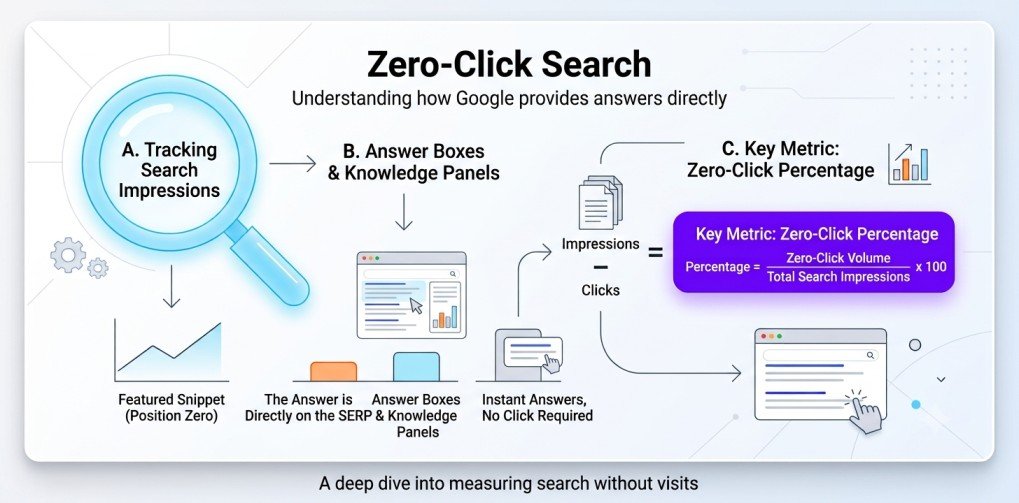
Zero-click search describes a search session that ends inside the search engine. Five SERP features produce it:
- AI Overviews synthesize a full answer from ranked pages and cite sources above the results.
- Featured snippets extract a passage from one page and display it directly.
- Knowledge panels answer entity queries from structured data.
- People Also Ask boxes resolve follow-up questions inline.
- Direct answers return weather, definitions, conversions, and scores.
Zero-click predates AI Overviews. Featured snippets and knowledge panels built the behavior over a decade. AI Overviews expanded it from facts to explanations.
Why are AI Overviews Killing Your Click-Through Rate?
AI Overviews reduce CTR because the answer arrives before the links. Pew Research measured a 47% relative drop in click rate across 68,000 queries when an AI Overview appears. Ahrefs measured a 34.5% CTR drop for position 1 across 300,000 keywords. SISTRIX recorded position-one CTR on AI-feature queries falling from 27% to 11% in March 2026.
Lower CTR does not prove lower business impact. Three facts establish this:
- The lost clicks were the cheapest ones. AI Overviews trigger on 39.4% of informational queries and 4% of e-commerce queries. The absorbed traffic sat furthest from purchase.
- Citation restores clicks. Seer Interactive found brands cited inside an AI Overview earn 35% more clicks than uncited brands on the same query.
- Remaining visitors convert better. A user who clicks after reading a summary already has the definition. That user wants pricing, proof, or a decision.
CTR measures click efficiency. Revenue measures business impact. The two decoupled in 2026.
How Do You Quantify Zero-Click Impact?
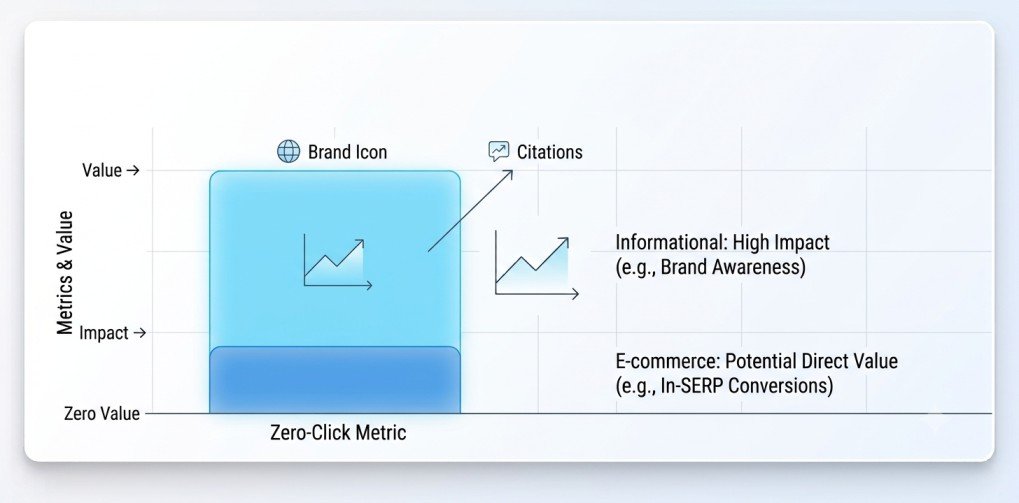
Quantify zero-click impact by comparing impressions against clicks, segmented by query class. The absorption signature is specific: impressions flat or rising, clicks and CTR falling, and the decline confined to one query class.
Run this comparison in Google Search Console:
- Select a 3-month window and compare it to the same window one year earlier.
- Split queries into four classes using regex filters: informational, commercial, transactional, branded.
- Record impressions, clicks, and CTR for each class in both periods.
- Calculate the change per class.
Read the output against two patterns:
- Impressions up, clicks down, decline isolated to informational queries. This is zero-click absorption. Rankings held.
- Impressions and clicks falling together, across all classes. This is ranking loss. Diagnose it as an algorithm or technical problem.
Which Search Queries Lose the Most Clicks?
The loss is not spread evenly, and that is the good news. One class absorbed almost all of it. The other three sit close to revenue and barely moved, which means the damage on your dashboard is concentrated somewhere specific enough to find.
Informational Queries
Informational queries lose the most clicks. AI Overviews trigger on 39.4% of them. Queries opening with “what is,” “how to,” “why does,” and “guide to” produce answers a summary can complete.
Definition pages, beginner explainers, and general how-to content carry this loss. These formats generate impressions without clicks in 2026.
Commercial, Transactional, and Branded Queries
Commercial, transactional, and branded queries retain their clicks. Three trigger rates prove the gap:
| Query Class | AI Overview Trigger Rate | Click Behavior |
|---|---|---|
| Informational | 39.4% | Heavy loss |
| Navigational | 12% | Minimal loss |
| Branded | Low | Intact |
| E-commerce, Transactional | 4% | Intact |
Comparison pages, pricing pages, product pages, local queries, and branded searches sit outside the absorption zone. These queries also sit closest to revenue.
How Do You Measure Zero-Click Search Performance?
Measurement is where this gets uncomfortable, because the tool everyone uses cannot see the thing everyone is worried about. Search Console will not tell you an overview appeared. What it will tell you, once you segment it, is whether your rankings held while your clicks left. That is the same answer arrived at sideways.
Review Search Performance in Google Search Console
Search Console reports impressions, clicks, CTR, and average position. Search Console does not report whether an AI Overview appeared or whether your page was cited inside it. As of 2026, Google confirms no AI Overview dimension exists in the Performance report.
Treat Search Console as your ranking and impression source. Treat it as incomplete for AI visibility.
Compare Performance by Search Intent
Build four saved regex filters and report each class separately every month:
- Informational: what|how|why|guide|tutorial|examples|meaning
- Commercial: best|top|vs|versus|review|comparison|alternative
- Transactional: buy|price|pricing|cost|near me|book|hire
- Branded: your brand name and its misspellings
One aggregate line hides the split. Four lines expose it.
Track Brand Demand Over Time
Branded search volume proves AI visibility converts into demand. A user reads your citation inside an AI Overview, clicks nothing, then searches your brand three days later. Branded impressions record that path.
Track branded impressions and branded clicks monthly. Rising branded demand alongside falling informational clicks indicates working AI visibility, not decline.
Measure Business Outcomes Instead of Traffic Alone
Sessions measure the wrong target when Google answers the question. Four numbers measure the right one:
- Organic conversions
- Revenue from organic
- Qualified leads from organic
- Conversion rate per organic visit
Conversion rate per visit rises during zero-click absorption. Low-intent traffic moves to the summary layer, and the remaining visitors carry purchase intent.
Analyze Impressions vs Clicks by Query Intent
Rising impressions with falling clicks on informational queries is the absorption signature. Build one monthly table with four rows and five columns: query class, impressions change, clicks change, CTR change, conversions change.
Read the conversions column first. A class losing clicks while holding conversions requires no intervention. A class losing both requires diagnosis.
How Do You Protect Your SEO Performance?
Nothing below tries to recover the absorbed clicks, because they are not recoverable. Each practice does one of two things instead: earns value on the queries where the click is gone, or moves your investment to the queries where it is not.
Improve AI Search Visibility
Build a prompt set of 30 to 50 questions your buyers ask, phrased conversationally. Run each prompt through AI Overviews, AI Mode, ChatGPT, and Perplexity. Record which domains earn citations.
Track each surface separately. Only 14% of URLs cited in AI Mode also appear in AI Overview citations for the same query, so one surface does not predict another.
Then restructure pages for extraction: a direct answer within the first 100 words of each section, question-based headings, and exact figures instead of adjectives.
Focus on High-Intent Search Opportunities
Transactional queries trigger AI Overviews in 4% of cases. Navigational queries trigger them in 12%. These classes carry the least AI exposure and the most revenue.
Prioritize four formats: comparison pages, pricing pages, product decision content, and local landing pages. Each resists synthesis because each requires information a model cannot generate.
Increase Brand Recognition
Branded search is the query class AI Overviews cannot intercept. Four signals build the entity behind it:
- One canonical brand name used consistently across the web
- Organization and Person schema with sameAs references to authoritative profiles
- Author bylines carrying verifiable credentials
- Google Business Profile and Merchant Center feeds, which Google names as direct inputs into AI responses for local and shopping queries
Unlinked brand mentions also count. Generative systems ingest text, so mentions across press, forums, Reddit, and YouTube corroborate the entity without a link.
Publish Experience-Driven Content
Content a language model can generate without reading your page earns no citation. Google’s May 2026 generative AI optimization guide names unique, expert-led content as the primary driver of visibility in AI search features.
Four inputs produce non-commodity content: original data from your own operations, first-hand results with methodology, named practitioner expertise, and a documented position on a contested question.
Reallocate Investment Toward High-Intent Content
Content budget follows AI exposure. Apply this allocation:
| Query Class | AI Exposure | Investment Action |
|---|---|---|
| Informational | High | Maintain for citation and brand lift, reduce new production. |
| Commercial | Medium | Increase. Original testing and real differentiation. |
| Transactional, Local | Low | Increase. This class retained its clicks. |
| Branded | Low | Defend and expand. |
Publishing more informational content in 2026 produces impressions. Publishing commercial and transactional content produces revenue.
Which Reporting Mistakes Should You Avoid?
Four reporting errors produce false conclusions:
- Reporting clicks alone. Total clicks fall during absorption while revenue holds. The report shows failure that did not occur.
- Ignoring query intent. One aggregate line merges a 39.4% exposure class with a 4% exposure class. The split disappears.
- Overlooking branded search growth. Branded demand is the downstream proof that AI visibility works. Excluding it hides the return.
- Treating every CTR decline as a problem. CTR falls when an AI Overview appears above a page that still ranks. This is absorption, not damage.
Which Metrics Matter in a Zero-Click Environment?
Monitor seven KPIs monthly:
- Impressions by query class: proves rankings held
- CTR by query class: isolates absorption from ranking loss
- Branded search growth: measures downstream demand from AI visibility
- Organic conversions: measures search revenue independent of session volume
- Revenue from organic: the outcome that funds the channel
- Engagement per visit: confirms remaining traffic carries intent
- AI visibility: citation rate and share of voice per surface, where measurable
Report all seven. Reporting one produces the wrong decision.
Frequently Asked Questions
Does zero-click search mean SEO is becoming less valuable?
No. AI Overviews cite pages from the Search index, and Google confirms AI Overviews and AI Mode run on core ranking and quality systems. Ranking still controls retrieval. Zero-click search changed the payout, not the mechanism.
How can I tell if AI Overviews are affecting my website?
Compare impressions against clicks by query class in Search Console, year over year. Rising impressions with falling clicks, isolated to informational queries, indicates AI Overview absorption. Impressions and clicks falling together across all classes indicates ranking loss.
Which SEO metrics should I prioritize in a zero-click environment?
Prioritize organic conversions, revenue, branded search growth, and CTR segmented by query class. Total sessions measure the query class that AI Overviews absorbed and no longer predict business outcomes.
How can I maintain visibility even if users don’t click?
Earn citations. Brands cited inside an AI Overview earn 35% more clicks than uncited brands, and citation without a click still generates branded search later. Publish content carrying original data, structure it for extraction, and build entity clarity through schema, credentialed authors, and consistent naming.
Conclusion
Zero-click search changed how SEO success is measured, not whether SEO works. Google answers more queries directly. Google builds those answers from ranked pages. The ranking layer still decides who appears.
Three actions follow. Segment reporting by query class, because a 39.4% exposure class and a 4% exposure class behave differently and one aggregate line hides both. Reallocate content investment toward commercial, transactional, and branded intent, where clicks survived. Measure branded search growth and organic conversions, because those numbers capture the value that citations create after the click disappears.
Visibility, high-intent traffic, brand demand, and revenue are the outcome. Clicks were only ever the proxy.

Farhan khan
Farhan is an SEO writer covering content strategy, search visibility, and brand discovery across search engines and AI platforms.